
Key Insight
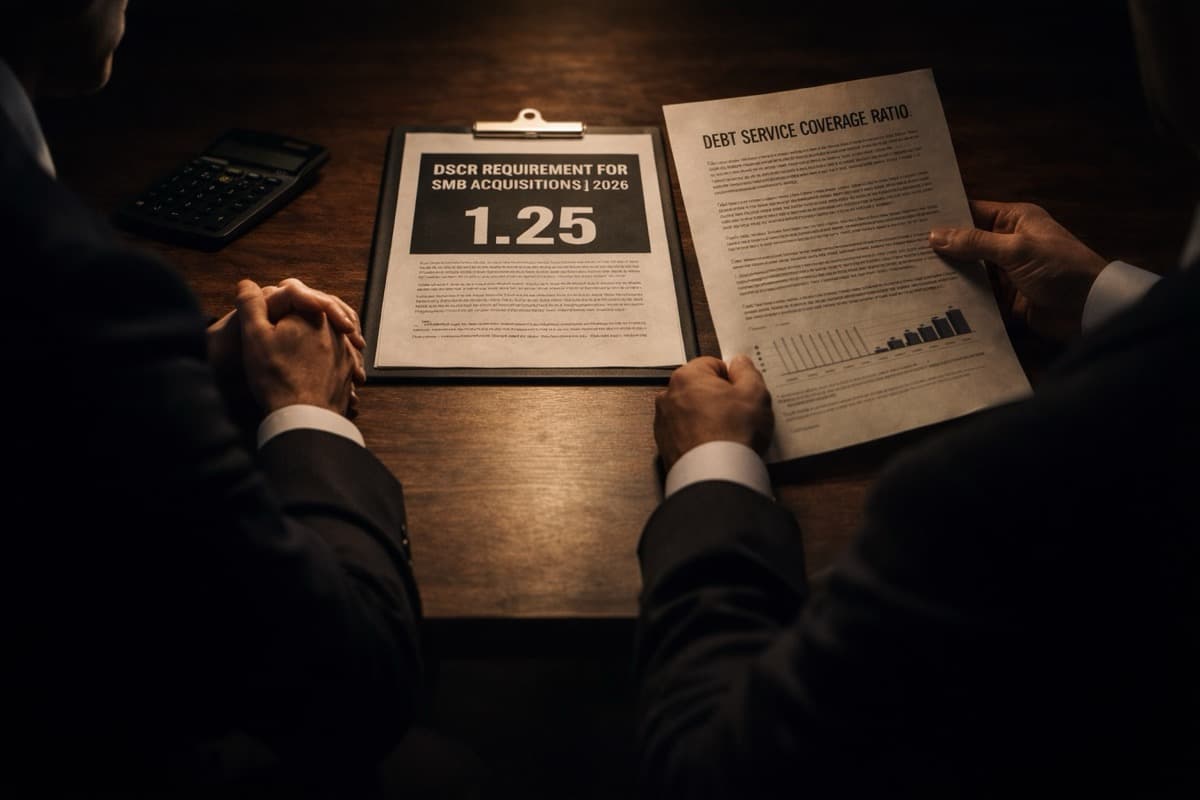
In 2026, SBA 7(a) lenders have tightened DSCR requirements following the sunset of the SBSS score. While the official SBA floor in SOP 50 10 8 is 1.15x, the practical "market floor" for acquisitions is currently 1.25x to 1.35x.
Advisory
These benchmarks are educational and directional, not lender commitments. Every acquisition file is unique, and credit standards vary by industry, borrower profile, and market cycle. Confirm debt capacity and deal viability with your CPA, attorney, and SBA lender before signing an LOI or committing capital.
The 2026 DSCR Benchmarks
Not all DSCRs are created equal. Depending on the lender and the deal structure, you'll encounter different "Comfort Zones":
| DSCR Level | Lender Sentiment | Buyer Risk |
|---|---|---|
| < 1.15x | Instant Decline | Extreme Risk: One bad month leads to default. |
| 1.20x - 1.25x | Marginal / "Skinny" | High Risk: Very little room for error or owner draws. |
| 1.35x - 1.50x | The "Sweet Spot" | Healthy: Safe margin for market fluctuations. |
| > 1.75x | Aggressive Approval | Elite: Highly bankable, likely to get better terms. |
How Lenders Calculate Your Income (The Numerator)
This is where buyers and lenders often clash. You might think the business makes $400k in SDE, but the lender's "Net Operating Income" (NOI) calculation might only show $310k.
Why the gap?
- Replacement Salary: Lenders will subtract a market-rate salary for a manager, even if you plan to do the work yourself.
- Standardized Add-backs: Lenders are skeptical of "personal" add-backs like car leases or club memberships unless they are perfectly documented.
- Historical Averaging: Many lenders use a weighted average of the last 3 years of tax returns, not just the "Trailing Twelve Months" (TTM) which might be inflated.
The "Global" DSCR Trap
For many solo searchers, the bank won't just look at the business. They will look at your Global DSCR.
Global DSCR = (Business NOI + Your Other Income) / (Business Debt + Your Personal Debt)
If you have a large mortgage, high credit card debt, or other personal loans, it can "drag down" the business's bankability. Even a "perfect" deal can be killed by a buyer's weak personal balance sheet.
Why DSCR is Your Best Friend (Not Your Enemy)
It's tempting to view DSCR as a hurdle to clear. Instead, view it as your Downside Protection.
If a lender tells you the DSCR is too low, they are effectively telling you that the price you are paying is too high for the risk involved.
When you apply for an acquisition loan, the lender is looking at one thing above all else: The Cushion. They are not just checking if you can pay the loan today; they are stress-testing whether you can still pay if your largest client leaves or rates move up another 50 basis points. Understanding how the bank calculates DSCR is the difference between getting a yes and spending months on a deal that was never bankable.
The Stress-Test Rule: Before you sign an LOI, run a "20% Drop" scenario. If a 20% drop in revenue pushes your DSCR below 1.0, you are over-leveraged.
Diligence Checklist: Verifying the DSCR Numerator
To ensure your DSCR isn't built on a foundation of sand, you must verify the following documents during the "Context" phase:
- 3 Years of Federal Tax Returns: Ensure the "Net Income" matches the internal P&L. Lenders ignore "pro-forma" numbers if they can't be reconciled to a tax return.
- YTD P&L and Balance Sheet: Verify that recent performance hasn't dipped since the last year-end.
- Rent/Lease Agreements: If the lease is ending or has a major "step-up" in cost, your future DSCR will be lower than historicals.
- Key Contract Verification: For B2B businesses, verify that the 3 largest contracts are transferable. If 20% of revenue is tied to a non-transferable contract, your DSCR is effectively 20% lower.
- Owner Benefit Audit: Explicitly document every add-back. If you can't prove it's a personal expense, the bank will add it back to the "expense" column, lowering your NOI.
100-Day Operator Plan: Optimizing Your Debt Coverage
Once you close, your primary goal is to expand the cushion. A safer DSCR leads to lower stress and higher valuation.
- Days 1-30: Expense Audit: Review all vendor contracts. Eliminating "zombie" SaaS subscriptions or high-cost legacy vendors is the fastest way to increase NOI without increasing sales.
- Days 31-60: Revenue Verification: Implement a "customer success" check-in with the top 20% of clients. Securing their business for the next 12 months "de-risks" the debt service.
- Days 61-100: Efficiency Gains: Automate one core manual process. Every $10,000 saved in annual labor costs represents roughly $1,200 in monthly "DSCR breathing room."
Understanding DSCR is about understanding the structural cushion of a deal. By analyzing debt service coverage under different scenarios and implementing an efficiency-first 100-day plan, buyers can transform a "skinny" deal into a resilient asset.
Ready to Stress-Test Your Deal?
Don't guess on the math. Use our specialized tools to see how debt service holds up under different scenarios:
- Run the Math: Use our SBA Cash Flow Stress-Test Tool.
- Audit the SDE: Ensure your numerator is real with the SDE Calculator.
- Structure the Deal: Learn how seller notes and earnouts can fix a broken DSCR.

Avery Hastings, CPA
Founder, Acquidex • CPA • Tokyo, Japan
Avery Hastings is a CPA based in Tokyo, Japan and the founder of Acquidex. She focuses on helping buyers evaluate small-business deals with clear cash-flow logic, realistic downside analysis, and practical diligence frameworks.
Keep up with Avery →Sources
No external sources are cited in this article.
Keep Reading
- How to Analyze an HVAC Service Business Before You Buy It11 min read read
- Where Good Small Business Deals Come From: A Sourcing Playbook11 min read read
- SBA 7(a) Loans for Business Acquisitions: 2026 DSCR, Down Payment & Seller Note Rules14 min read read
- 20 Questions to Ask When Buying a Business10 min read read
- What to Ask For Before LOI vs After: Pre-LOI Document Request Checklist7 min read read
- How Much Does It Cost to Buy a Small Business? Full 2026 Cost Breakdown9 min read read