


Short Answer
When a small business deal falls apart after LOI, it’s often not because something suddenly goes wrong. It’s because diligence exposes risks that were never priced into the deal.
After LOI, the story stops selling and starts getting audited. Financials are reconciled instead of summarized. Banks replace optimism with underwriting rules. Working capital, owner dependency, customer concentration, and legal exposure stop being abstract and start becoming personal risk.
The LOI locks in a theory of the deal. Diligence determines whether reality agrees.
When it doesn’t, the deal doesn’t “fail.” It simply stops making sense.
Key Insight
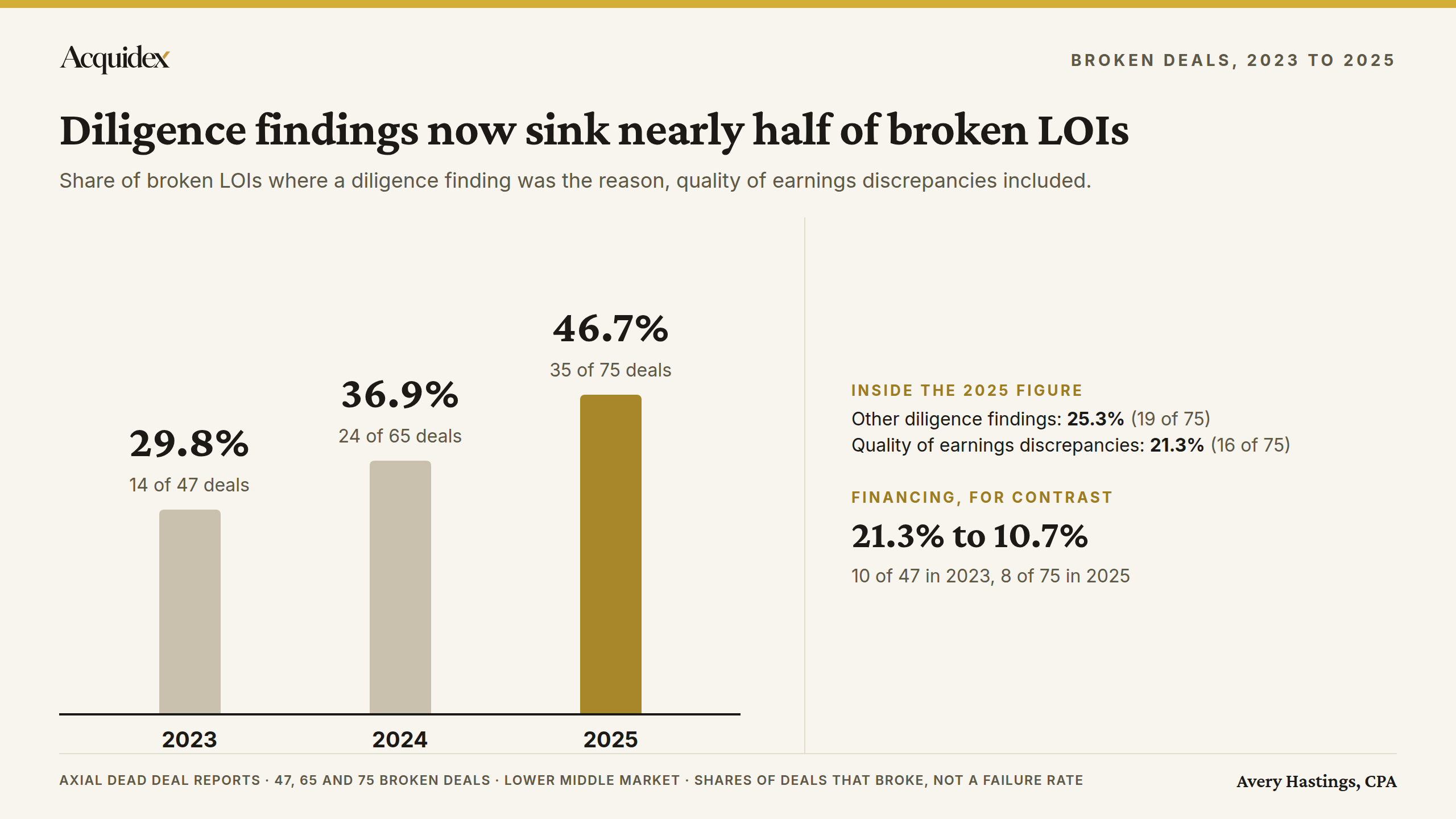
In Axial’s 2025 data, the most common reason an LOI broke was something diligence found. Diligence findings accounted for 46.7% (35 of 75) of broken LOIs, more than any other reason, and the single most common reason was findings outside the quality of earnings review, at 25.3% (19 of 75), such as undisclosed legal or compliance risks, customer concentration concerns and contract issues. These are shares of deals that broke, not a failure rate, from small samples of lower middle market deals, larger than most Main Street sales, on one platform. This post covers seven breakpoints, chosen by judgment rather than ranked by data: SDE that does not fully reconcile under scrutiny, financing that weakens once banks normalize cash flow, working capital gaps that appear after emotional leverage has built, owner dependence that is deeper than advertised, customer concentration that increases downside risk beyond lender tolerance, legal or regulatory issues that surface after time and money are sunk, and seller behavior that shifts once exclusivity removes competitive pressure. The LOI locks in a theory of the deal. Diligence determines whether reality agrees. In our judgment, buyers who treat the LOI as a commitment rather than a checkpoint risk sinking time and money into a deal that diligence was always likely to break.
What does the data say about why deals die after the LOI?
Axial runs a platform for lower middle market deals, and its Dead Deal Reports look at letters of intent on that platform that broke, and why. Its reports for 2023, 2024 and 2025 are the source for every figure in this section.
Each percentage is a share of that year’s broken LOIs, with the number of deals beside it. Read the limits further down before leaning on any of them.
| Axial Dead Deal Report | 2023 | 2024 | 2025 |
|---|---|---|---|
| Broken LOIs analyzed | 47 | 65 | 75 |
| Non-QoE diligence findings | 19.1% (9 of 47) | 21.5% (14 of 65) | 25.3% (19 of 75) |
| QoE EBITDA discrepancies | 10.6% (5 of 47) | 15.4% (10 of 65) | 21.3% (16 of 75) |
| Diligence combined | 29.8% (14 of 47) | 36.9% (24 of 65) | 46.7% (35 of 75) |
| Financing | 21.3% (10 of 47) | Not cited here | 10.7% (8 of 75) |
Source: Axial’s Dead Deal Reports for 2023, 2024 and 2025. QoE is a quality of earnings review, the financial diligence work that tests whether reported earnings hold up. Percentages are rounded, so the combined row is worked from the deal counts, not by adding the two rows above it.
The combined diligence share rose from 29.8% (14 of 47) in 2023 to 36.9% (24 of 65) in 2024 and 46.7% (35 of 75) in 2025. With samples this small, we would read that as a direction, not a trend to project forward.
Financing moved the other way, from 21.3% (10 of 47) of broken LOIs in 2023 to 10.7% (8 of 75) in 2025.
What were the five most common reasons in 2025?
Axial’s 2025 report covers 75 broken LOIs. Its five most common reasons, in order:
- Non-QoE diligence findings: 25.3% (19 of 75). Problems found in diligence outside the QoE, and the single most common reason. Axial’s examples are undisclosed legal or compliance risks, customer concentration concerns and contract issues.
- QoE EBITDA discrepancies: 21.3% (16 of 75). Reported performance diverged materially from what the buyer expected.
- Renegotiation: 14.7% (11 of 75). The two sides could not agree on revised pricing or structure, often after diligence findings or updated financial analyses.
- Seller decisions: 13.3% (10 of 75). For example, sellers pulling the deal off the market, or reconsidering strategic alternatives partway through the process.
- Financing: 10.7% (8 of 75). Deal Killer #2 below looks at how financing breaks after an LOI.
How these line up with the seven deal killers below is our mapping, not Axial’s. Non-QoE findings take in customer concentration (#5) and legal, compliance and contract problems (#6). QoE discrepancies are the lower middle market form of books that don’t reconcile (#1), measured on EBITDA rather than SDE. Financing is #2. Seller decisions overlap with #7, although Axial’s examples are about sellers changing course, not sellers becoming hard to work with.
Renegotiation has no number of its own in this post. In our reading, it is where several of the seven end up when a finding calls for a new price or structure and the two sides can’t agree on one. Working capital (#3) and owner dependence (#4) are not named in Axial’s top five. They may sit inside the broader categories, but these figures don’t show it.
What are the limits of these figures?
They are shares, not a failure rate. The 2025 diligence figure, 46.7% (35 of 75), means that 35 of the 75 broken LOIs in Axial’s 2025 report broke over diligence findings. It does not mean that share of all LOIs die in diligence. The figures say nothing about what share of LOIs close.
They are lower middle market deals. Those deals are larger than most Main Street business sales. A smaller deal may break for different reasons, or in different proportions.
The samples are small. The reports cover 47, 65 and 75 broken deals. At that size, a few deals can reorder the list: the top two reasons in 2025 were 19 deals and 16. Rankings also move between years. In 2023, financing (10 of 47) broke more of these deals than either diligence category did on its own.
They come from one platform. Deals that run through other channels may break differently.
Our read, which is a judgment rather than a finding: the two diligence categories, the biggest in 2025, are about the business as it already was. Legal and compliance risks, customer concentration, contract issues and earnings that differ from what the buyer expected can all be looked for before anyone signs. That is the case for the five questions below, and for a pre-LOI screen.
The Brief
If you’re surprised that deals die after LOI, you’re misunderstanding where the real risk lives.
Before LOI, everyone is aligned around potential: clean SDE, reasonable pricing, “financeable” structure, and smooth transition assumptions.
After LOI, those assumptions get stress-tested.
This is where small business acquisitions often quietly unravel. Not necessarily through fraud or bad actors, but because:
- earnings don’t fully reconcile under scrutiny
- financing weakens once banks normalize cash flow
- working capital gaps appear late, when leverage is emotional
- the business depends more on the owner than advertised
- customer concentration increases downside risk
- legal or regulatory issues surface after time and money are sunk
- seller behavior shifts once exclusivity removes pressure
None of these problems are unusual. What’s unusual is pricing a deal as if they don’t exist.
This article breaks down why these deal killers show up after exclusivity begins, and how buyers surface the issues early enough that all parties can restructure before committing further resources.
The Illusion of Progress After LOI
Signing a Letter of Intent feels like momentum.
You’ve agreed on price.
You’ve aligned on structure.
You’ve probably told yourself, “Okay, we’re basically doing this.”
That’s the mistake.
An LOI isn’t the end of the deal.
It’s the moment the deal stops being a story and starts being tested.
Before LOI:
- sellers are selling
- brokers are framing
- buyers are imagining
After LOI:
- buyers verify
- banks underwrite
- lawyers stress-test
- sellers start defending
That shift is where small business deals often fall apart.
Not because anyone suddenly acts in bad faith, but because assumptions don’t survive scrutiny.
The LOI locks in a theory of the deal.
Everything that follows is about whether reality agrees.
What an LOI Actually Is (and What It Isn’t)
A Letter of Intent is a largely non-binding document built on trust and assumptions. The exceptions are provisions written to bind, such as exclusivity and confidentiality. Which terms bind, and how, is a question for counsel.
It typically outlines:
- price (or pricing logic)
- structure (asset vs stock, seller note, earnout basics)
- exclusivity window
- diligence timeline
- key conditions to close
What it does not do:
- guarantee financing
- certify the numbers
- resolve legal risk
- ensure seller cooperation
- confirm operational transferability
An LOI is a pause in negotiations, not a promise to close.
Once exclusivity starts, leverage shifts. Information asymmetry shrinks. And tolerance for surprises drops fast.
That’s why deals don’t usually explode immediately after LOI. They erode.
Slowly. Quietly. Expensively.
Before You Sign an LOI: 5 Questions That Catch Post-LOI Blowups Early
- Can the seller prove earnings with deposits? (P&L → bank statements, not vibes)
- Would the deal still work if cash flow dropped, say, 10% to 15%? (an illustrative range, not a lender rule; debt doesn’t care about optimism)
- What’s “normal” working capital, and can we define it in writing?
- Who owns customer relationships: processes or the owner’s phone?
- What’s the one thing that would make the bank say no? (find it now, not weeks into diligence)
Why Deals Are Most Fragile After LOI
Seven common places small business deals fail after LOI (our judgment, not a ranking by frequency):
- Financials that don’t reconcile under scrutiny
- Financing that weakens or collapses in underwriting
- Working capital assumptions that fall apart late
- Owner dependency that makes the business non-transferable
- Customer concentration that increases downside risk
- Legal or regulatory exposure discovered too late
- Seller behavior that deteriorates once exclusivity begins
If you want the fast version of these failure points, see 7 red flags that kill deals instantly.
It’s easy to assume the riskiest part of an acquisition happens before LOI.
In reality, the most fragile phase comes after, when three things collide:
- The numbers are reconciled, not summarized
- Financing replaces theory with constraints
- Operational dependencies become unavoidable
Before LOI, everyone can agree in broad strokes. After LOI, details start costing real money.
This is when:
- clean SDE starts to wobble
- lenders push back
- lawyers flag issues no one mentioned earlier
- sellers grow less cooperative
- timelines slip
Often, a deal doesn’t “fail.” It stops making sense.
When Walking Away After LOI Is the Right Move
Not every issue uncovered in diligence should kill a deal.
But some signals aren’t “friction.” They’re structural.
Walking away after LOI is usually the correct decision when:
- financing only works under optimistic or fragile assumptions
- normalized cash flow fails conservative debt tests
- working capital gaps can’t be clearly defined or agreed on
- the business depends heavily on the seller with no credible transition plan
- customer concentration creates single-point-of-failure risk
- legal or regulatory exposure can’t be cleanly resolved
- seller behavior deteriorates once exclusivity begins
These aren’t diligence annoyances.
They’re ownership risks.
The mistake buyers make isn’t walking away. It’s staying too long because:
- time has already been spent
- advisors are involved
- momentum feels expensive to lose
But sunk costs don’t make a weak deal stronger.
A deal that only works if everything goes right isn’t a deal. It’s a gamble.
Deal Killer #1: The Books Don’t Reconcile
This is a common place for small business deals to die.
It is not the most common one in Axial’s data. In 2025, Axial’s nearest category, EBITDA discrepancies found in a quality of earnings review, accounted for 21.3% (16 of 75) of broken LOIs, second to other diligence findings at 25.3% (19 of 75). Those are shares of lower middle market deals, larger than most Main Street sales, that broke on one platform, from a small sample, not a failure rate.
Use this teardown if you need a forensic checklist: messy financials in due diligence.
Not fraud.
Not scandal.
Just accounting reality.
After LOI, buyers stop relying on summaries and start tying numbers together:
- P&L to bank statements
- revenue to deposits
- expenses to actual cash out
That’s where problems surface.
Common issues include:
- revenue that doesn’t match deposits
- cash vs accrual confusion
- personal expenses half-coded
- add-backs that require explanation instead of documentation
- tax returns telling a different story than internal books
None of this automatically means the business is bad.
It does mean the deal just became riskier.
And risk changes price, structure, or both.
If you’re relying on “adjusted” earnings, make sure you understand how SDE is built, and where add-backs diverge from lender standards.
Deal Killer #2: Financing Falls Apart When the Bank Gets Involved
A deal can look perfectly reasonable to a buyer and still fail the moment a lender gets involved.
Before you submit to underwriting, run how to tell if a small business is overpriced so financing stress shows up early.
That’s because banks don’t underwrite stories.
They underwrite risk, documentation, and downside protection.
After LOI, financing shifts from “should work” to “prove it works.”
This is where many deals quietly stall or collapse.
Why Financing Risk Is Underestimated Before LOI
Before LOI, buyers often assume:
- SBA financing is a formality
- the business “clears DSCR”
- the bank will be flexible if the deal makes sense
After LOI, those assumptions get tested.
Banks reframe the deal around questions buyers often overlook:
- Are earnings consistent and verifiable?
- Is cash flow durable under stress?
- Is the owner truly replaceable?
- Does the business survive without aggressive assumptions?
If the answer to any of those is unclear, financing tightens fast.
Common Financing Breakpoints After LOI
Deals often run into trouble when:
- Adjusted earnings come in lower than expected
- Add-backs are rejected or capped
- Customer concentration spooks the lender
- Key person dependency becomes obvious
- Working capital needs exceed projections
- Collateral coverage is thin
- Seller notes or equity injections increase
Each issue alone may be manageable.
Stacked together, they break the loan.
The DSCR Trap Buyers Don’t See Coming
Many buyers hear:
The deal clears DSCR.
What they don’t hear:
…under ideal assumptions.
Banks test DSCR using:
- conservative earnings
- normalized expenses
- downside scenarios
A deal that barely clears DSCR on paper can fail underwriting once:
- earnings are adjusted
- owner pay is normalized
- reinvestment is acknowledged
If the loan only works at peak performance, the bank will notice.
When Financing Risk Turns Into Deal Failure
Once financing weakens, one of three things usually happens:
- The buyer must inject more equity
- The seller must carry more risk
- The deal dies
This is where negotiations often break down.
Sellers may resist:
- price reductions
- seller notes
- earnouts
- delayed payouts
Buyers may refuse to:
- over-leverage themselves
- fund gaps personally
- proceed without margin of safety
That standoff kills momentum.
Early Warning Signs Buyers Miss
Pay attention if:
- lenders ask for repeated revisions
- underwriting timelines keep slipping
- assumptions keep getting “reframed”
- financing only works with perfect execution
At that point, the deal isn’t failing suddenly. It’s failing predictably.
Deal Killer #3: Working Capital Assumptions Blow Up at Close
Working capital is the quiet deal killer nobody wants to argue about, until it’s unavoidable.
The full diligence flow is in how to analyze a small business deal.
Before LOI, working capital is usually hand-waved away with phrases like:
- “The business has always operated fine”
- “We’ll leave enough to run it”
- “That’s baked into the price”
After LOI, those assumptions get tested.
And this is where deals that survived pricing and financing suddenly unravel.
Why Working Capital Becomes a Flashpoint
Working capital isn’t abstract once you’re closing.
It determines:
- whether payroll clears
- whether vendors get paid
- whether inventory can be restocked
- whether the business can operate on day one
After LOI, buyers and sellers often realize they were talking about different definitions of “normal.”
Sellers remember peak cash moments.
Buyers inherit troughs.
The “Normalized Working Capital” Fight
Many deals include a clause requiring the seller to deliver the business with a “normalized” level of working capital.
The problem:
“Normalized” is rarely defined tightly enough.
Common points of friction:
- seasonality ignored
- cash balances inflated temporarily before close
- inventory levels not aligned with run-rate demand
- payables stretched artificially
- accrued expenses quietly deferred
What looked like a clean balance sheet suddenly requires interpretation.
And interpretation invites conflict.
How This Kills Deals Late in the Process
Working capital disputes tend to surface:
- late in diligence
- right before closing
- after legal costs are sunk
- when everyone is tired
At that point, leverage is emotional, not logical.
Buyers feel exposed.
Sellers feel accused.
Brokers feel pressure to “just get it done.”
That tension is enough to stall or kill a deal outright.
The Real Risk Buyers Miss
The danger isn’t just the closing balance.
It’s what happens in the first months after close if working capital was underestimated.
When working capital is thin:
- small delays create cash crunches
- owners defer pay
- credit lines get tapped early
- stress compounds fast
That’s not bad luck. That’s a bad assumption.
Early Warning Signs
Pay attention if:
- working capital is discussed vaguely
- historical cash swings aren’t explained
- inventory or receivables fluctuate wildly
- the seller resists defining a target level
If the business only works with perfect timing, it doesn’t really work.
Deal Killer #4: Key Person Risk and Owner Dependency Surface
Many small business deals look solid until one uncomfortable question gets asked:
Deep dive: key person risk in small business acquisitions.
What actually happens when the owner steps away?
Before LOI, this risk is easy to gloss over. After LOI, it becomes unavoidable.
That’s because diligence forces buyers to map how the business really operates, not how it’s described.
And in many deals, the answer is uncomfortable: the owner isn’t just important. They are the business.
How Owner Dependency Hides in Plain Sight
Owner dependency rarely shows up as a single red flag. It’s usually scattered across the operation:
- the owner is the primary salesperson
- key customers only trust the owner
- pricing decisions live in the owner’s head
- vendor relationships are personal, not contractual
- the owner handles scheduling, hiring, and problem-solving
On paper, everything works. In practice, it works because one person holds it together.
That’s not scale. That’s fragility.
Why This Risk Explodes After LOI
After LOI, buyers start asking operational questions like:
- Who handles this day to day?
- Who makes decisions when something breaks?
- Who owns customer relationships?
- What happens if the owner is gone for 30 days?
Those questions expose gaps that weren’t obvious earlier.
And once lenders and lawyers see heavy owner dependency, they react quickly:
- lenders tighten underwriting or reduce leverage
- buyers demand transition support or price adjustments
- sellers resist anything that implies the business can’t stand alone
That tension kills momentum.
Transition Periods Don’t Magically Fix Dependency
Many deals try to solve this risk with:
- short transition periods
- consulting agreements
- vague “seller support” clauses
These help, but they don’t eliminate the problem.
If the business:
- requires the owner’s judgment
- relies on personal relationships
- lacks documented processes
Then the risk doesn’t disappear at close. It just shifts to you.
When Key Person Risk Becomes a Deal Breaker
Owner dependency becomes fatal when:
- there is no credible replacement plan
- customers aren’t transferable
- systems aren’t documented
- the seller resists extended involvement
- the bank questions continuity
At that point, the deal doesn’t fail because of price. It fails because the asset isn’t transferable.
Early Warning Signs Buyers Miss
Pay attention if:
- “the owner just handles that” comes up repeatedly
- key roles aren’t documented
- customer concentration overlaps with owner relationships
- the seller minimizes the issue instead of mitigating it
A business that can’t survive without the owner isn’t a business. It’s a job in disguise.
Deal Killer #5: Customer Concentration and Revenue Fragility
Customer concentration is one of those risks everyone nods at, and then quietly underestimates.
If concentration is high, read customer concentration risk in SMB deals before final pricing.
Before LOI, it’s easy to say:
- “The customer’s been with us for years”
- “They’re not going anywhere”
- “That’s just how this industry works”
After LOI, those assumptions get stress-tested.
And that’s when deals start to wobble.
Why Concentration Looks Harmless, Until It Isn’t
On paper, concentration can look efficient:
- fewer customers to manage
- predictable billing
- strong relationships
In reality, it creates single-point-of-failure risk.
As a rough rule of thumb (our judgment, not a lender or industry standard, and lender policies vary), if one customer represents:
- 20% to 30% of revenue → it’s a yellow flag
- 30% to 50% → it’s often a lender problem
- 50% or more → it’s a deal-defining risk
Banks see concentration as fragility. Buyers feel it as exposure.
What Happens When Buyers Dig Deeper
After LOI, buyers start asking questions that weren’t urgent before:
- Are contracts assignable?
- Can pricing be changed?
- What happens if this customer leaves?
- Is revenue diversified across people, or just accounts?
Often, that’s when uncomfortable truths surface:
- contracts aren’t long-term
- relationships are personal to the owner
- pricing power is weaker than assumed
- one customer subsidizes weak margins elsewhere
None of this shows up in a teaser. All of it shows up in diligence.
Why Concentration Breaks Financing
From a lender’s perspective, customer concentration means:
- higher volatility
- less predictable cash flow
- fewer levers if something goes wrong
That translates into:
- reduced leverage
- higher equity requirements
- additional guarantees
- or a flat rejection
A deal can look attractive to a buyer and still fail underwriting because the revenue base is too fragile.
The “What If They Leave?” Test
Here’s the simplest concentration test buyers should run:
If your largest customer disappeared tomorrow, would the business survive?
Not “would it be painful.”
Not “could you recover eventually.”
Would it survive.
If the answer is no, concentration isn’t a nuance. It’s a pricing and structure issue.
Early Warning Signs Buyers Miss
Pay attention if:
- contracts are short-term or informal
- pricing hasn’t changed in years
- margins are thin but volume is high
- the seller dismisses the risk entirely
Loyal customers are an asset. Dependency on them is not.
Deal Killer #6: Legal, Regulatory, and Compliance Issues Surface Late
Legal and regulatory problems rarely announce themselves early.
Related checklists: how to uncover legal red flags and regulatory licensing red flags.
They surface late: after the LOI is signed, after diligence is underway, and after time and money have already been spent.
That timing is what makes them dangerous.
Why These Issues Hide Until After LOI
Before LOI, sellers focus on:
- earnings
- growth
- upside
- “how the business runs day to day”
After LOI, lawyers and advisors start asking different questions:
- Are licenses transferable?
- Are permits current and compliant?
- Are contracts enforceable post-close?
- Are there outstanding disputes or liabilities?
That’s when hidden exposure shows up.
Common Late-Stage Legal Surprises
These issues don’t always kill deals, but they often change them:
- licenses tied to the seller personally
- permits that don’t transfer cleanly
- expired or non-compliant registrations
- customer or vendor contracts with change-of-control clauses
- employee misclassification or wage exposure
- unresolved tax or regulatory filings
Individually, these can be manageable. Together, they erode confidence fast.
Why Legal Risk Breaks Momentum
Legal and compliance issues create asymmetric risk.
For the seller:
- they already lived with the exposure
- the business “worked anyway”
For the buyer:
- the risk is new
- how much liability comes with the business depends on the deal structure (an asset or a stock purchase) and the purchase documents, which is a question for counsel
- the downside can become personal, for example through a personal guarantee on the acquisition debt
That mismatch makes renegotiation emotional.
Buyers push for:
- price reductions
- indemnities
- escrow holdbacks
- delayed closing
Sellers often resist. Deals stall.
The Problem With “We’ve Never Had an Issue”
Past survival doesn’t equal future safety.
Regulatory exposure often stays invisible until:
- ownership changes
- audits are triggered
- competitors complain
- employees leave
- customers ask new questions
Once you own the business, the protection disappears.
Early Warning Signs Buyers Miss
Pay attention if:
- licenses are described vaguely
- compliance questions get brushed aside
- documentation is “hard to locate”
- legal review is delayed intentionally
Legal problems don’t need to be fatal to be expensive. Late discovery is what kills deals.
Deal Killer #7: Seller Behavior Changes Once Exclusivity Starts
One of the most under-discussed deal killers has nothing to do with numbers.
Pre-LOI prep list: questions to ask before buying a business.
It’s behavior.
Specifically: how sellers act after exclusivity begins.
Why Exclusivity Changes the Power Dynamic
Before LOI, sellers are selling. After LOI, they’re waiting.
Once exclusivity is granted:
- buyers slow down to diligence
- sellers lose competitive pressure
- incentives quietly shift
The seller already feels “sold.” The buyer is now exposed.
That’s when behavior starts to change.
Common Post-LOI Seller Shifts
None of these show up in a CIM, but buyers see them fast:
- responsiveness drops
- documents arrive late or incomplete
- answers get vague or defensive
- tone shifts from cooperative to adversarial
- new “clarifications” appear that weren’t mentioned earlier
Individually, these look like friction. Together, they signal risk.
Why This Matters More Than Buyers Expect
Seller behavior post-LOI is a preview of:
- how the transition will go
- how disputes will be handled
- how much trust actually exists
If collaboration deteriorates during diligence (when incentives should be aligned), it rarely improves after closing.
That’s why experienced buyers treat behavior as data.
The Control Problem Buyers Miss
Exclusivity removes leverage.
Once you’re exclusive:
- sellers know you’ve invested time and money
- walking away becomes psychologically harder
- pressure subtly flips onto the buyer
Some sellers exploit that. Not maliciously. Just human nature.
Deals break when buyers realize:
“This person is going to be hard to deal with forever.”
Early Warning Signs
Watch closely if:
- deadlines are repeatedly missed
- new issues surface without explanation
- diligence feels like pulling teeth
- blame shifts to advisors or staff
- the seller resists reasonable transparency
A seller who becomes difficult under scrutiny often becomes worse under transition stress.
The Quiet Truth
You’re not just buying a business. You’re buying a handoff.
If that handoff already feels strained before money changes hands, the risk is higher than the spreadsheet shows.
Why These Issues Don’t Kill Deals Early, but Often Kill Them After LOI
In our judgment, small business deals rarely fall apart because of a single fatal flaw.
They fall apart because risk accumulates faster than trust.
Before LOI, buyers are optimistic. After LOI, buyers are accountable.
That shift changes everything.
Before LOI: The Story Phase
Pre-LOI, deals live in abstraction:
- numbers are summarized
- risks are theoretical
- assumptions go largely untested
Buyers are asking:
Could this work?
Sellers are answering:
Here’s why it does.
At this stage, almost everything looks fixable.
After LOI: The Ownership Phase
Post-LOI, the question changes to:
What breaks if I actually own this?
That’s when:
- SDE gets rebuilt the buyer’s way
- debt service becomes real
- legal exposure transfers
- customers, employees, and licenses get scrutinized
- seller behavior matters more than projections
This is where optimism meets accountability.
And accountability kills weak deals.
The Common Thread Across All Deal Breaks
Every issue we covered shares the same DNA:
- It was survivable for the seller
- It’s dangerous for the buyer
- It wasn’t fully priced into the deal
That mismatch creates friction.
Not because buyers are paranoid, but because ownership changes the cost of being wrong.
Why “Nothing Changed” Is the Most Dangerous Phrase in Deals
Sellers often say:
Nothing has changed since we agreed on the price.
From their perspective, that’s true.
From the buyer’s perspective:
- more information exists
- assumptions have collapsed
- risk has been revealed
The deal didn’t change. Understanding did.
And price that ignores new understanding doesn’t hold.
The Real Reason Deals Die After LOI
Deals die post-LOI because buyers finally see:
- how thin the margin for error is
- how dependent cash flow really is
- how much risk they’re personally absorbing
At that point, walking away isn’t fear. It’s discipline.
The Buyer Takeaway
If you want fewer broken deals, ask better questions earlier:
- What fails under debt?
- What depends on the seller personally?
- What breaks if revenue dips?
- What risk isn’t priced in?
- What assumptions don’t survive ownership?
Then pressure-test the full package with how to analyze a small business deal.
The earlier you pressure-test reality, the fewer surprises you’ll face after LOI.
One Last Reality Check
A deal that collapses in diligence didn’t “fall apart.”
It revealed the truth before it became your problem.
That’s not failure. That’s the system working.
FAQ: Deals Falling Apart After LOI
Is it normal for a deal to fall apart after LOI?
It happens. Confirmatory diligence starts after the LOI, and that is when assumptions get replaced by bank underwriting, legal review, and reconciled numbers. The figures this post cites are not a failure rate, so they can’t say how often it happens. They do show where broken deals broke: in Axial’s 2025 data, diligence findings accounted for 46.7% (35 of 75) of broken LOIs. Those are lower middle market deals, larger than most Main Street sales, on one platform, from small samples.
What’s the most common reason deals fail after LOI?
In Axial’s 2025 data, it was diligence findings other than the quality of earnings review, at 25.3% (19 of 75) of broken LOIs, with examples such as undisclosed legal or compliance risks, customer concentration concerns and contract issues. EBITDA discrepancies found in a quality of earnings review came second, at 21.3% (16 of 75). Those are shares of lower middle market deals, larger than most Main Street sales, that broke on one platform, from a small sample, not a failure rate. In our judgment, financials that don’t reconcile are also a common breakpoint in smaller deals: earnings that can’t be tied to cash deposits, unsupported add-backs, or tax returns that contradict the internal books.
How often do deals fall apart after LOI?
This post doesn’t cite a failure rate. The Axial figures above are shares of deals that broke, not of all LOIs, so they can’t answer how often deals fall apart. In our judgment, the useful question isn’t “will something show up?” It’s whether what shows up is quantifiable, fixable, and financeable.
When is a deal not worth continuing after LOI?
When the structure only works under optimistic assumptions, working capital cannot be defined, owner dependency cannot be resolved through transition terms, concentration breaks financing, or cooperation on diligence collapses.
What should be in an LOI to reduce surprises later?
Clear conditions, timeline, exclusivity, diligence scope, financing contingency language (if applicable), and a working capital target methodology, not vague “normal” wording.
Sources
The broken LOI figures in this post come from Axial’s Dead Deal Reports:
- Axial, Dead Deal Report: Unpacking 2023’s Broken LOIs
- Axial, Dead Deal Report: Breaking Down 2024’s Broken LOIs
- Axial, Dead Deal Report: Unpacking 2025’s Broken LOIs
Author: Avery Hastings, CPA. The seven deal killers are analysis of general deal mechanics, not findings from Axial’s reports and not a report of engagements conducted by the author.
Want to Catch These Issues Earlier?
Acquidex pressure-tests SDE, debt impact, buyer take-home pay, concentration risk, and deal fragility, before you waste weeks in diligence.
Surface the issues before they surface in underwriting. Structure better. Close cleaner.

Avery Hastings, CPA
Founder, Acquidex • CPA • Tokyo, Japan
Avery Hastings is a CPA based in Tokyo, Japan and the founder of Acquidex. She focuses on helping buyers evaluate small-business deals with clear cash-flow logic, realistic downside analysis, and practical diligence frameworks.
Keep up with Avery →Sources
Keep Reading
- How Do You Look Up a Business's SBA Loan History Before You Buy It?8 min read read
- Who Actually Steals From Small Businesses, and Why It Matters When You Buy One8 min read read
- Customer Contracts in an Acquisition: The Four Clauses That Decide What They're Worth14 min read read
- When Did the Owner Last Take Three Weeks Off? The Cheapest Diligence Question There Is7 min read read
- Who Does the Customer Call at 7pm? The Relationship Map Most Buyers Skip8 min read read
- How to Verify a Seller's Growth Story: Four Checks, and the One That Killed Mine15 min read read