


Key Insight
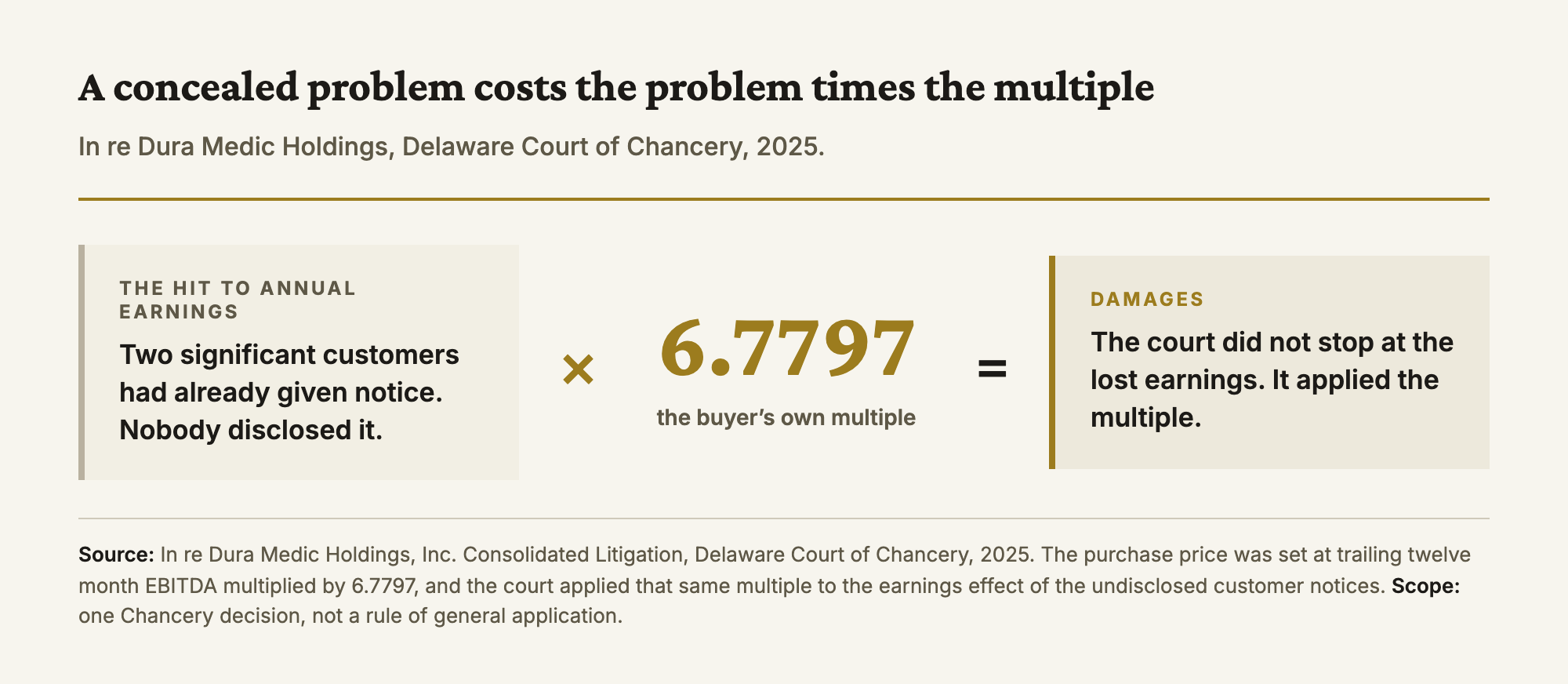
Delaware's Court of Chancery decided In re Dura Medic Holdings, Inc. Consolidated Litigation in 2025, and it is the clearest available illustration of why a concealed problem is not priced like a disclosed one. The buyer had set the purchase price the way these prices are usually set: trailing twelve month EBITDA multiplied by a number, and here the number was 6.7797. After closing, it emerged that two significant customers had already given notice they were leaving or reducing their business, and that this had not been disclosed. The court did not award the lost earnings as a one-time sum. It worked them out across the same twelve month period the price had been built on and multiplied that figure by 6.7797, the same multiple the buyer had used to set the price, reasoning that whether a misrepresentation warrants applying a multiple turns on the extent to which it affects future earning periods. The mechanism generalises even though the decision does not: when a price is a multiple of earnings, the buyer is paying for a stream rather than for one year, so anything that quietly reduces the recurring stream reduces the value of everything the multiple was applied to. A concealed problem costs the problem times the multiple. This is one Chancery decision, not a rule of general application, and the practical protection is in the survival period, the escrow and the cap rather than in the wording of the representation.
The arithmetic nobody expects
Most buyers, asked what an undisclosed problem costs, will answer with the size of the problem. If two customers worth $100,000 of annual earnings walk away and nobody mentioned they were going, the loss is $100,000.
That is not what happened in Delaware.
A private equity firm bought a supplier of durable medical equipment, the crutches and splints and braces end of the market, through a reverse triangular merger. The price was set the way these prices are always set: take trailing earnings, multiply by a number. The number was 6.7797, which tells you it was negotiated to the fourth decimal place rather than picked off a chart.
Vice Chancellor J. Travis Laster decided In re Dura Medic Holdings, Inc. Consolidated Litigation on 20 February 2025, Cons. C.A. No. 2019-0474-JTL. The multiple was applied to EBITDA for the twelve months ending 30 April 2018.
They closed. Then they found out that two significant customers had already given notice they were leaving or cutting back, and that nobody had told them.
The court worked out the lost earnings from those two customers across the same twelve month period the price had been built on, and multiplied that figure by 6.7797.
Why the multiple is the right measure
The reasoning is worth carrying even if you never see the inside of a courtroom.
When you pay a multiple of earnings, you are not buying this year's profit. You are buying an earnings stream and paying several years of it up front. The multiple is the market's shorthand for how long that stream is expected to continue and how reliable it is.
A misrepresentation that reduces the recurring earnings therefore does not damage one year. It damages the thing the multiple was applied to.
The holding is narrower than the headline suggests, and the narrowness is the useful part. The agreement did address multiples: it permitted damages calculated on "a multiple of earnings, revenue or other metric." What it did not say was when a multiple should apply. Into that gap the court read the common law, which allows damages on a multiple where the price of the target was itself established using one.
Read the other way round it becomes a drafting instruction. The parties had contemplated multiples and left the trigger unwritten, and the gap was filled against the seller. A seller who does not want that outcome has to say when a multiple applies, not merely whether one may.
The court's test for whether a multiple is warranted was the extent to which the misrepresentation affects future earning periods. Where it does, applying the multiple follows. Where the effect is genuinely confined to one period, a one-time sum is the right measure. A single unusual expense in the trailing year is a one-period problem. Two customers who have given notice are not.
This is also why concealment and error land so differently in practice even before anyone starts arguing about intent. An error in a single month's coding is bounded. A customer relationship that was described as stable and was not is a change to the stream.
The second holding, which buyers should know about
The same opinion settled a separate question that matters just as much and gets far less attention.
Delaware is a pro-sandbagging jurisdiction by default. A buyer can bring a post-closing claim for breach of a representation even if the buyer suspected at closing that the representation was false. Knowing about the problem does not forfeit the claim.
That runs against most people's intuition, and it changes the calculus when something surfaces late in a deal. A buyer who finds a problem two days before closing is not obliged to choose between walking away and waiving the issue. They can close and claim.
The corollary belongs to sellers. If a seller wants protection against that, they need an express anti-sandbagging provision in the agreement. Silence favours the buyer here too, for the same reason it did on the multiple.
What this does not mean
One Chancery decision is one Chancery decision.
Delaware's Court of Chancery is unusually influential in transactional disputes, and the reasoning above is a description of what that court did in In re Dura Medic Holdings, Inc. Consolidation Litigation. It is not a general rule that undisclosed problems are always valued at a multiple, and the outcome in any particular dispute turns on the contract, the facts, the forum and what was actually pleaded and proved.
Read it as an illustration of a mechanism rather than as authority for a number.
The useful takeaway is not "I can recover the multiple." It is that the exposure created by a concealed recurring problem is structurally larger than the problem looks, which is a reason to shape the deal so that you find these things before closing rather than a reason to be relaxed about finding them afterwards.
Why representations are weaker protection than they read
Every purchase agreement contains representations about the financial statements, the customers, and the absence of undisclosed adverse changes. Buyers read them and feel covered. The gap between that feeling and the actual protection is where most of the disappointment lives.
A representation gives you a contractual claim, and the terms that govern it are settled long before closing, in the letter of intent. Turning a claim into money requires all of the following to go right.
You have to discover the breach in time. Survival periods are frequently twelve to eighteen months. Customer losses often become visible at the first renewal cycle after close, which can fall outside that window depending on when in the contract year you bought.
You have to prove it. That means establishing what was known, by whom, and when. In the Delaware case the customers had already given notice, which is a documentable fact. Softer versions, where a relationship was deteriorating but nothing was ever written down, are far harder.
There has to be something to collect against. A seller who has spent the proceeds is a judgment you cannot enforce. This is what escrows and holdbacks are actually for, and it is why structure matters more than headline price.
The cap has to be big enough to matter. A cap set at ten percent of purchase price does not care that a court would have valued the harm at a multiple.
What to negotiate instead of better wording
The terms that decide whether a representation is a remedy or a sentiment are almost never in the representation itself.
- Survival period. Long enough to cover at least one full renewal cycle for the customer contracts that matter. If the top five customers all renew in March and you close in April, a twelve month survival buys you almost nothing.
- Escrow or holdback. The only term that guarantees there is money to collect against. Size it against the concentration you found in diligence, not against a market convention. See seller notes, earnouts and holdbacks for how the three interact.
- The cap. Consider a separate, higher cap for the specific representations that map to your actual concentration, typically financial statements and customer relationships.
- Definition of knowledge. Whose knowledge counts, and does it include what they should have known? A knowledge qualifier limited to the owner's actual knowledge is materially weaker than one that reaches the general manager.
- A specific customer representation. A general "no material adverse change" is harder to run on than an express statement that no customer above a stated revenue threshold has given notice of termination or reduction.
- Whether the agreement says when a multiple applies, not just whether one may. Dura Medic's agreement permitted multiple-based damages and never said in what circumstances. If you are the buyer and the price is a multiple, that gap currently works in your favour in Delaware; if you are the seller, it is the clause worth closing.
- Whether there is an anti-sandbagging provision, and who it helps. Its absence preserves the buyer's right to claim on something they already suspected.
The version of this that has nothing to do with litigation
Most buyers who find an undisclosed problem never sue anybody. The deal is smaller than the cost of the fight, or they find it before closing and simply have to decide what to do.
The structural point survives without the courtroom, and it applies at the negotiating table.
A disclosed problem gets priced once. Both sides look at the same fact, argue about what it is worth, and adjust the price or the structure by a specific amount. That is an ordinary and survivable conversation.
A concealed problem gets priced twice. Once for the thing itself, and again for everything that can no longer be taken on trust. The mechanism behind that second pricing is set out in a $500,000 problem against a $417 lie. Diligence works by verifying a fraction and extending confidence to the remainder. A concealment tells the buyer that extension was unsound, which puts every accepted figure back into question and widens the protection the buyer will now insist on.
Which is why, from the seller's side, concealing something small is one of the most expensive things available to them, and the cost has almost nothing to do with the item concealed.

Avery Hastings, CPA
Founder, Acquidex • CPA • Tokyo, Japan
Avery Hastings is a CPA based in Tokyo, Japan and the founder of Acquidex. She focuses on helping buyers evaluate small-business deals with clear cash-flow logic, realistic downside analysis, and practical diligence frameworks.
Keep up with Avery →Sources
Keep Reading
- Form 8594: How a Business Purchase Price Gets Allocated (and Why It Decides Your Taxes)10 min read read
- Form 8594: The Asset Acquisition Statement Explained (With the Seven Asset Classes)9 min read read
- Asset Purchase Agreement (APA): What's Inside, How It Differs From a Stock Sale, and Free Template13 min read read
- Confidential Information Memorandum (CIM): Guide + Free Template (2026)11 min read read
- Letter of Intent for Buying a Business: Complete Guide + Free Template12 min read read