


Key Insight
A diligence finding is one of two different things and they do not get the same response. A problem has a number attached to it: half a million dollars of deferred capital expenditure can be priced, escrowed, split, or walked away from with a specific figure in mind. It is expensive and it is bounded. A lie has no number, because the number was never the finding. Diligence is a sampling exercise. Nobody verifies every transaction, every contract and every customer relationship, so confidence is extended from the fraction that was checked to the remainder that was not, and that extension is the entire product. A problem is a data point inside the sample and does not threaten the extension. A misstatement that was known, asked about and not disclosed tells you the population is not what you assumed, and everything unchecked returns to being unknown. The practical test is not the discrepancy but what happens when you raise it, specifically whether documentation arrives before the explanation or an explanation arrives that the documentation never catches up with. Delaware's Court of Chancery put an arithmetic value on the difference in In re Dura Medic Holdings (2025): where a buyer had priced the business at trailing twelve month EBITDA multiplied by 6.7797 and two significant customers had given notice without disclosure, the court did not stop at the lost earnings. It applied the same multiple the buyer had used. A concealed problem costs the problem times the multiple. Most discrepancies are not concealments. Small businesses have thin bookkeeping and people make mistakes, and treating every one as dishonesty will lose good deals.
There is a payment leaving the business every month to a company nobody there can identify.
It is $417.
You are four months into diligence, you have spent real money, and you have already started telling people at home the name of the place. You ask about the $417.
The seller knows immediately. Not "let me look into that." They know. It is a consulting arrangement, they say, from a few years back. You ask for the agreement. Two days later there is no agreement, but there is a better explanation, and the better explanation does not quite match the first one.
That same week you find something else. The equipment is older than the schedule says and most of it needs replacing inside three years. Call it half a million dollars.
Nobody hid the equipment. It was sitting in plain sight waiting for somebody to look, and you looked.
You will spend the next week on the equipment.
Almost everybody does. And it is the wrong week.
The half a million is the easy part
A problem has a number attached to it. That is its defining feature, and it is why problems are survivable.
Half a million of deferred capital expenditure can be priced. Knock it off. Escrow it. Split it. Build it into the first year's budget. Or walk, with a specific figure in your head for what this business was actually worth. None of those conversations are pleasant. All of them are conversations, and the problem sits still while you have them.
It is also bounded. You know roughly what it is. The range of how wrong you might be is narrow. Equipment that needs replacing does not secretly need replacing twice.
Expensive and finite. That combination you can work with.
The $417 is not about $417
Nobody walks from a deal over $417. Nobody should.
So why does it matter more than the half million?
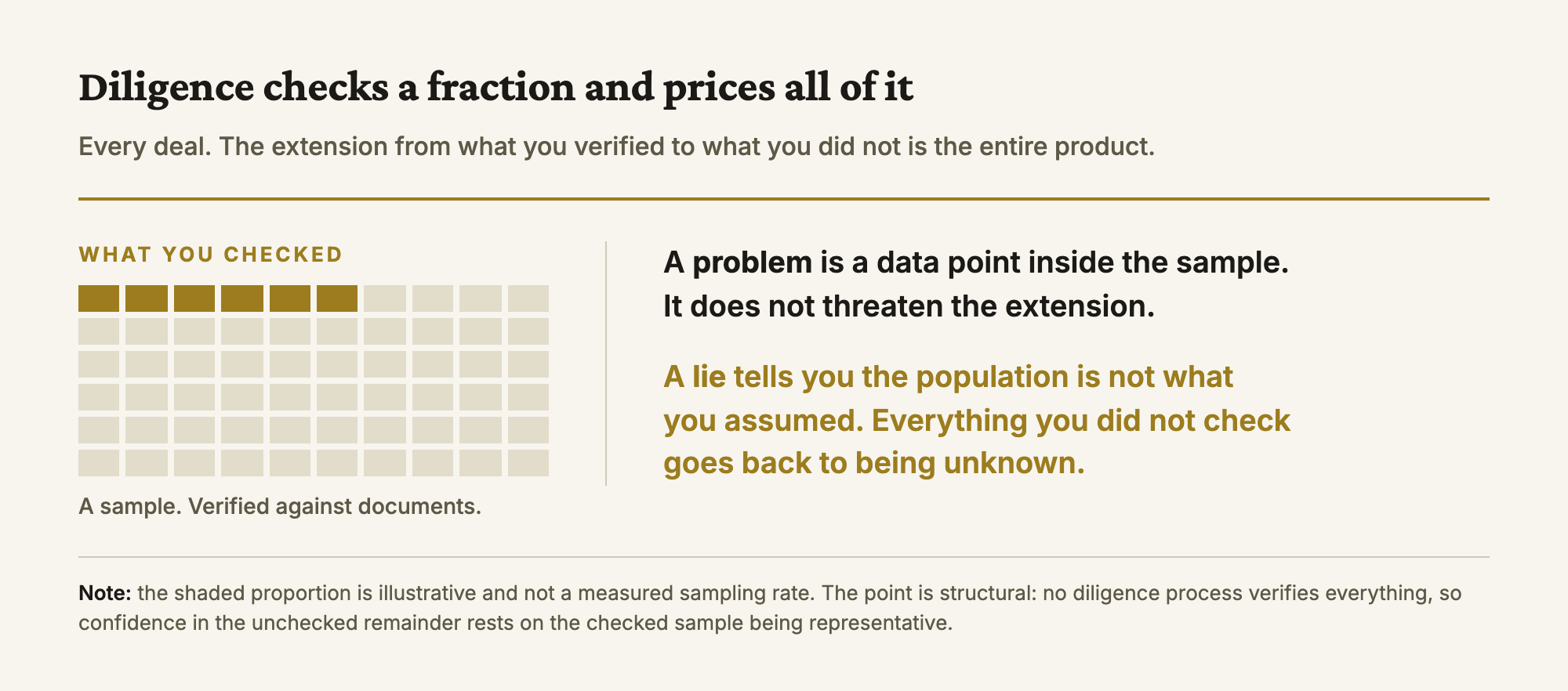
Because diligence is a sampling exercise.
You cannot verify everything and nobody ever has. Not in a $2 million deal, not in a $200 million one. You check a fraction of the transactions, a fraction of the contracts, a fraction of the customer relationships. Then you extend your confidence from what you checked to what you did not.
That extension is the entire product. It is not a shortcut or a compromise. It is the thing you are paying for, and it is the only reason diligence works at all.
A problem is a data point inside the sample. It sits there, it gets priced, and it does not threaten the extension.
A lie is a different category of object. A lie tells you the population is not what you assumed. And the moment you know that, everything you did not check goes back to being unknown.
You did not find a $417 discrepancy.
You found out that the numbers you were handed are the kind of numbers that can be wrong on purpose.
Now ask the question nobody asks
Here is the part that should make you uncomfortable.
You did not find that payment because you are good at this. You found it because it happened to sit in the slice you pulled. A few percent of the transactions got looked at properly. The rest you took on trust.
So ask two questions.
What is the probability this is the only one?
What is the probability this is the biggest one?
Work it through. Say you sampled five percent of transactions and found one deliberate misstatement. If misstatements are scattered rather than concentrated, one in your five percent implies roughly twenty in the whole. That is arithmetic, not paranoia.
And the one you found was not selected for being large. It was selected for being in your sample. The distribution of the other nineteen is completely unknown to you. There is no particular reason the largest would have been the one that landed in front of you.
The $417 is not the finding.
The $417 is the corner of something you can now only estimate.
Most discrepancies are not lies
None of this means every discrepancy is dishonesty. A buyer who treats it that way will lose good deals to buyers who do not.
Small businesses have thin bookkeeping. The bookkeeper is part-time and has been there eleven years. Owners run things through the company that they half-forgot about. Accounting software defaults put things in the wrong place and nobody notices for six years. A misstatement is not automatically a lie.
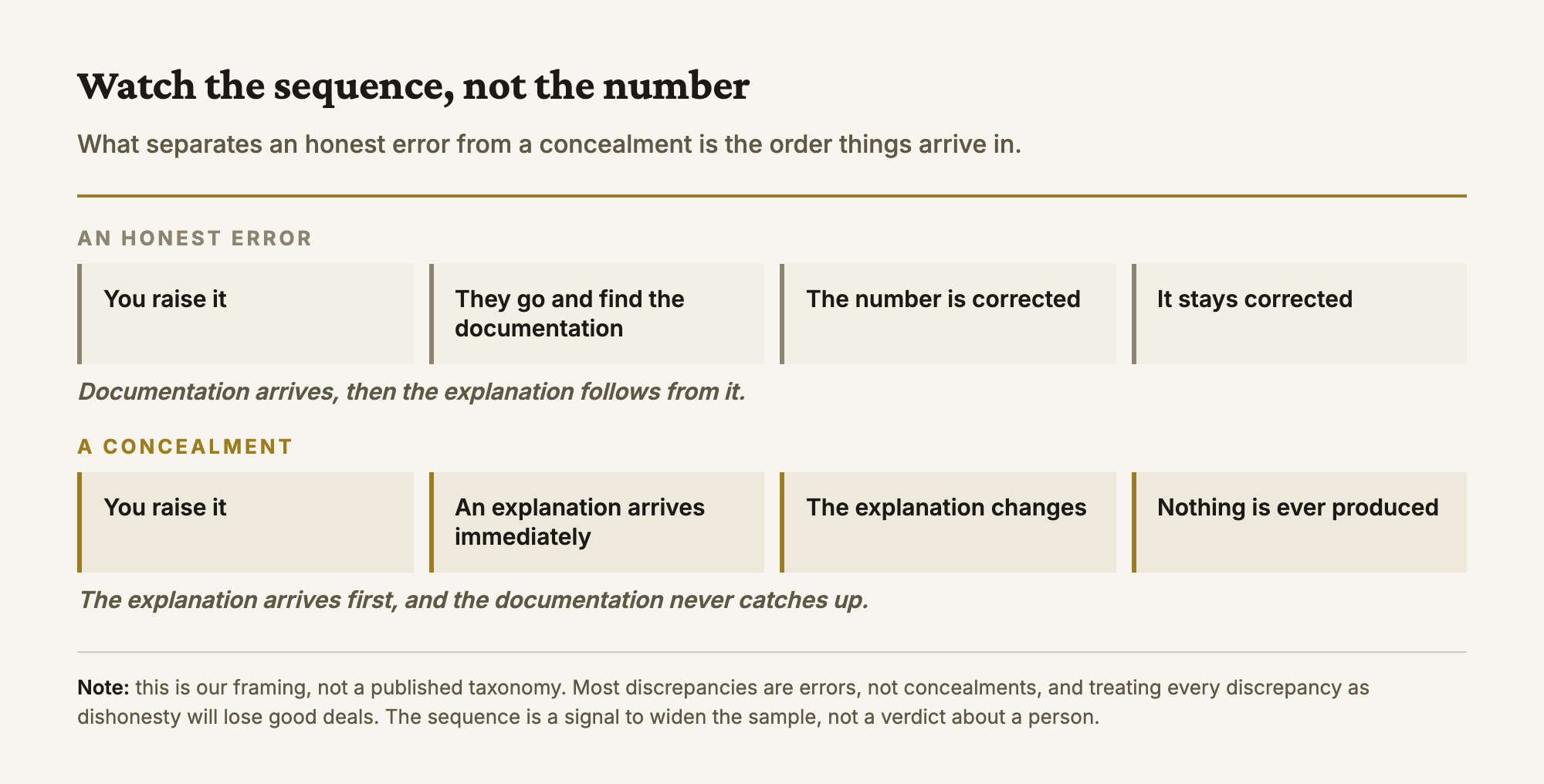
The test is not the discrepancy. The test is what happens when you raise it.
An honest error behaves in a recognizable way. The seller is mildly embarrassed. They go and find the documentation, usually faster than you expected, because they want it resolved as much as you do. The number gets corrected and it stays corrected. Sometimes the correction makes the business look slightly worse and they tell you anyway.
A concealment behaves differently, and the difference is in the order things arrive.
The explanation comes first. The documentation is promised and then does not arrive, or arrives partially, or arrives as something adjacent to what you asked for. Then the explanation changes, usually improving. Then the scope of the question gets renegotiated, or the answer expands to cover something you never asked about.
Watch the sequence, not the number. Documentation that follows an explanation is a different animal from an explanation that follows documentation.
Four ways a seller can be wrong, and only one is a lie
These get treated identically on most issues lists. They should not be.
Error
The number is wrong and nobody knew. A misclassified expense, a duplicate entry, a payroll accrual that never got reversed.
What it looks like: the owner is surprised, the bookkeeper is apologetic, and the fix takes an afternoon.
What to do: correct it and move on. Do not let it color anything else. Errors are the normal condition of a small business, and a set of books with no errors in it would be more suspicious than one with several.
Omission
Something true was never mentioned. Nobody asked, either.
What it looks like: the largest customer is on a handshake, and you find out because you asked to see contracts, not because anybody volunteered it.
What to do: this is the genuinely ambiguous category and it deserves judgment rather than a rule. Sellers are not obliged to narrate every weakness unprompted, and buyers routinely fail to ask obvious questions. The workable test is whether a reasonable person in their position would have expected it to matter to you. A handshake deal with the biggest customer passes that test. The fact that the delivery van needs tires does not.
Framing
Everything stated is technically accurate and the overall impression is wrong.
What it looks like: revenue described as recurring, which renews annually by customer choice with no obligation either way. A customer described as a ten-year relationship, which has been shrinking for four of them. Margins quoted at a level that is real but was achieved in one exceptional year. A team described as experienced, which is one experienced person and four people who joined last spring.
What to do: notice that nothing here is false, and that no representation has been breached. You will not get anywhere arguing about it, because there is nothing to argue about. You simply have to re-derive the picture from the underlying facts rather than from the description.
This is where most deals actually go wrong, and it is the reason a piece about lying is incomplete without it. Framing is legal, it is universal, it is what every seller's adviser is paid to produce, and it never trips the alarm that a flat untruth would. If you only test for lies you will miss most of what is being done to you.
Concealment
Something true was known, was asked about, and was not disclosed.
What it looks like: the $417.
What to do: everything below.
What re-underwriting actually looks like
- Three companion pieces go deeper than this one does on particular parts of the argument: who actually steals from small businesses on the control environment you are inheriting, what a concealed problem actually costs on the damages measure, and should a seller disclose a problem before listing on the same mechanism from the other side of the table.
Widen the sample in the same category first. If the discrepancy was in expenses, pull a much larger expense sample, not a larger everything. Misstatement clusters by category because it clusters by whoever was handling that category.
- Separate what you verified from what you accepted. Mark every input in your model as documented or asserted. The assertions usually carry more of the value than anyone realised, and nobody ever wrote down which was which.
- Re-ask one question you already have an answer to. Not a new question. One from weeks ago, where you know what you were told. Consistency over time is cheap information and the fastest read on whether the first answer was constructed.
- Work from the bank, not the ledger. Records can be coded to say anything; money movement leaves a counterparty. Pull the largest deposits and the largest recurring payments and name the other side of each.
- Price the delay honestly. Re-underwriting costs real weeks, and the seller's other buyer does not stop existing while you do it. Sometimes the answer is that the deal is no longer worth what it would take to get comfortable.
"Go back and check more" is useless advice. Here is the specific version.
Widen the sample in the same category first. If the discrepancy was in expenses, pull a much larger expense sample. Not a larger everything. Misstatement clusters by category because it clusters by whoever handled that category. The fastest way to learn how deep this goes is to go deeper in the same place, not wider everywhere.
Separate what you verified from what you accepted. Take your model and mark every input as either documented or asserted. Revenue by customer: documented or asserted? Owner add-backs: documented or asserted? The lease terms, the equipment condition, the reason the last general manager left?
Most buyers discover two things doing this. The assertions carry more of the value than they realized, and nobody ever wrote down which was which.
Re-ask one question you already have an answer to. Not a new question. One you asked six weeks ago, where you know exactly what you were told. Consistency over time is information you can get almost for free, and it is the fastest available read on whether the first answer was recalled or constructed.
Interview somebody other than the seller. The seller is one source and you have been running your entire process through them. A long-serving employee, a departing manager, a supplier who has been invoicing for fifteen years. People who have no stake in the transaction answer differently from people whose retirement depends on it.
Price the delay honestly. Re-underwriting costs real money and real weeks, and the seller's other buyer does not stop existing while you do it. Sometimes the right answer is that the deal is no longer worth what it would take to get comfortable. That is a legitimate reason to walk, and it has nothing to do with the business being bad.
The whole thing in two lines
A problem changes the price.
A lie changes the reliability of everything you have been told, including the things that made you want this business in the first place.
You can negotiate the first one. There is no negotiating the second, because what you would be negotiating over is your own confidence, and the seller has no way to give that back to you.
What it costs the seller, who never sees it coming
Most sellers have no idea about this part, and their advisers often do not raise it.
Concealing something small is one of the most expensive things a seller can do, and the cost has nothing to do with the item concealed.
Once a buyer finds one, four things happen at once.
The diligence budget goes up, because the sample has to get bigger. That is the buyer's money, but it buys them delay and it buys the seller nothing.
The timeline extends, because a bigger sample takes longer. Deals do not improve with age. Every extra month is another month for a customer to leave, a key employee to resign, a lender to change its mind, or the buyer to find something else.
Every remaining representation is worth less, because a representation is only worth the credibility of the person making it. The seller has hundreds of them in the purchase agreement, and they have all just been marked down together.
The price protection widens. Larger escrow, longer survival periods, more specific indemnities. The buyer is no longer pricing a list of known items. They are pricing a distribution of unknowns, and distributions are always more expensive than lists.
A seller who discloses a real problem early usually gets it priced once. A seller caught concealing a small one gets everything repriced.
The mechanism is not moral. Nobody is punishing them. The buyer has simply lost the ability to extend confidence from the sample, and rebuilding that costs money that comes out of the price.
What a seller should actually do
The advice implied by all of this is not "be honest," which nobody has ever found useful. It is more specific than that.
Disclose the thing you are dreading, early, in writing, with the number attached.
Every seller has one. The customer who is drifting. The employee who is the whole operation. The year that was exceptional and is not coming back. The equipment. The lease.
There are three reasons to put it on the table before anyone finds it.
It gets priced once. A problem disclosed in week two is a negotiation about that problem. The same problem found in week twelve is a negotiation about that problem plus a negotiation about what else you have not mentioned, and the second one is open-ended.
It buys you credibility you can spend later. A seller who volunteers something that costs them money establishes something a hundred reassurances cannot. Every subsequent answer they give is worth more. That is a real asset and it is cheap to acquire, because it only costs you a thing the buyer was going to find anyway.
It removes the buyer's best exit. Deals die for reasons buyers find hard to say out loud. "I lost confidence" is much easier to act on than "the price is too high," and it does not require them to justify anything. Leaving a concealed item lying around hands them a reason to walk that they never have to defend.
The seller who says "before we go further, there are three things you should know, and here is what I think each of them costs" does not lose the deal. They lose the argument about those three things, which they were going to lose anyway, and they win every argument after it.
A court has already put a number on this
None of this is a philosophy of diligence. It is how the disputes actually end, in court, with somebody writing a check.
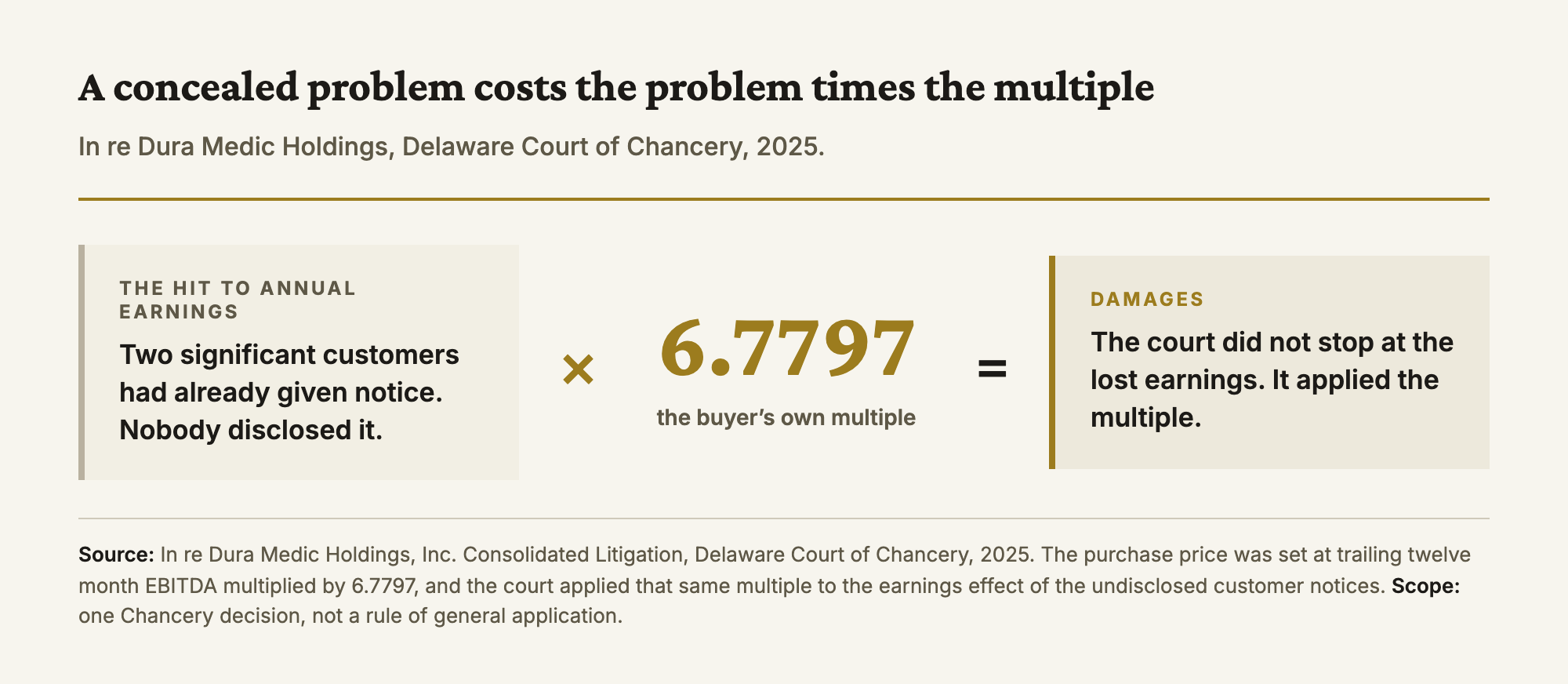
Delaware, last year. A private equity firm acquires a business. The price is set the way these prices are always set: take trailing twelve month earnings, multiply by a number. Here the number was 6.7797.
They close. Then it emerges that two significant customers had already given notice of their intent to terminate or reduce their business, and that this had not been disclosed.
Now watch what the court did, because it is not what most people would expect.
It did not stop at the lost earnings.
It took the effect on annual earnings and multiplied it by 6.7797. The same multiple the buyer had used to set the price in the first place.
The reasoning is the part worth carrying around:
whether a misrepresentation diminishes the value of the business sufficiently to warrant applying a multiple turns on the extent to which the misrepresentation affects future earning periods
Read that again. A concealed problem does not cost what the problem costs.
It costs the problem times the multiple, because it was quietly priced into something everyone assumed would keep happening.
Same asymmetry as the $417. Now with a number on it, decided by a judge instead of argued by a buyer.
Worth noting what this means for the seller specifically. The customers leaving was the problem. The failure to mention them was the concealment. Had it been disclosed, it would have been a negotiation about the multiple. Undisclosed, it became a judgment against them at the multiple.
The civil case: what a concealment costs. In re Dura Medic Holdings, Inc. Consolidated Litigation, Delaware Court of Chancery, Vice Chancellor J. Travis Laster, 20 February 2025, Cons. C.A. No. 2019-0474-JTL. A private equity buyer acquired a supplier of durable medical equipment by reverse triangular merger, at a price built on EBITDA for the twelve months ending 30 April 2018 multiplied by 6.7797. The sellers had warranted that no significant customer had notified the company of an intent to terminate or reduce its business. That was untrue of two customers. The court measured the lost earnings from those two customers across the same twelve month period the price had been built on, then applied the 6.7797 multiple to that figure. The agreement permitted damages on "a multiple of earnings, revenue or other metric" but never said when a multiple should apply, and the court filled that gap with the common law. It also reaffirmed Delaware's pro-sandbagging default: a buyer may claim for breach of a representation even if it suspected at closing that the representation was false. Scope: one Chancery decision, not a rule of general application.
The criminal case: what it looks like from the buyer's side. United States v. Rood, Western District of Missouri. Todd Edwin Rood, former owner of a Missouri machine shop, pleaded guilty to loan application fraud on 6 December 2017 and was sentenced to four years in federal prison without parole. The purchasers agreed to pay about $1.9 million and borrowed roughly $1.7 million from a Georgia bank, which relied on financial documents Rood had falsified across 2015 and 2016. He had his bookkeeper record $120,000 of loans from his parents as income, and two further loans of $121,327 received the same treatment. He was ordered to pay $1,347,608 in restitution. The mechanism is the one this piece is about, and it leaves a trace: borrowed money arrives with no customer attached to it, so it has no invoice, no order and no name. Scope: one prosecuted case, not a pattern.
Why you will get this wrong anyway
Everything above is easy to agree with in the abstract and difficult to apply on a deal you want.
By the time a small discrepancy surfaces you are usually months in. You have spent money on lawyers and accountants. You have told people. You have started imagining the first hundred days, which employee you will promote, what you will do about the pricing. The deal has stopped being something you are evaluating and started being something you are trying to complete.
At that point a lie is enormously inconvenient. And inconvenient findings get reclassified.
The explanation that did not quite hold becomes a misunderstanding. The document nobody produced becomes a paperwork issue. The seller who knew the answer too quickly was just familiar with their own business. None of this feels dishonest while you are doing it. It genuinely feels like the reasonable reading, because the alternative reading costs you something you have already spent four months and a lot of money acquiring.
The tell is that you are arguing on the seller's behalf inside your own head.
If you notice yourself constructing the innocent explanation before they have offered one, that is the moment. Not the discrepancy. The advocacy.
The cheapest protection against this is to write down, before diligence starts and while you are still genuinely neutral, what would make you walk away. Name three specific, checkable facts. A list written by somebody with nothing invested is worth a great deal more than a judgment made by the same person four months and sixty thousand dollars later.
You cannot make yourself objective at month four. You can leave instructions for yourself from month zero.
None of this replaces an ordinary process. It sits alongside financial due diligence and the standard list of red flags that kill deals; what it adds is a rule for deciding which of the two kinds of finding you are holding.
The sorting question
The practical version is one question, and it should get asked out loud in deal meetings.
Is this a problem, or is this a credibility issue?
If it is a problem: price it, allocate it, move on. Do not let it consume more attention than its number deserves. Half a million dollars of anything is a line item, not a crisis.
If it is a credibility issue: stop pricing and start re-underwriting. Everything in the section above.
Two different findings. Two completely different responses. Most diligence processes have exactly one response, which is to put everything in the same issues list and argue about the total at the end.
The line
Every deal has problems. Problems are normal. Problems are what the price is for.
But strip away the earnings and the customers and the equipment and look at what you are actually buying. You are buying a set of statements made by somebody you met four months ago.
That is it. That is the asset.
The business is worth exactly what those statements are worth, and not a dollar more.
A $500,000 problem costs you $500,000.
A $417 lie costs you the right to believe anything else you were told.
Go and split your current deal into two lists. What you believe because you checked it. What you believe because somebody told you and seemed like a reasonable person.
Write the second list down.
It is longer than you think, and you already know which line you would put the $417 on.
Note on sources. This is a framework piece and makes no statistical claims. The opening scene is an illustration, not an account of a particular transaction. The Delaware case is In re Dura Medic Holdings, Inc. Consolidated Litigation, Delaware Court of Chancery, 2025: the purchase price was set at trailing twelve month EBITDA multiplied by 6.7797, the sellers failed to disclose that two significant customers had given notice of intent to terminate or limit their business, and the court applied that same multiple to the earnings effect. The quotation is from the court's own reasoning. Verified 12 September 2026.

Avery Hastings, CPA
Founder, Acquidex • CPA • Tokyo, Japan
Avery Hastings is a CPA based in Tokyo, Japan and the founder of Acquidex. She focuses on helping buyers evaluate small-business deals with clear cash-flow logic, realistic downside analysis, and practical diligence frameworks.
Keep up with Avery →Sources
Keep Reading
- The Four Risks That Decide Whether an Acquisition Works11 min read read
Most SMB and lower-middle-market deals don't fail on strategy. They fail because four risks — overstated cash flow, customer concentration, owner dependency, and aggressive leverage — were each judged manageable in isolation, then compounded after close.
- How Much of a Small Business's Profit Is Actually the Owner?17 min read read
Two natural experiments on eleven million firms measured what happens when an owner leaves. Profit fell 82% after death and 83% after retirement. A replacement-salary add-back prices the same person at 17%.
- How to Verify a Seller's Growth Story: Four Checks, and Why Two Designs Disagreed24 min read read
I tested whether hailstorms grow roofing companies. Compared across counties the effect was geography. Compared to itself, each county gained three points. A seller only ever shows you one of those.