
The Silver Tsunami Is Ageing, Not Arriving
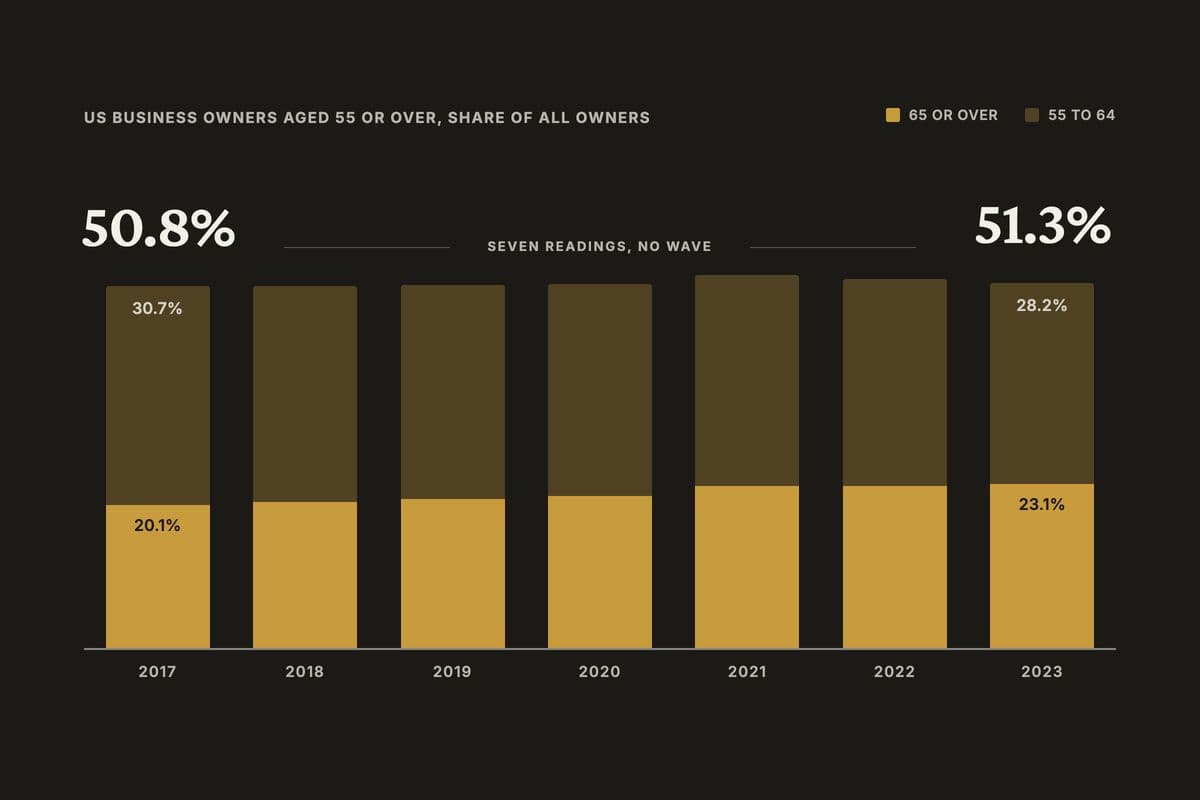
Seven annual Census readings show no surge of sellers building. The share of owners aged 55 or over barely moved. The share past 65 is creeping up — and those owners are already leaving, at about 8% a year.
Primary-source analysis of how small businesses are really bought, financed, and valued — built from SBA lending records, IRS data, and federal statistics. Numbers a broker deck won’t show you.

Seven annual Census readings show no surge of sellers building. The share of owners aged 55 or over barely moved. The share past 65 is creeping up — and those owners are already leaving, at about 8% a year.

A deal's structure adds commitment on a schedule while diligence is supposed to keep the decision open. What fifty years of research says about that tension, new evidence from actual acquisitions, and where the evidence stops.

An SBA credit line is approved, and then the money sits there. How fast the owner first reaches for it turns out to be one of the cleanest default signals in the public loan file, and it only works where the owner gets to choose.

A problem changes the price. A lie changes the reliability of everything you were told, including the things that made you want the business. Diligence is a sampling exercise, and that is the whole reason the difference matters.

A landmark study on Forbes 500 CEOs shows overconfident executives have 65% higher odds of making an acquisition, and the market reacts 90 basis points more negatively to their deals. The mechanism transfers to private-market buyers. The measurement does not. Here is what a buyer-side test would actually look like.

Two natural experiments on eleven million firms measured what happens when an owner leaves. Profit fell 82% after death and 83% after retirement. A replacement-salary add-back prices the same person at 17%.

I tested whether hailstorms grow roofing companies. Compared across counties the effect was geography. Compared to itself, each county gained three points. A seller only ever shows you one of those.

A roadside motel will sell. A law practice records thirteen times the closures per sale. Census data on 104 industries shows the difference is not profit, size, or how well the business was run.

There is no small business discount. There is a diversification tax, and across 89 industries it is worth about 2.7 turns of earnings before size, illiquidity or transferability are considered at all.

The FY2023 cohort charged off at 2.515% within 36 months — the highest since 2010. It is also only the fourteenth-highest of thirty-three cohorts on record. A CPA reads the full loan-level series.

Across 50,942 SBA-financed acquisitions, fitness centres charge off at 8.60% and liquor stores at 1.02%. Same leased retail, same street, same kind of buyer. A CPA reads the loan-level outcome data.

Business applications just hit a June record — but the share that becomes an employer business you can actually buy has fallen to the lowest level on record, and it's rotating hard by sector.

Seasonal businesses default at roughly the market average overall — but at 5.4% in cold-winter states versus 9.7% in warm, sunny ones. A CPA reads the SBA survival data on what separates the resilient acquisition from the fragile one.

The most-repeated warning to first-time buyers — most partnerships fail — is an unsourced number. A CPA reads the SBA loan records on who actually survives, and finds the opposite.

Ranked by IRS margin, professional services lead American small business at 39.7%. Ranked by AI task-exposure, the same cognitive work sits near the top. A CPA on why the two lists run nearly inverse — and what it means for anyone paying a premium multiple.

The businesses a generation is told to buy pay their owners less than a living wage. A CPA reads the IRS returns on what small firms actually net — and why the headline figure understates a real acquisition.

Adjusted EBITDA — or its Main Street cousin, SDE — sets the asking price, anchors the negotiation, and sizes the loan. It is also the only number in the deal that is an argument rather than a measurement. A CPA reads the add-back schedule.

More Americans borrow to buy a full-service restaurant than any other business. On the three numbers that decide whether an acquisition survives, it ranks near the bottom. A CPA reads the SBA lending data.

The SBA doubled its combined loan ceiling to $10M as US default rates run elevated. A quarter-century of Japanese small-business credit data suggests low rates and easy access do not equal low risk — they produce a different risk.

Most SMB and lower-middle-market deals don't fail on strategy. They fail because four risks — overstated cash flow, customer concentration, owner dependency, and aggressive leverage — were each judged manageable in isolation, then compounded after close.