
Key Insight
Across 50,942 SBA-financed business acquisitions approved between FY2018 and FY2021, fitness and recreational sports centres recorded the highest charge-off rate of any measurable sector at 8.60% on 349 loans, while beer, wine and liquor stores recorded 1.02% on 881 loans. That is a ratio of roughly 8.4 to 1 between two businesses that occupy the same leased retail, serve the same few square miles, and are bought by the same kind of buyer. The acquisition-wide rate was 2.92%. The pattern repeats elsewhere in the file: snack and nonalcoholic beverage bars charged off at 5.19% against 1.90% for drinking places serving alcohol, and two categories recorded no charge-offs at all across five years, self-storage on 133 acquisitions and assisted living on 233. The proposed explanation, which is an argument rather than a measured finding, is that businesses selling self-improvement carry revenue that must be continually re-sold, while businesses selling a habit or an inertia carry revenue that persists until actively stopped. The practical consequence for a buyer is that "recurring revenue" describes how often a customer is billed, not how hard it is for them to stop, and only the second property is durable. A charge-off is a loan failing rather than a business closing, and this dataset covers SBA-financed acquisitions only.
Somewhere in America last year, someone bought a gym.
They did the work. Three years of financials. Tax returns tied to the P&L. They counted members, pulled the autopay file, checked how many were locked into annual contracts.
What they found was contracted, recurring, predictable revenue — the exact thing every buyer in this market is told to look for.
Then they signed personally on an SBA note.
What does the SBA loan data actually measure?
The SBA 7(a) program is the main channel through which Americans borrow to buy an existing business. Every loan it guarantees is published at loan level under FOIA, including the outcome: paid in full, still current, or charged off.
That last field is the useful one. It is a recorded fact rather than a survey response, and it is attached to a business category, an approval date, and a dollar amount.
I filtered the published file to change-of-ownership loans — acquisitions, not startups or refinancing — approved between FY2018 and FY2021, and asked which ones charged off within five years of approval. That seasoning window matters: it stops a 2018 cohort with seven years of exposure from being compared against a 2024 cohort with barely any.
The filtered population is 50,942 acquisitions. The overall charge-off rate across sectors with enough loans to measure was 2.92%.
Which businesses fail most after someone buys them?
One category sits on top, and it is not close.
| Sector | Acquisitions | Charged off | Rate |
|---|---|---|---|
| Fitness and recreational sports centres | 349 | 30 | 8.60% |
| Offices of chiropractors | 267 | 14 | 5.24% |
| Snack and nonalcoholic beverage bars | 231 | 12 | 5.19% |
| Full-service restaurants | 1,266 | 61 | 4.82% |
| Landscaping services | 323 | 15 | 4.64% |
| General automotive repair | 449 | 18 | 4.01% |
| Beer, wine and liquor stores | 881 | 9 | 1.02% |
| Hotels and motels | 1,208 | 9 | 0.75% |
| Self-storage | 133 | 0 | 0.00% |
Gyms fail at roughly three times the acquisition-wide average, about eight and a half times the rate of liquor stores, and about eleven times the rate of hotels.
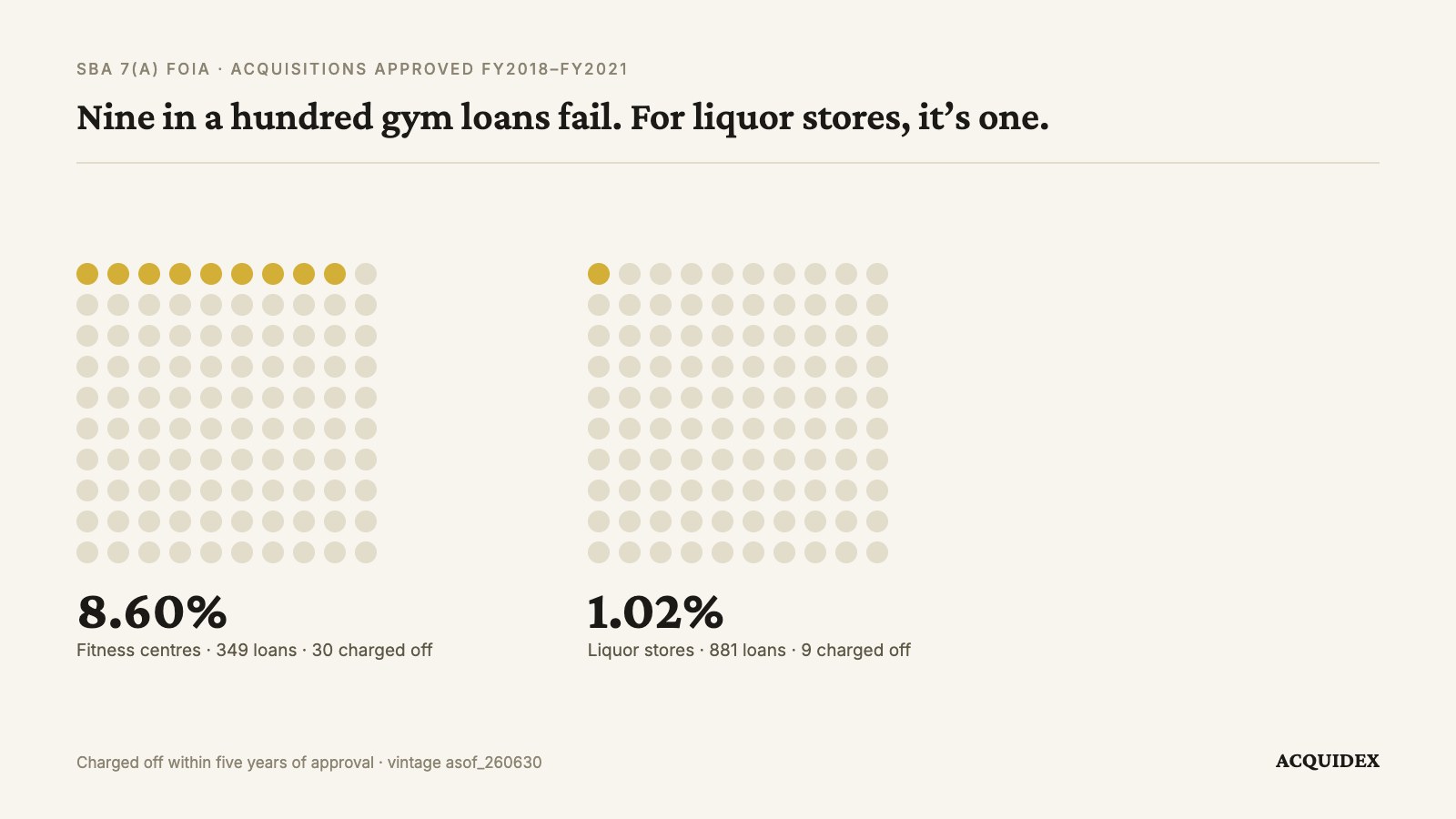
Hold the two ends of that against each other. A gym and a liquor store are both leased retail. Neither owns the building. Both serve a few square miles of neighbourhood. Both get bought by first-time owner-operators using the same loan product.
One of them is eight times more likely to take the note down with it.
Does the pattern hold outside gyms and liquor stores?
This is where it stopped looking like a quirk of one category.
Juice and smoothie bars charged off at 5.19%. Bars serving alcohol charged off at 1.90%. Same footprint. Same counter. Same person handing you a drink across it. Nearly a three-fold difference in outcome.
And at the bottom of the entire file, two categories with meaningful sample sizes recorded no five-year charge-offs at all: self-storage across 133 acquisitions, and assisted living across 233. Funeral homes came within one, at 0.57% across 176.
Is it really about the industry?
Line the whole table up and the usual sorting principles fail one after another.
It is not services against retail — both ends contain both. It is not asset-heavy against asset-light, as above. It is not even licensing or regulatory difficulty: liquor stores are among the most heavily licensed small businesses in America and they sit near the floor.
Here is what I think is actually going on. The numbers above are published and checkable. This next part is mine, and I would rather label it as an argument than dress it up as a finding.
Every business at the dangerous end sells someone a better version of themselves. A gym. A juice bar. A chiropractor.
Every business at the safe end sells a habit, an obligation, or an inertia. A liquor store. A funeral home. A storage unit. An assisted living bed.
Why would aspiration churn and habit not?
A gym membership is a promise someone makes to a future version of themselves. They buy it in January, when they are the person who is going to change. They stop going in March, when they are the person they actually are.
The revenue was never a contract. It was a mood, and moods have a churn rate.
Now hold that against a storage unit. Nobody wakes up on a Tuesday and decides to become the kind of person who no longer needs theirs. Leaving means renting a truck, giving up a Saturday, and finding somewhere else to put the things you already decided you did not want in your house.
Cancelling a gym takes about nine seconds on a phone.
Both businesses bill monthly. Both are nominally month-to-month. Only one of them is genuinely hard to leave.
Aspiration has to be renewed. Habit only has to be uninterrupted.
Does "recurring revenue" mean what buyers think it means?
Every listing in this market says the same three words.
A gym is about as recurring as a small business gets. Memberships. Autopay. Annual contracts with cancellation windows. Deferred revenue sitting on the balance sheet like a promise. On a spreadsheet it is the most predictable cash flow you will ever underwrite.
It has the highest failure rate in the file.
To be precise about what that claim rests on: the loan data contains no revenue figures at all. The business-model characterisation is mine. What the file contains is the outcome, and the outcome does not reward the category that looks most contracted.
So "how much of the revenue is recurring" was never the useful question. It measures billing frequency, which is not a risk property.
What should a buyer ask instead?
Replace it with a question about friction.
What does the customer have to do to make the revenue stop, and how unpleasant is it?
If the answer is "tap a button," you are underwriting a mood. If the answer is "rent a truck," you have found something durable.
That question is answerable in diligence, and it is answerable before you are emotionally committed. Ask how a customer cancels, whether they can do it without speaking to anyone, whether a notice period exists and is actually enforced, and how many steps sit between wanting to leave and having left. Every one of those steps is a unit of protection, and none of them appear anywhere in the financials.
There is a second-order version of this worth asking too: what share of this year's revenue had to be sold again to the same customer? A business that re-sells its entire book every twelve months is a marketing operation with a lease attached. A business that does not is an annuity.
Where could this be wrong?
Several places, and they are worth stating plainly.
Some of the safest sectors here carry real estate. Hotels, self-storage and assisted living often involve property, and property secures a loan. That explains part of the floor. It does not explain gyms against liquor stores, or juice bars against pubs, which are structurally the same and still run two to eight times apart.
A charge-off is a loan failing, not a business failing. A business can close and repay its note; a loan can charge off while the doors stay open. The two are correlated, not identical.
This is SBA-financed acquisitions only. Cash deals and seller-financed deals are invisible here, and they are not a random sample of the market.
Loan amount is not purchase price. The file records the loan. Buyers contribute equity and sellers frequently carry paper.
Two of the four cohorts got federal help. CARES Act Section 1112 paid six months of instalments for FY2020 and FY2021 borrowers, which permanently flatters those vintages relative to FY2018 and FY2019. It applies across all sectors, so it moves the levels more than it moves the comparisons — but it is real and it is in the data.
Sample sizes vary a lot. Fitness centres rest on 349 loans and 30 charge-offs, which is enough to be confident about a rate that far from the mean. Categories with a handful of loans are not, and I have kept them out of the table for that reason.
And I cannot tell you why. I tested the obvious relationships and none of the non-circular ones reach statistical significance. The willpower explanation is my reading of the pattern. The rates are checkable. The explanation is an argument.
Sources & method
Computed from the SBA 7(a) loan-level FOIA extract, public domain, published quarterly by the U.S. Small Business Administration and mirrored on data.gov. Vintage asof_260630.
Population: change-of-ownership 7(a) loans approved FY2018–FY2021, n = 50,942. A loan counts as charged off when a charge-off date is recorded within five years of the approval date, so that older and newer cohorts carry comparable exposure. Sector rates are computed only for categories with enough acquisitions to be meaningful; the acquisition-wide rate of 2.92% is computed across all sector rows (n = 22,557, 659 charge-offs).
Program mechanics referenced from the SBA 7(a) loan program. Note that as of July 4, 2026 the cumulative 7(a) and 504 limit rose to $10 million, though each programme's individual maximum remains $5 million.
The computed aggregates and the scripts that produce them are published, so every figure above can be reproduced or argued with.
Analysis by Avery Hastings, CPA, founder of Acquidex.

Avery Hastings, CPA
Founder, Acquidex • CPA • Tokyo, Japan
Avery Hastings is a CPA based in Tokyo, Japan and the founder of Acquidex. She focuses on helping buyers evaluate small-business deals with clear cash-flow logic, realistic downside analysis, and practical diligence frameworks.
Keep up with Avery →Sources
Keep Reading
- The Most-Financed Business in America Is One of Its Worst to Own9 min read read
More Americans borrow to buy a full-service restaurant than any other business. On the three numbers that decide whether an acquisition survives, it ranks near the bottom. A CPA reads the SBA lending data.
- America's Highest-Margin Small Businesses Are Its Most AI-Exposed7 min read read
Ranked by IRS margin, professional services lead American small business at 39.7%. Ranked by AI task-exposure, the same cognitive work sits near the top. A CPA on why the two lists run nearly inverse — and what it means for anyone paying a premium multiple.
- A Partner Cuts SBA Buyer Failure by 44%, the Loan Data Shows8 min read read
The most-repeated warning to first-time buyers — most partnerships fail — is an unsourced number. A CPA reads the SBA loan records on who actually survives, and finds the opposite.
- Seasonal Businesses Default Twice as Often in Sunny States8 min read read
Seasonal businesses default at roughly the market average overall — but at 5.4% in cold-winter states versus 9.7% in warm, sunny ones. A CPA reads the SBA survival data on what separates the resilient acquisition from the fragile one.