

Key Insight
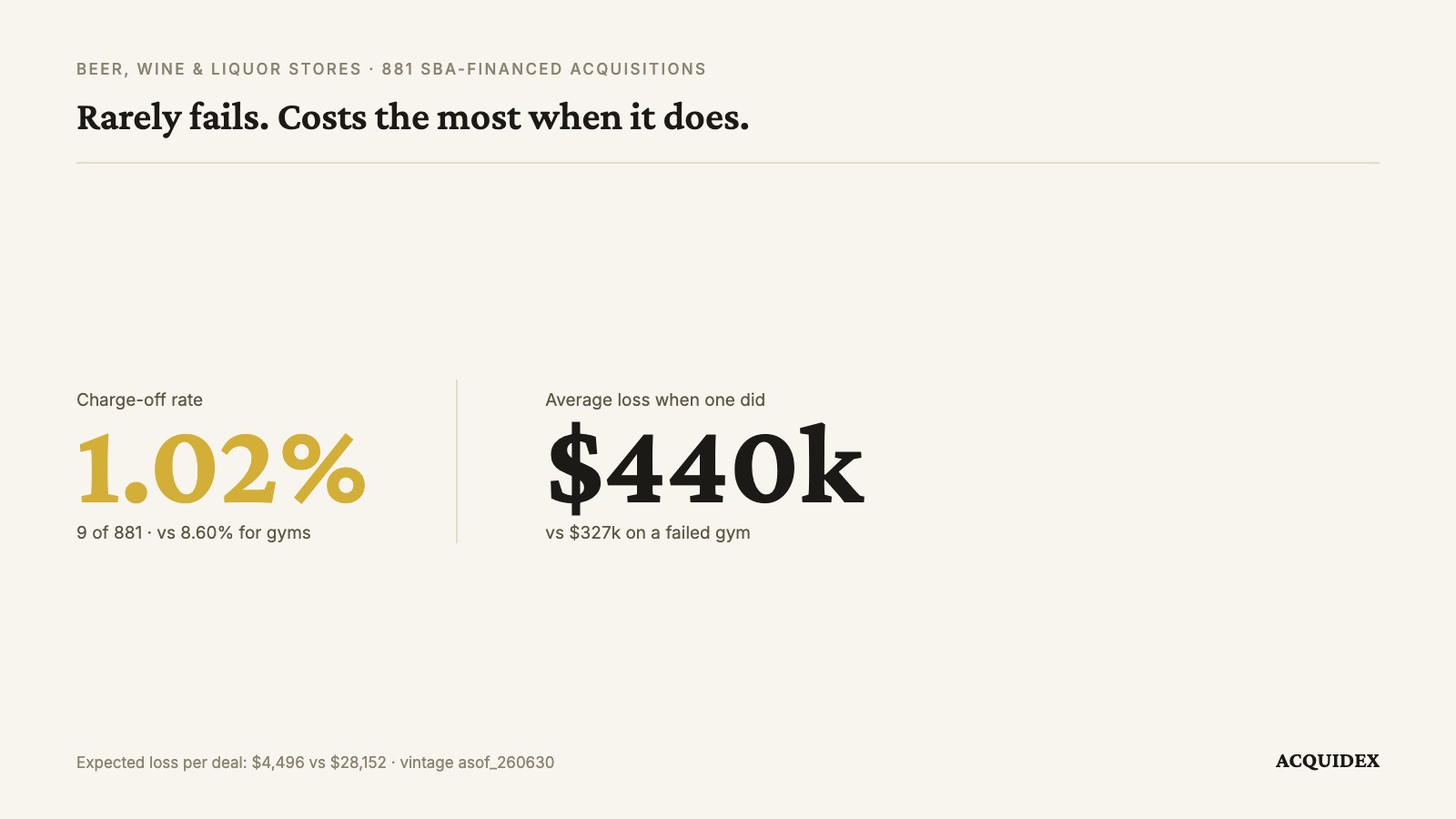
Beer, wine and liquor stores recorded a 1.02% charge-off rate across 881 SBA-financed acquisitions approved between FY2018 and FY2021, the lowest of any measurable retail category and roughly one-third the acquisition-wide average of 2.92%. The comparison that matters is against fitness centres at 8.60%: both are leased neighbourhood retail bought by similar owner-operators, and one fails about eight times less often. The offsetting finding is severity. When a liquor store loan did charge off, the average realised loss was $440,123, larger than the $327,499 average on a failed gym, because the loans themselves are larger — about $869,408 on average against $475,974 — reflecting inventory and, in many jurisdictions, licence value embedded in the purchase price. Expected loss per deal remains low at roughly $4,496 versus $28,152 for a fitness centre. Diligence should concentrate on whether the alcohol licence transfers and on what conditions, on inventory quantity and valuation at closing, on gross margin broken out by category rather than blended, and on how much revenue is thin-margin pass-through such as lottery and tobacco. A charge-off is a loan failing rather than a business closing, and this dataset covers SBA-financed acquisitions only.
Liquor stores are the most durable retail business in the SBA acquisition file.
Across 881 change-of-ownership loans approved between FY2018 and FY2021, nine charged off. That is 1.02%, against an acquisition-wide average of 2.92%.
For comparison, in the same file and the same period, fitness centres charged off at 8.60%. Same leased retail. Same neighbourhood. Roughly eight times the failure rate.
But the file contains a second number that complicates the first one, and most buyers never see it.
If they fail so rarely, why is the average loss so large?
When a liquor store acquisition loan did charge off, the average realised loss was $440,123.
That is larger than the average loss on a failed gym, which was $327,499.
The explanation is loan size. The average liquor store acquisition loan in this file was about $869,408, against $475,974 for a fitness centre — nearly double.
| Liquor stores | Fitness centres | |
|---|---|---|
| Acquisitions | 881 | 349 |
| Charged off | 9 | 30 |
| Charge-off rate | 1.02% | 8.60% |
| Average loss when one failed | $440,123 | $327,499 |
| Average loan approved | $869,408 | $475,974 |
| Expected loss per deal | $4,496 | $28,152 |
Expected loss — frequency multiplied by severity — is what actually matters, and there the gap reopens: roughly $4,500 per liquor store deal against $28,000 per gym.
Why are the loans so much bigger? Two reasons, and both are diligence targets rather than trivia: these deals carry substantial inventory, which is real and saleable, and in many jurisdictions they carry licence value, which may not be.
Why is the licence effectively the whole deal?
In most jurisdictions a retail alcohol licence does not transfer automatically when a business is sold. Transfer requires regulatory approval, and that approval is frequently discretionary rather than administrative.
In quota jurisdictions — where the number of licences is capped by population or by statute — the licence itself can represent a large share of the purchase price, because it is scarce and cannot simply be applied for.
That produces a specific and underappreciated failure mode. A buyer negotiates against financial statements, agrees a price that embeds licence value, and then discovers that transfer is conditional, delayed, or refused.
What to establish before anything else:
- Is the licence transferable at all, and does the transfer require approval from a state authority, a local authority, or both?
- What is the actual timeline? Approval measured in months changes your working capital plan.
- Is closing conditioned on approval? If it is not, you are assuming the regulatory risk personally.
- Are there outstanding violations against the licence, and do they follow the licence or the licensee?
- How much of the price is licence value, explicitly, in the allocation?
That last point matters for tax as well as for risk. The purchase price allocation is reported on IRS Form 8594, and licence value sits in a different class from inventory or equipment.
How do you verify the revenue and the margin?
Liquor retail is cash-adjacent, high-transaction-count, and relatively easy to misstate in either direction. The P&L alone is the weakest evidence available.
Reconcile three independent sources:
- Point-of-sale exports at category level — not a summary, the underlying transaction data.
- Merchant-processor statements covering the same period, which bound the card share.
- The tax returns, which bound what the seller was willing to declare.
Then add a fourth check that is unusually strong in this sector: distributor and wholesaler purchase records. In many jurisdictions alcohol purchases are separately reported and are difficult for a seller to alter after the fact. Opening inventory plus purchases minus closing inventory should reconcile to cost of goods sold. Where it does not, you have found something worth understanding before you go further.
Our general framework for this is in verifying revenue without trusting the seller.
Why is blended gross margin the wrong number?
Because the mix drives everything, and blended margin conceals the mix.
Spirits, wine and craft beer generally carry meaningfully higher margins than domestic beer. Lottery, tobacco and money-order services typically carry very thin margins while contributing real revenue and, importantly, real footfall.
Two stores with identical revenue and identical blended margin can have completely different economics. One might be a wine business with a lottery terminal attached; the other might be a lottery and tobacco counter that happens to sell beer.
Ask for margin by category across at least twenty-four months, and ask what share of revenue is pass-through. Then ask the harder question: if the lottery contract or the tobacco licence went away, what would remain?
What actually kills a liquor store deal?
- Licence transfer failing or being delayed past the point where the business can carry itself.
- Inventory that is not what it says it is. Count it, and value slow-moving stock honestly. Dusty inventory is not working capital; it is a write-down you have agreed to buy.
- A new competitor licensed nearby. Check pending applications in the trade area, not just the current competitive set. In quota jurisdictions this is a real constraint working in your favour; where licences are freely issued, it is a live threat.
- Lease and zoning. Alcohol retail is frequently subject to distance restrictions from schools, places of worship and similar. A location that is compliant today may not be re-permittable if the lease lapses.
- Shrinkage. High-value, small-format, easily concealed inventory. Ask for shrink as a percentage of sales and how it is measured.
- Concentration on a single supplier relationship or a single high-margin brand exclusivity that may not survive the sale.
How does SBA financing shape the deal?
Most of these acquisitions run through the SBA 7(a) programme, and two structural points are worth knowing.
First, inventory-heavy deals interact with working capital differently from service businesses. The inventory you are buying is collateral, but it is also cash you no longer have.
Second, as of July 4, 2026, the cumulative 7(a) and 504 limit rose to $10 million. Each programme's individual maximum remains $5 million. Given that the average liquor store acquisition loan here was already $869,408, and that many of these deals include the building, the decoupling matters more in this sector than in most: the operating company can sit on the 7(a) while the real estate sits on the 504 without the two competing for the same headroom.
What would make us underwrite one?
- Licence transfer confirmed in principle before closing, with the closing conditioned on it.
- Inventory counted and valued by someone who is not the seller, with slow-moving stock identified.
- Margin by category stable across twenty-four months, and not dependent on a single thin-margin traffic driver.
- Purchases reconciling to COGS against distributor records.
- A lease with real remaining term and no zoning fragility.
- Owner not personally load-bearing. A store that runs on staff is worth more than one that runs on the owner being behind the counter six days a week. See key person risk.
The base rate here is genuinely favourable — this is the safest measurable retail category in the file. The work is making sure the specific deal is the category, and that the licence is real.
Methodology and limits
Figures computed from the SBA 7(a) loan-level FOIA extract, public domain, published by the U.S. Small Business Administration and mirrored on data.gov. Vintage asof_260630. Beer, wine and liquor stores: 881 change-of-ownership loans approved FY2018 to FY2021, 9 charged off within five years of approval.
Nine charge-offs is a small numerator. The 1.02% rate is well-supported by 881 loans, but the $440,123 average loss rests on nine observations and should be read as directional rather than precise.
A charge-off is a loan failing, not a business failing. This is SBA-financed acquisitions only — cash and seller-financed deals are invisible here. Loan amount is not purchase price. FY2020 and FY2021 cohorts are flattered by CARES Act Section 1112, which paid six months of instalments for those borrowers.
Licensing is jurisdiction-specific. Nothing above is a substitute for advice from counsel licensed in the relevant state on that state's alcohol beverage control rules.
Analysis by Avery Hastings, CPA, founder of Acquidex.

Avery Hastings, CPA
Founder, Acquidex • CPA • Tokyo, Japan
Avery Hastings is a CPA based in Tokyo, Japan and the founder of Acquidex. She focuses on helping buyers evaluate small-business deals with clear cash-flow logic, realistic downside analysis, and practical diligence frameworks.
Keep up with Avery →Sources
Keep Reading
- How Many Small Businesses Actually Sell Each Year?7 min read read
- How Do You Choose a Quality of Earnings Provider?9 min read read
- Should a Seller Get a Sell-Side Quality of Earnings?9 min read read
- What Happens When a Quality of Earnings Report Comes In Low?10 min read read
- Should a Seller Disclose a Problem Before Listing? The Cost Asymmetry Nobody Explains7 min read read
- How to Analyze a Gym or Fitness Business Acquisition9 min read read