


Key Insight
Fitness and recreational sports centres recorded the highest charge-off rate of any sector measured across 50,942 SBA-financed business acquisitions approved between FY2018 and FY2021, at 8.60% on 349 loans against an acquisition-wide average of 2.92%. The average realised loss when one charged off was $327,499, producing an expected loss per deal of about $28,152, the highest in the dataset. The structural tension for a buyer is that gyms carry more nominal recurring revenue than almost any other small business category, in the form of memberships, autopay and annual contracts, while cancellation is close to frictionless. Diligence should therefore centre on retention measured by joining cohort rather than blended churn, on gross joins and gross cancellations tracked separately across at least twenty-four months, on how many steps stand between a member wanting to leave and having left, on whether prepaid annual memberships are recorded as deferred revenue and settled at the working capital peg, and on equipment age and remaining life. A charge-off is a loan failing rather than a business closing, and this dataset covers SBA-financed acquisitions only.
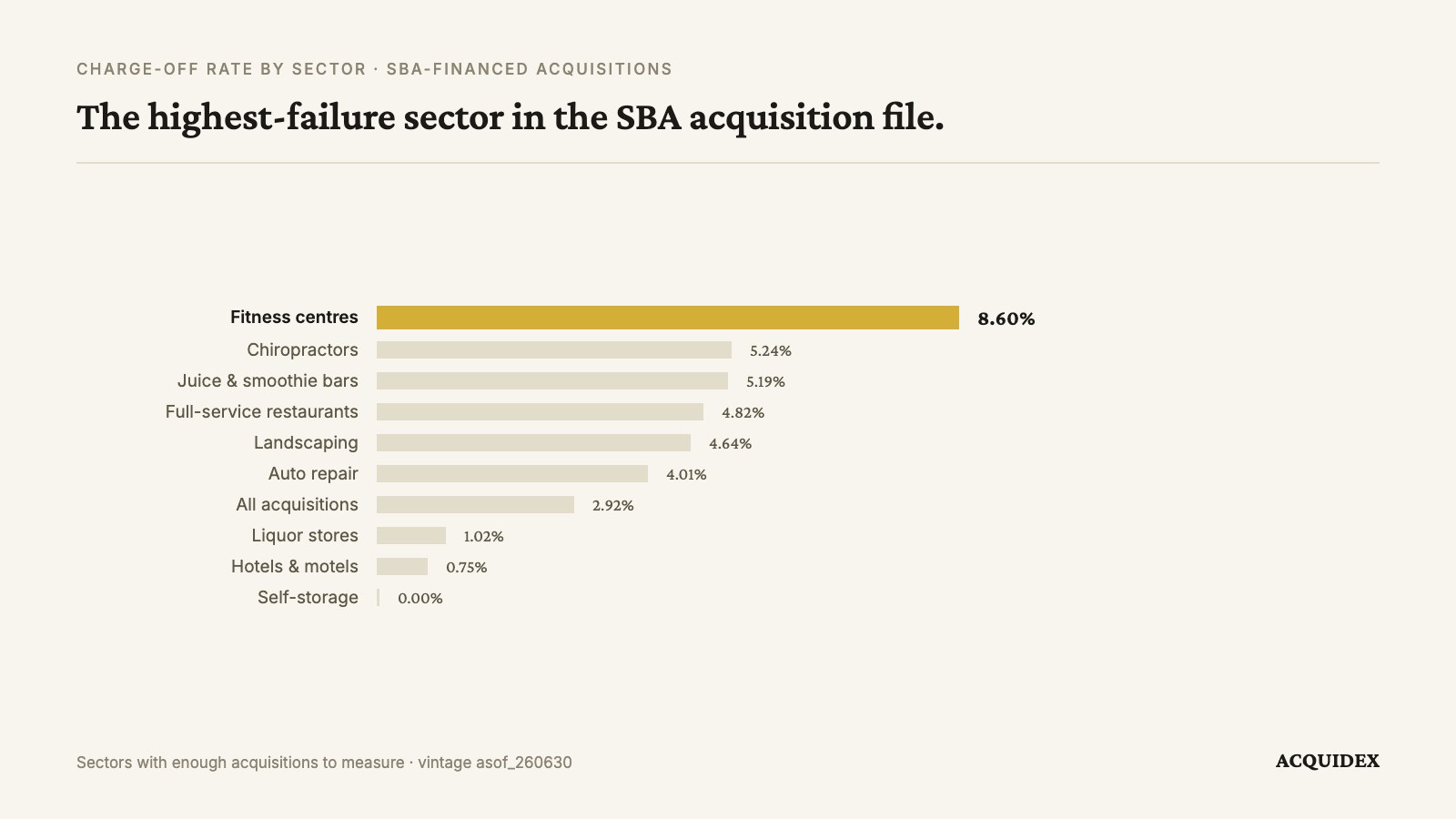
Fitness and recreational sports centres charge off at 8.60%.
That is the highest rate of any sector measurable across 50,942 SBA-financed business acquisitions approved between FY2018 and FY2021. It is roughly three times the acquisition-wide average of 2.92%, and about eleven times the rate for hotels and motels.
The average loss when one of those loans failed was $327,499. Multiply frequency by severity and the expected loss is about $28,152 per deal — again the highest in the file.
None of that means a gym cannot work. Plenty do. It means the base rate is high, and a buyer who does not price it is being optimistic rather than analytical.
Why does gym revenue look safer than it is?
A gym is about as recurring as a small business gets. Memberships. Autopay. Annual contracts with cancellation windows. Deferred revenue sitting on the balance sheet like a promise.
On a spreadsheet it is the most predictable cash flow you will ever underwrite.
The problem is what a member has to do to stop paying: usually, tap a button.
Compare that to self-storage, which is also month-to-month and which recorded zero five-year charge-offs across 133 acquisitions in the same file. Leaving a storage unit means renting a truck and giving up a Saturday. Both businesses bill monthly. Only one of them is genuinely easy to leave.
A gym membership is a promise someone makes to a future version of themselves. They buy it in January, when they are the person who is going to change. They stop going in March, when they are the person they actually are.
That is not a criticism of gyms. It is a description of the revenue, and it should change what you verify. The full analysis sits in our research piece on why gyms fail eight times more often than liquor stores.
How do you test membership retention properly?
Ask for retention by joining cohort, not a blended monthly churn figure.
A blended number hides the shape. Fitness businesses tend to show a characteristic curve: a large intake, heavy decay across the first ninety days, then a stable residue of genuine regulars who would keep coming if the sign changed.
Those two populations have completely different values to a buyer, and a blended average makes a healthy core and a leaking top look identical.
What you want to see is the January cohort's six-month retention set against the September cohort's. If they differ substantially, a meaningful share of the revenue is a resolution rather than a habit, and it will need to be re-sold every year.
Why do net member counts mislead?
Net member count is the number most sellers lead with, and it is the least informative one.
A gym holding 1,200 members can be adding 90 and losing 85 a month, or adding 15 and losing 10. The first is a marketing operation that has to keep running to stand still. The second is a business.
Ask for gross joins and gross cancellations by month for at least twenty-four months. If the seller cannot produce it, that itself is information: it means nobody has been managing to it.
What happens when a member tries to leave?
Retention offers, pause options and win-back discounts are all legitimate. Their prominence tells you how hard the business works to hold the line.
Ask directly:
- Can a member cancel online, or must they call during staffed hours?
- Is there a notice period, and is it enforced or waived on request?
- Is there a cancellation fee, and how often is it actually collected?
- How many screens, forms or conversations sit between wanting to leave and having left?
Every step in that sequence is a unit of protection. None of it appears in the financials.
What are the balance-sheet traps in a fitness deal?
Deferred revenue on prepaid annuals. Prepaid annual memberships look like cash and are, in substance, an obligation to deliver a service to someone who may already have stopped attending. Confirm how it is recorded and make sure it is settled at the working capital peg rather than treated as free money. Our post on working capital adjustments at closing covers the mechanics.
Equipment age and remaining life. Cardio equipment has a finite service life and a replacement cost that lands in lumps. Ask for the purchase date of every major unit and the maintenance history. Deferred maintenance in a fitness business is a capital expenditure schedule the seller has quietly moved onto you.
The lease. Fitness businesses are location-dependent in a way few other service businesses are. Confirm remaining term, renewal options, whether the landlord consents to assignment, and what happens to rent on renewal. A gym that has to move is usually a gym that has to start over.
Does the SBA loan structure change the maths?
It can. The SBA 7(a) programme is how most of these deals get financed, and its terms shape whether a base rate this high is survivable.
Two things matter. First, amortisation: a longer term on the business portion lowers the monthly debt service and buys margin for error, which on an 8.60% base rate is worth real money. Second, as of July 4, 2026, the cumulative 7(a) and 504 limit rose to $10 million — though each programme's individual maximum remains $5 million. For a gym acquisition without real estate, nothing changed; for one where you are also buying the building, the two programmes no longer compete for the same headroom.
What would make us underwrite one anyway?
The base rate is a starting point, not a verdict. Things that genuinely move it:
- Retention that holds across cohorts, especially outside the January intake.
- Revenue that is not purely membership — personal training, physiotherapy, childcare, or a rehabilitation referral relationship. These carry friction that a membership does not.
- A member base with tenure. Two hundred members at four years is a different asset from eight hundred at seven months.
- Owner independence. If members come for one trainer and that trainer is the seller, you are buying a client list with a lease attached. See key person risk.
- Equipment recently replaced, with documentation.
A gym that clears those is not an 8.60% business. But the burden is on the deal to demonstrate it clears them, because the category average says it probably does not.
Methodology and limits
Figures computed from the SBA 7(a) loan-level FOIA extract, public domain, published by the U.S. Small Business Administration and mirrored on data.gov. Vintage asof_260630. Fitness and recreational sports centres: 349 change-of-ownership loans approved FY2018 to FY2021, 30 charged off within five years of approval.
A charge-off is a loan failing, not a business failing. A business can close and repay its note; a loan can charge off while the doors stay open.
This is SBA-financed acquisitions only. Cash and seller-financed deals are not visible.
Loan amount is not purchase price. The file records the loan; buyers contribute equity and sellers often carry paper.
FY2020 and FY2021 cohorts are flattered by CARES Act Section 1112, which paid six months of instalments for those borrowers.
We are not claiming causation. The cancellation-friction explanation is our reading of the pattern, not a demonstrated mechanism. The rates are checkable; the explanation is an argument.
Analysis by Avery Hastings, CPA, founder of Acquidex.

Avery Hastings, CPA
Founder, Acquidex • CPA • Tokyo, Japan
Avery Hastings is a CPA based in Tokyo, Japan and the founder of Acquidex. She focuses on helping buyers evaluate small-business deals with clear cash-flow logic, realistic downside analysis, and practical diligence frameworks.
Keep up with Avery →Sources
Keep Reading
- How Many Small Businesses Actually Sell Each Year?7 min read read
- How Do You Choose a Quality of Earnings Provider?9 min read read
- Should a Seller Get a Sell-Side Quality of Earnings?9 min read read
- What Happens When a Quality of Earnings Report Comes In Low?10 min read read
- Should a Seller Disclose a Problem Before Listing? The Cost Asymmetry Nobody Explains7 min read read
- How to Analyze a Liquor Store Acquisition9 min read read