


Key Insight
Overconfident CEOs have 65% higher odds of making an acquisition than their non-overconfident peers, and the stock market prices the damage in real time: announcement returns for overconfident acquirers averaged negative 90 basis points, against negative 12 basis points for non-overconfident acquirers, a difference of 78 basis points per deal. The evidence comes from Ulrike Malmendier and Geoffrey Tate's landmark 2008 study in the Journal of Financial Economics, covering Forbes 500 companies from 1980 to 1994. The sample is large public companies only. No equivalent study exists on private-market buyers. The mechanism, that overconfident decision-makers underestimate integration difficulty and overestimate their own ability to extract value, is argued to transfer as a direction. The measurement, revealing overconfidence through option-holding behavior and press characterization of named executives, does not. Standard acquisition diligence is designed to test the target. If the buyer is the source of value destruction, a clean target file does not address that risk. What would testing the buyer actually look like?
What did Malmendier and Tate actually find?
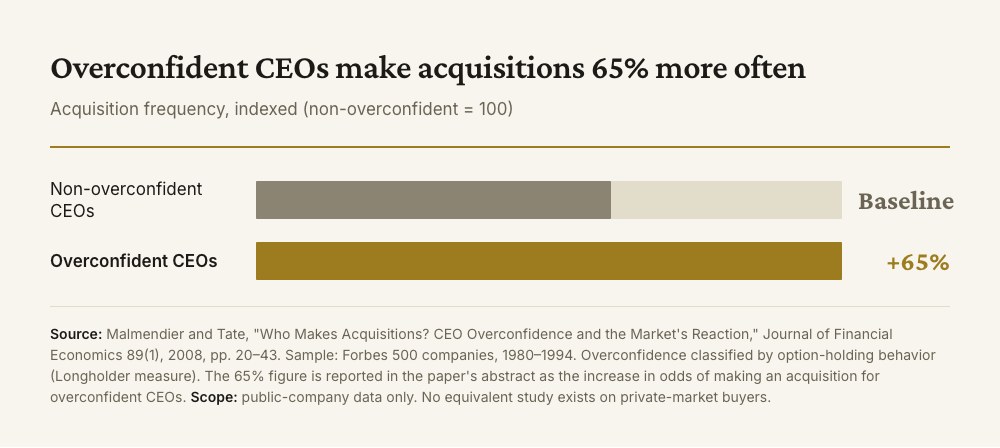
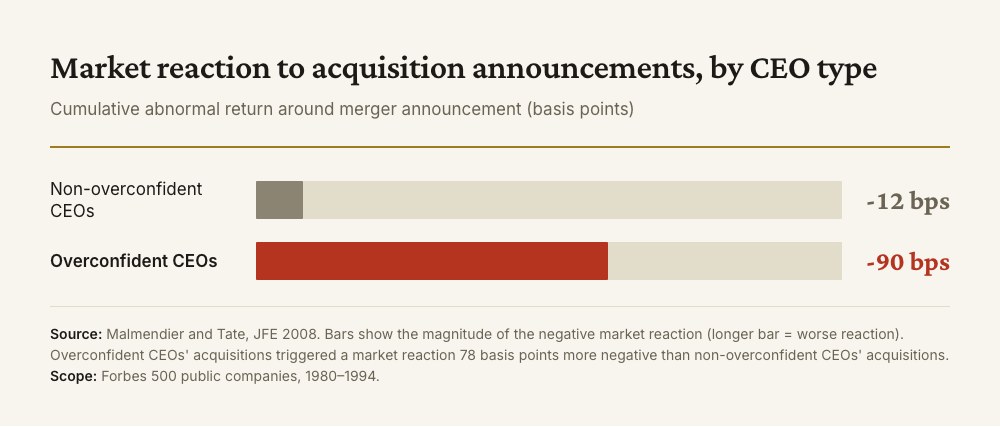
Overconfident CEOs have 65% higher odds of making an acquisition than non-overconfident CEOs, and the market reacts to their deals at negative 90 basis points versus negative 12 basis points for non-overconfident CEOs, a difference of 7.5 times.
The paper is Ulrike Malmendier and Geoffrey Tate, "Who Makes Acquisitions? CEO Overconfidence and the Market's Reaction," Journal of Financial Economics 89(1), 2008, pages 20 to 43. The sample is Forbes 500 companies from 1980 to 1994, covering 394 CEOs and 5,651 firm-years.
The central finding is stated plainly in the paper's abstract: "Overconfident CEOs over-invest and are more acquisitive. They overpay for acquisitions and undertake value-reducing mergers."
The two key magnitudes:
| Metric | Overconfident CEOs | Non-overconfident CEOs |
|---|---|---|
| Likelihood of making an acquisition | 65% higher | Baseline |
| Announcement return (CAR) | −0.90% | −0.12% |
| Difference in announcement return | −0.78 percentage points |
The 65% figure is an odds ratio from a probit model controlling for firm size, industry, year, cash flow, leverage and Tobin's Q. It is not a claim that most acquisitions are by overconfident CEOs. It is a claim that conditional on observable firm characteristics, an overconfident CEO is substantially more likely to be the one who makes the call.
The −90 basis point announcement return is a cumulative abnormal return measured over a five-day window around the deal announcement. It combines the market's assessment of overpayment, integration risk, and the information signal about the CEO's judgment embedded in the act of doing the deal.
How did the researchers measure overconfidence?
Revealed preference, not self-report. That methodological choice is the reason the paper is influential rather than merely interesting.
The primary measure works as follows. A CEO holds company stock options. Those options have a rational exercise window that finance theory can specify: when an in-the-money option reaches a certain value relative to its volatility and time to expiration, a diversification-motivated rational agent exercises. A CEO who consistently holds past that window, repeatedly, across multiple grant cycles, is demonstrably more optimistic about the company's future stock price than the option's own pricing implies.
Malmendier and Tate call this "Longholder." A CEO is classified as overconfident if they hold an in-the-money option until the final year before expiration at least once in their tenure.
"We use two measures," they write. "Longholder identifies CEOs who at least once during their tenure held an option package until expiration although it was at least 40 percent in the money entering its final year." The measure is backward-looking and revealed rather than forward-looking and stated, which removes the obvious criticism that confident people just say they are confident.
The secondary measure uses press coverage. The authors coded newspaper and magazine articles characterizing each CEO, scoring each mention as confident, optimistic, reliable, cautious, conservative, frugal, or similar. A CEO whose press characterization skewed toward the first set against the second set received the press-coverage overconfidence flag. Both measures predicted acquisition behavior in the same direction, and their correlation validated that they were capturing the same underlying trait rather than noise.
Neither measure is available for a private-market buyer in a small business acquisition. An individual searcher has no publicly traded option grants and receives no systematic press coverage. This is the fundamental measurement problem that prevents the Malmendier-Tate finding from being applied directly to ETA.
Why do overconfident executives acquire more?
The paper's proposed mechanism is that overconfident CEOs systematically overestimate the returns to their own investment decisions. Specifically, they believe the synergies from an acquisition will be larger than they are, and that they are uniquely capable of extracting those synergies after close. Both beliefs lead to the same behavior: they bid more aggressively, they bid more often, and they interpret resistance from the board or the market as incorrectness in others rather than as a signal about their own assessment.
"Overconfident CEOs believe that markets undervalue their firms," Malmendier and Tate write, describing the mechanism. "They are more willing to undertake investments, even if the funding has to come from outside investors."
The result is what the paper calls "the hubris hypothesis in a revealed-preference form." The CEO's behavior, not their statements, is the evidence. And the market prices the behavior immediately.
There is a second-order effect worth naming. Overconfident executives are more acquisitive precisely in conditions that make acquisition most dangerous: when they have access to internal cash or easy external funding. Malmendier and Tate show that the effect is stronger for firms with low leverage and high cash flow, where the CEO's ability to act on their beliefs is unconstrained. The board cannot stop what the treasury can afford.
In private-market acquisitions, the analogue is a buyer whose financing is arranged and whose earnout or seller-carry requirements are minimal. A fully funded buyer with no lender discipline is an unconstrained decision-maker in the same structural sense.
What is the scope caveat, and why does it bind tightly?
The sample is Forbes 500 large public companies from 1980 to 1994. No equivalent study exists on private-market buyers.
This constraint needs to be stated with precision rather than as a perfunctory disclaimer, because it shapes what any inference from the paper is worth.
Forbes 500 CEOs in 1980 to 1994 are:
- Named individuals with extensive documented records (option grants, press coverage, board disclosures)
- Operating firms with liquid equity markets that price their decisions in real time
- Subject to board oversight, proxy statements, and external shareholder review
- Executing acquisitions measured in nine figures or larger, where investment banks, fairness opinions, and public disclosure requirements create friction
A searcher acquiring a seven-figure manufacturing business operates in none of those conditions. There is no liquid equity market pricing the decision, no option grant series revealing time-preference, no press characterization building over a decade of coverage, and no announcement return to measure. The board, where it exists, is often constituted for and funded by the acquirer.
The mechanism, overconfident buyers underestimate integration difficulty and overestimate their ability to extract value, is argued to transfer as a direction. A self-confident buyer who believes a seller's customer relationships are more transferable than the data supports is exhibiting the same cognitive error the paper measures. The magnitude of the effect, the 65% higher acquisition probability and the 78-basis-point announcement return spread, cannot be transferred without a study of the private-market population.
Anyone claiming this paper shows that ETA buyers overpay by 90 basis points is going beyond what the evidence supports. The honest claim is narrower: there is strong evidence that overconfidence is a systematic predictor of acquisition frequency and value destruction in large public companies, and a plausible argument that the mechanism applies to private-market buyers, for which no study of comparable quality yet exists.
Does the finding survive being attacked?
Malmendier and Tate invest substantial space in the paper's robustness section, and the concerns they test are the right ones.
Is the Longholder measure capturing risk tolerance, not overconfidence?
The worry: a CEO who holds in-the-money options is not necessarily overconfident about the stock. They may simply be unusually comfortable holding concentrated exposure to their employer. That would produce the same option-holding behavior and might independently predict acquisition activity through a different channel.
The paper addresses this by testing whether Longholder predicts capital expenditures and equity issuance in the same direction. Overconfidence should make a CEO more willing to invest in all things. Risk tolerance should be neutral across investment types. The pattern of results is more consistent with overconfidence than with undifferentiated risk preference, though the authors acknowledge the measures are correlated.
Are the Longholder CEOs just the ones with genuinely good information?
An alternative reading: a CEO who holds options to expiration believes the stock will rise because they know something. If they are right more often than not, the option-holding behavior reflects private information rather than a cognitive error.
This is the cleanest rival hypothesis and the hardest to dismiss entirely. The paper's response is the press coverage measure: an independent characterization of the CEO's style that does not rely on option-holding at all. Both measures predict acquisition behavior in the same direction. An insider-information story does not cleanly explain why CEOs whose press characterizations cluster around "confident" are the same ones whose acquisitions destroy shareholder value. Inside information should improve the acquisition, not worsen it.
Is it a deal-type artifact?
Malmendier and Tate separate diversifying acquisitions, deals outside the firm's primary industry, from within-industry acquisitions. Overconfident CEOs are more likely to pursue diversifying deals, which in a large literature are on average more value-destroying than within-industry deals. Part of the value destruction may be deal-type selection rather than overpayment within deal type.
The paper finds value destruction across both types, but the magnitude is larger for diversifying acquisitions. The finding does not entirely reduce to deal-type selection. It persists within deal type, though it is stronger when deal type amplifies it.
The robustness section matters because it defines what survives. The core claim, that overconfident CEOs are more acquisitive and their deals are worse at announcement, survives multiple specifications and two independent measures. The magnitude is less certain, and the causal claim, that overconfidence causes the underperformance rather than selecting for it, rests on the quality of the measurement strategy rather than on an experiment.
What are the boundary cases?
The theory has edge cases worth naming, because the boundary is where a framework earns its credibility or loses it.
High-conviction buyers who are correct
Not all acquisitions by overconfident CEOs underperform. The announcement return is an average, and averages conceal variance. A buyer with systematically wrong beliefs about their own ability will destroy value in expectation, but any given instance may generate returns if the target is cheap enough or if the integration happens to be easy.
The Longholder measure identifies a persistent trait, not an infallible predictor of deal-by-deal outcomes. A CEO classified as overconfident who acquires a target during a market dislocation at a distressed price may produce a positive return despite the bias. The bias increases the probability of overpaying; it does not guarantee it on every transaction.
The private-market implication is that a searcher with overconfident tendencies is not necessarily doomed. The concern is systematic, across a career and across the population of buyers, not individual.
The deal where overconfidence is a feature, not a bug
Some acquisitions would not happen without a buyer who is willing to hold a more optimistic view of integration than the data strictly supports. Turnarounds, businesses in distressed industries, targets with operational problems requiring hands-on fixes: these require a buyer to believe they can do something their predecessors did not. A purely evidence-constrained buyer would not pursue them.
Malmendier and Tate's sample is large public companies in arms-length strategic acquisitions, not turnarounds. The overconfidence effect they measure is concentrated in deals where the rational expectation, given what the market knows, is not positive. That is a different situation than a value-add acquisition where the buyer's optimism is the basis of the thesis.
The distinction matters for application. An ETA buyer whose edge is operational improvement, and whose optimism is grounded in demonstrated operational skill, is not the same type of buyer the paper models. The paper models buyers whose optimism is generalized rather than domain-specific.
The overconfidence-skill confound
Entrepreneurial contexts systematically select for people with above-average confidence in their own abilities. This is necessary for the entrepreneurial act itself: someone who perfectly calibrated the probability of failure would rarely start. That selection makes overconfidence endemic to the buyer population in private markets, which cuts against cleanly separating overconfident from non-overconfident buyers the way the paper does with executive populations.
The measurement challenge, absent the option-grant and press-coverage instruments available for public company CEOs, is identifying the buyers in the overconfident tail rather than just observing that the whole population skews confident. That distinction does not have a clean solution yet.
Why can acquisition diligence not test the buyer?
Standard acquisition diligence is designed to evaluate the target. Its logic assumes a rational buyer operating on accurate self-knowledge who needs information about the object being acquired.
A quality of earnings report examines whether the target's historical earnings are real and normalized. A commercial due diligence tests whether the target's market position and customer relationships are durable. A legal review tests whether the target's contracts and liabilities are as represented. All of these are target-side instruments.
If the material source of value destruction is the buyer's own judgment, none of these instruments address it. A clean quality of earnings report on a target that a buyer is overpaying for by 30% is not evidence that the deal will succeed. It is evidence that the target's history was accurately stated. The premium to accurate history is a buyer-side variable.
This is the structural gap the Malmendier-Tate finding exposes. Diligence is not designed to test whether the person authorizing the transaction has accurate beliefs about their own ability to execute. It is designed to test the target. The framework contains no buyer-side instrument by default.
Lenders have a partial instrument: the buyer's personal financial history, prior venture outcomes, and the financial projections submitted in the loan package. A systematic pattern of optimistic projections, across multiple prior periods or prior applications, is a revealed-preference signal of the same type as option-holding behavior, though at a much coarser resolution. Whether lenders weight it as such is an open question.
Two adjacent pieces are worth reading alongside this one: the pre-LOI versus post-LOI question list, which covers what to ask and when, and the SBA loan data on buyer survival, which measures outcomes for a different buyer-side variable.
What would a buyer-side test actually look like?
Three instruments emerge from the behavioral finance literature, none of which is currently standard in private-market acquisition diligence.
Revealed-preference review of prior forecasts
The option-holding measure in Malmendier and Tate is a revealed-preference instrument because it observes behavior rather than accepting self-report. A private-market analogue is a review of prior financial projections against realized outcomes, across business ventures, employment decisions, or prior acquisitions.
A buyer who has prepared three-year projections in prior contexts, whether for lenders, investors, or their own planning, and whose actual outcomes can be compared to those projections, is generating the same kind of data the paper uses. Systematic optimistic bias, where projections consistently exceed outcomes by a directional margin, is a measurable pattern in personal financial history.
This is not currently part of lender underwriting or buyer due diligence in any standardized form. It would require a buyer to furnish prior projections alongside realized outcomes, which most buyers have not systematized and most lenders have not requested.
Structured pre-mortem
The pre-mortem is a decision-making intervention developed in cognitive psychology, associated with Gary Klein's work on naturalistic decision-making. Before a commitment is made, the decision-maker is asked to assume the decision turned out badly and to enumerate all the reasons it failed.
The intervention has been shown in controlled settings to reduce decision errors by making failure scenarios concrete rather than abstract. Overconfidence is partly a failure to weight low-probability bad outcomes at their true probability. Making those outcomes explicit before commitment shifts the reference frame.
In an acquisition context, a structured pre-mortem before Letter of Intent would ask the buyer to enumerate, in writing, every specific reason the deal could fail in the first 24 months. The quality of that enumeration is observable. A buyer who produces two generic answers, "the market could change" and "integration could be harder than expected," is not engaging the exercise. A buyer who produces twelve specific answers naming customer names, key-person risks, supplier relationship assumptions, and capital requirements under pessimistic scenarios has demonstrated the capacity to model failure.
This is low-cost, requires no external data, and produces an observable output. It is not currently standard practice.
Reference checking the buyer
Target reference checks are standard. Buyer reference checks are essentially absent from private-market diligence.
For a seller evaluating whether to accept a given buyer, a reference check with prior counterparties, sellers who transacted with this buyer before, investors who have evaluated their plans, or employers whose operational context the buyer is claiming relevant experience from, is informative about exactly the right variable. Did post-acquisition execution match pre-close expectations? Did the buyer's projections for the business materialize? Did they demonstrate the operational capabilities they represented?
A seller who accepts an earnout or seller carry has a direct economic interest in the buyer's accuracy. That seller has information about buyer reliability that no target due diligence process generates.
The obstacle is that buyers control their own reference universe in the same way employees do, and there is no neutral database of acquisition outcomes linked to buyer identities in private markets. Building such a database is not a near-term solution. Requesting references from prior counterparties the buyer did not select is the practical version, and it requires sellers to ask for it.
How does this interact with the financing structure?
Malmendier and Tate find that the overconfidence effect is amplified when the CEO has access to abundant internal cash. The board cannot stop what the treasury can afford. In private acquisitions, SBA lending and seller carry create a different dynamic: a buyer with high leverage is disciplined by the lender's underwriting standards, which function as a partial check on optimistic projections.
The credit discipline is not a complete substitute for buyer-side assessment, because lender underwriting is itself based on the buyer's stated projections, historical earnings, and the appraised value of the target. If the buyer's projections are systematically optimistic, the lender is calibrating against a biased input.
Where SBA 7(a) underwriting requires a minimum debt-service coverage ratio, the effective check is on the downside of the target's historical earnings rather than on the buyer's future projections. A deal that clears coverage on trailing earnings and relies on buyer-driven growth to service the full debt stack is underwritten on optimism, regardless of how it is presented.
The interaction between buyer overconfidence and deal structure is an area where the Malmendier-Tate mechanism predicts behavior, but where no study has tested it in private markets. That is a gap worth naming rather than filling with inference.
What are the full limitations of this evidence?
The paper is strong within its sample. Its boundaries matter for any application outside that sample.
Sample scope. Forbes 500 companies, 1980 to 1994. Large public corporations only. No equivalent study exists on private-market buyers. The mechanism is argued to transfer; the measurement does not. This is not a minor caveat. It is the binding constraint on what any practitioner can take from this paper and apply to an individual deal.
Historical period. 1980 to 1994 predates modern private equity, post-Sarbanes-Oxley governance reforms, and the emergence of ETA as a distinct acquisition category. Norms around deal process, diligence, and board oversight have changed. The direction of the effect likely persists; the magnitude may differ.
Measurement availability. Option-holding and press characterization are not available for private buyers. Any proxy measure in private markets will be coarser, less standardized, and not validated against the outcome data the paper uses.
Announcement return as the outcome measure. The paper measures value destruction at the announcement window, which is the market's immediate assessment of the deal. Post-close performance, which is what a private-market buyer actually experiences, is a different measure. Announcement returns and long-run operating performance are correlated in the literature but not identical. A deal the market prices as bad at announcement sometimes performs acceptably; a deal the market accepts sometimes underperforms.
No private-market equivalent. This limitation bears repeating because it is the one most likely to be minimized in application. The absence of an equivalent study on private-market buyers is not a gap the Malmendier-Tate paper can fill by extension. It is a gap in the literature.
What would make it stronger for private markets. A study linking self-reported or behaviorally measured buyer overconfidence in ETA or search-fund acquisitions to post-close DSCR or business survival, run across a population large enough to support the same regression specifications Malmendier and Tate use, would directly answer the question this paper can only approximate. No such study exists at the time of writing.
What should advisers and lenders take from this?
The Malmendier-Tate finding does not change deal mechanics. It identifies a variable, buyer overconfidence, that is currently unmeasured in private-market acquisition diligence, for which the academic evidence in a large-company context suggests it is a systematic predictor of value destruction.
For advisers working with buyers, the practical output is three questions added to pre-LOI conversation.
First: can you recall a project or venture where your outcome projections materially exceeded realized results? What was the cause, and what did you update? This is not asking whether the buyer has failed. It is asking whether they have updated from failure. Updating is what distinguishes productive optimism from overconfidence in the sense the paper models.
Second: if this deal goes badly, what specifically goes wrong first? The specificity of the answer is informative. A buyer who answers with named customers, named key employees, specific margin assumptions, and particular integration timing has modeled failure in a way that suggests their projections incorporate downside. A buyer who answers with generalities has not.
Third: who can we speak with about how your prior investment projections compared to realized outcomes? The question tests whether a revealed-preference check is possible.
For lenders, the underwriting implication is narrow but real. Where the debt-service case relies materially on post-acquisition growth in excess of the target's historical rate, the lender is underwriting on the buyer's projected improvement rather than on the target's historical performance. That buyer-driven portion of the underwriting case is the slice most exposed to overconfidence risk. Sizing the buyer-driven component explicitly, and testing it against the buyer's prior projection track record where that record exists, is a partial substitution for the buyer-side instrument the paper uses.
Neither of these is a validated protocol. They are the practical translation of an academic finding into private-market context, and they are offered as hypotheses rather than as established practice.
What question does diligence currently not ask?
Standard diligence asks whether the target is what it appears to be. It asks that question thoroughly and with considerable sophistication: earnings quality, customer concentration, key-person risk, legal exposure, environmental liability, working-capital normalization.
It does not ask whether the buyer's beliefs about the target, and about their own ability to operate it, are calibrated.
The Malmendier-Tate paper suggests that second question is not frivolous. In a large-company context, with the best available instruments for measuring it, it is a statistically significant predictor of announcement returns, with a directional effect of more than five times the magnitude for overconfident versus non-overconfident buyers.
The honest version of the limitation is that testing the buyer in private markets is hard, the instruments are coarse, and no validated protocol exists. The honest version of what remains is that "hard and unvalidated" is not the same as "not worth attempting."
Standard diligence assumes the buyer is not the risk. That assumption has not been tested in private markets at the scale it has been tested in public markets. It may be right. The question is open.
Sources
Ulrike Malmendier and Geoffrey Tate, "Who Makes Acquisitions? CEO Overconfidence and the Market's Reaction," Journal of Financial Economics 89(1), January 2008, pages 20 to 43. Published by Elsevier. The figures on this page were read from the published paper text on 5 September 2026.
Sample: Forbes 500 companies, 1980 to 1994. 394 CEOs. 5,651 firm-years.
The key magnitudes reported here: 65% higher likelihood of acquisition for overconfident CEOs (odds ratio, probit specification); cumulative abnormal return of −0.90% for overconfident acquirers against −0.12% for non-overconfident acquirers (five-day window around announcement). Both figures are from the paper's main results section.
One honest caveat, stated here rather than buried: the sample is Forbes 500 large public companies. No equivalent study exists on private-market buyers. The mechanism is argued to transfer; the measurement does not. Any application of this finding to small business acquisitions is a direction argument, not a calibrated estimate.
Author: Avery Hastings, CPA. This is analysis of published research, not a report of engagements conducted by the author.

Avery Hastings, CPA
Founder, Acquidex • CPA • Tokyo, Japan
Avery Hastings is a CPA based in Tokyo, Japan and the founder of Acquidex. She focuses on helping buyers evaluate small-business deals with clear cash-flow logic, realistic downside analysis, and practical diligence frameworks.
Keep up with Avery →Sources
Keep Reading
- The Silver Tsunami Is Ageing, Not Arriving45 min read read
Seven annual Census readings show no surge of sellers building. The share of owners aged 55 or over barely moved. The share past 65 is creeping up — and those owners are already leaving, at about 8% a year.
- The Formation Boom Is Real. The Pipeline Inside It Is Shrinking.13 min read
Business applications just hit a June record — but the share that becomes an employer business you can actually buy has fallen to the lowest level on record, and it's rotating hard by sector.
- Why Most Small Businesses Close Instead of Selling: 104 Industries, Ranked26 min read read
A roadside motel will sell. A law practice records thirteen times the closures per sale. Census data on 104 industries shows the difference is not profit, size, or how well the business was run.
- Why Does Walking Away Get Harder After the LOI?13 min read read
A deal's structure adds commitment on a schedule while diligence is supposed to keep the decision open. What fifty years of research says about that tension, new evidence from actual acquisitions, and where the evidence stops.