

Key Insight
An SBA line of credit is approved and then sits there until the owner decides to use it, which makes the timing of the first draw a choice the owner made without anyone watching. Across 114,756 SBA 7(a) credit lines approved from FY2010 to FY2017 and since paid off or charged off, lines first drawn within seven days of approval failed to repay 7.9% of the time. Lines first drawn 120 days or more after approval failed 3.5% of the time, more than twice the gap, and every step of delay in between lowered the rate. The pattern held in every approval year, every line size, every month and every industry examined. The most likely reading is that an early draw reveals a business whose cash was already tight when the line opened. That is an interpretation, not a proven cause, and plenty of early draws are planned: seasonal inventory, a known equipment purchase, a line opened for a specific job. The practical test is whether the stated reason matches the timing. The signal does not carry over to ordinary term loans, which usually fund when a deal closes rather than when the owner chooses.
The short answer: an early draw on a new SBA credit line is associated with more than twice the failure rate of a line left alone for months. Treat it as a question, not a verdict. Ask what the money was for, and check that the answer fits the date.
Why is the first draw on a credit line different from a term loan?
Because on a credit line, the owner picks the moment.
A term loan works like a mortgage. It is approved for a specific purpose, usually buying a business, a building or equipment, and the money goes out when that deal closes. The borrower rarely controls the date. The seller, the lender and the closing schedule do.
A revolving line of credit works like a safety net. The lender approves a limit, and then nothing happens until the owner decides to draw on it. Some owners use it the same afternoon. Some leave it untouched for months. Some barely use it at all.
That makes the first draw unusually informative. It is one of the few things in a loan file that the borrower did not prepare for an audience. Nobody tells an owner that the date they first touch their line is being watched. It just gets recorded.
How much more often do fast drawers default?
More than twice as often, and the relationship runs in a straight line. Every extra stretch of patience comes with a lower failure rate.
| First drew on the line | Lines | Failed to repay |
|---|---|---|
| Within a week of approval | 45,081 | 7.9% |
| 8 to 30 days | 22,512 | 7.3% |
| 31 to 60 days | 13,947 | 6.7% |
| 61 to 119 days | 11,566 | 5.2% |
| 120 days or more | 21,650 | 3.5% |
Most owners draw fast. 39% tapped their line within a week, and half had touched it within 17 days. The difference shows up even inside that first week: lines drawn the same day they were approved failed at 8.1%, against 7.3% for lines first drawn a few days later.
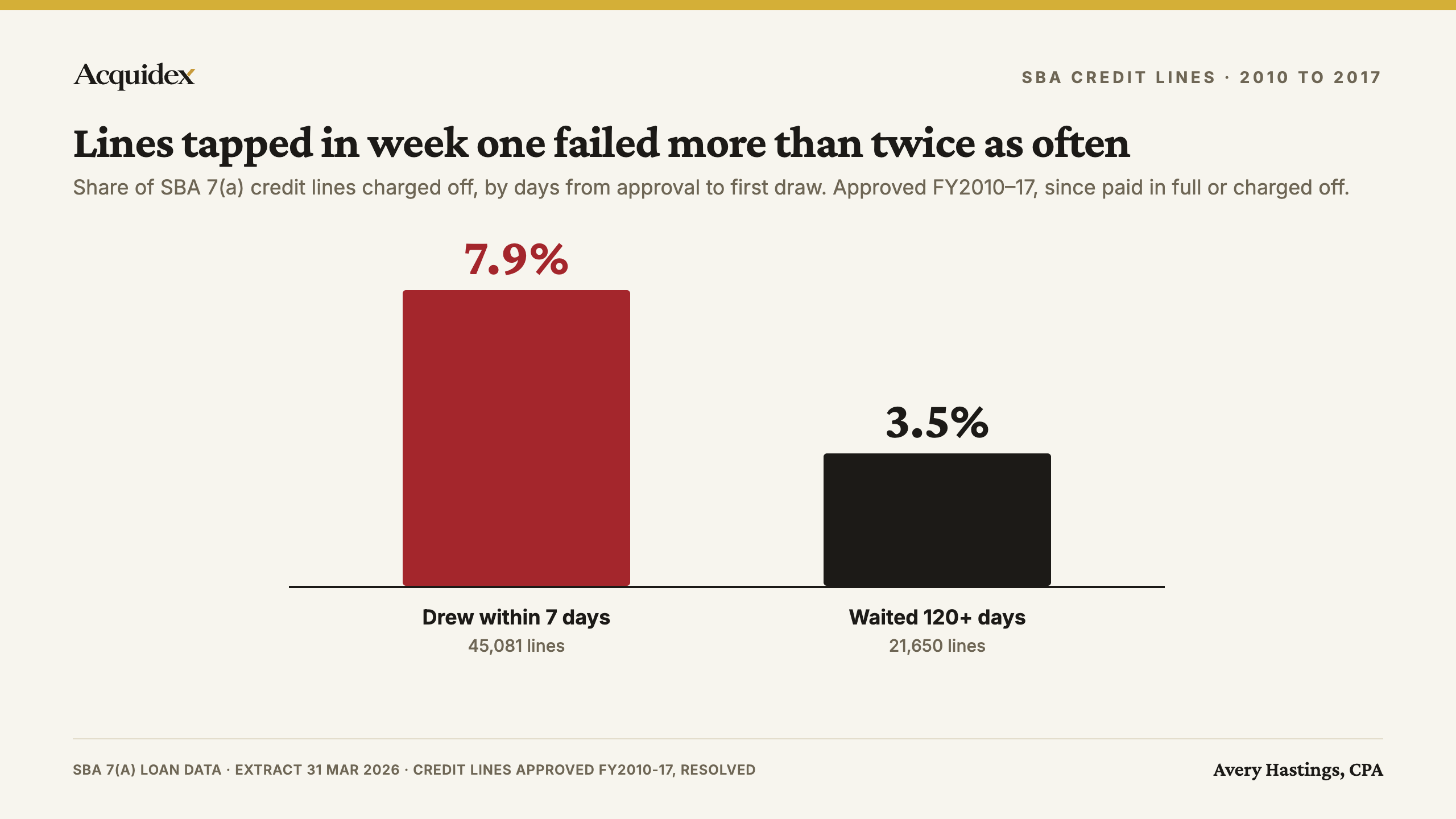
The obvious objections were tested and did not explain it. The pattern held in every approval year from 2010 to 2017, at every line size from under $25,000 to over $250,000, in all twelve months, and in every industry sector examined. It was not a head start for late drawers: measured over a fixed five years from the first draw, the gap was unchanged. And it was not that patient owners barely used their lines: among lines that failed, both groups had used around 94% of the limit. The full set of checks is in the research behind this post.
Does the size of the line change the picture?
A little. Smaller lines fail more often in both groups, but the gap between fast and slow drawers shows up at every size.
| Line size | Tapped within a week | Left alone 4+ months |
|---|---|---|
| Under $25,000 | 9.3% | 4.6% |
| $25,000 to $50,000 | 8.3% | 3.0% |
| $50,000 to $100,000 | 7.1% | 2.7% |
| $100,000 to $250,000 | 5.2% | 1.7% |
| Over $250,000 | 4.0% | 2.5% |
For most small businesses, the ones with lines under $250,000, a fast draw came with roughly two to three times the failure rate. The gap narrows for the biggest lines, which tend to go to larger, more established businesses that often open a line well before they need it. For a buyer looking at a typical owner-operated business, the smaller-line numbers are the ones that apply.
Why would drawing early predict default?
The most likely answer is simple. A credit line is built for the bad month: the slow season, the late receivable, the surprise repair. If a business needs it in the first week, the bad month had usually already arrived.
That matters because the line was underwritten on financial statements that describe the past. By the time the line opens, those statements may no longer reflect how much cash the business actually has. An owner who draws on day one is often telling you, without meaning to, that the account was thinner than the financials made it look.
It is worth being clear about what this does not mean. Waiting does not make a business safer. A credit line does not become less risky because it sat unused for a few months. The more likely story is that both the timing and the outcome come from the same underlying thing: how much room the business had to breathe on the day the line opened. The draw date is a clue to that, not a cause of anything.
The same logic explains why the signal disappears on ordinary term loans. When the owner does not choose the timing, the timing cannot reveal anything about the owner. On SBA term loans of seven years or less, loans funded within a week and loans funded after four months failed at almost the same rate.
When is an early draw perfectly normal?
Often. A fast first draw has plenty of innocent explanations, and treating every one as distress will cost you good deals.
Seasonal businesses draw on schedule. A landscaper that opens a line in February to buy spring inventory is doing exactly what a well-run seasonal business should. The data shows the seasonal pull too: 45% of credit lines approved in January were drawn within a week, against 36% of those approved in May.
Planned purchases often come first. Some owners open a line specifically to fund a known equipment order or a contract that starts next week.
Working capital for growth can be a good reason. A business that has just landed a large customer may need to fund inventory or payroll before the first invoice is paid.
What separates these from a warning sign is that the story fits the date, and the documents back it up. A planned inventory purchase has a purchase order behind it. A new contract has a signed agreement. An explanation that arrives without the paperwork, or changes when you ask a follow-up, is a different finding.
What should a buyer ask about a seller's credit line?
Ask early, ask neutrally, and ask for the documents alongside the answer.
- When was the line approved, and when did you first draw on it? Confirm against the loan documents and, for SBA lines, the public FOIA data.
- What was the first draw for? Look for a purchase order, a contract or an invoice that matches the date.
- How much of the line is drawn today, and how has that moved over the last twelve months? A line that is always near its limit is working as permanent capital, not a safety net.
- Has the line ever been renewed, increased or reduced? Ask why, and who asked for it.
- Will the line survive the sale? Most lines are tied to the current owner and lender, so plan for the working capital the business will need without it.
The timing question is only one input. It sits alongside the rest of the red flags buyers screen for. If the seller's records are hard to get, the public SBA data can fill the gap: how to look up a business's SBA loan history walks through it step by step.
What should a borrower take from this?
Check your own urgency.
If you are opening a credit line and already know you will need it next week, that is worth sitting with. The line was built for a bad month, not for the first month. Needing it immediately usually means the underlying cash problem is still there, and a credit line will fund it for a while without fixing it.
That is especially true if you are buying a business. An acquisition loan is sized on what the business earns, and lenders test whether it covers the debt; see the debt service coverage SBA lenders actually require. If the deal only works with the credit line drawn from day one, the deal may be tighter than the coverage ratio suggests.
What should lenders take from this?
That a free signal is sitting in every servicing system.
Every lender holds both dates for every line it has made. The interval requires no new data collection, no bureau pull and no questionnaire. It is produced by the borrower without awareness that it is informative, which makes it hard to game.
Whether it adds predictive value beyond a lender's existing models is something each lender can test on its own book. The public data suggests it is worth the afternoon it would take to find out.

Avery Hastings, CPA
Founder, Acquidex • CPA • Tokyo, Japan
Avery Hastings is a CPA based in Tokyo, Japan and the founder of Acquidex. She focuses on helping buyers evaluate small-business deals with clear cash-flow logic, realistic downside analysis, and practical diligence frameworks.
Keep up with Avery →Sources
No external sources are cited in this article.
Keep Reading
- Do SBA Loans Approved in September Default More Often?7 min read read
- The $10 Million SBA Limit: What It Buys, and What It Doesn't11 min read read
- What Is a Cash Proof? The SBA Test That Reconciles Your Bank Statements12 min read read
- SOP 50 10 8.1: The New SBA Rules for Buying a Business (October 1, 2026)13 min read read
- SBA 504 Loans for Buying a Business: How They Work (and How They Differ from 7(a))10 min read read
- What to Do When Your Acquisition Deal Misses DSCR (Recovery Structures)11 min read read