

Key Insight
The SBA publishes loan-level records for every 7(a) and 504 loan approved since fiscal year 1991, free, at data.sba.gov under "7(a) & 504 FOIA." The 7(a) data comes in four files split by fiscal-year range and is updated quarterly. Each record shows the borrower's legal name and address, the lender, the amount approved, the approval date, the first disbursement date, whether the loan is a revolving line of credit, and its status, including whether it was paid in full or charged off. To check an acquisition target, download the file for the years that matter and search the borrower name and zip code columns for the business's legal entity. Three findings are worth raising with a seller: an SBA loan that was not disclosed, a prior loan that was charged off, and a credit line that was first drawn within about a week of approval. Across 114,756 SBA credit lines approved from 2010 to 2017, lines drawn that fast failed to repay at 7.9%, against 3.5% for lines left untouched for four months or more. None of these findings is a verdict on its own. Each is a question to ask before the LOI, with the documents in front of you.
The short answer: go to data.sba.gov, find "7(a) & 504 FOIA," download the 7(a) file for the right years, and search the seller's legal name and zip code. Look for undisclosed loans, anything marked CHGOFF, and credit lines tapped in the first week. Then ask the seller about what you find.
Can you look up whether a business has an SBA loan?
Yes, and it takes about fifteen minutes. The SBA releases its loan records under the Freedom of Information Act, and the release is not a summary. It is one row per loan, with the borrower named.
That surprises most buyers. They assume loan records are private, the way a personal credit report is. For SBA-backed loans, the government is the guarantor, and the loans are published so the public can see where the guarantee went.
For a buyer, that means a seller's SBA borrowing history is sitting in a public spreadsheet. It will not tell you everything about the business. It will tell you whether the business has borrowed with an SBA guarantee, how much, when, what kind of loan it was, and how the loan ended.
Where is the SBA's loan data, and which file do you need?
The data lives at data.sba.gov, on the page titled "7(a) & 504 FOIA." The SBA describes it as loan-level data on all 7(a) and 504 loans approved since fiscal year 1991.
The 7(a) records are split into four downloadable files by the fiscal year the loan was approved:
| File | Covers loans approved in |
|---|---|
| FOIA 7(a), FY1991 to FY1999 | October 1990 to September 1999 |
| FOIA 7(a), FY2000 to FY2009 | October 1999 to September 2009 |
| FOIA 7(a), FY2010 to FY2019 | October 2009 to September 2019 |
| FOIA 7(a), FY2020 to present | October 2019 onward |
The SBA's fiscal year starts in October, so a loan approved in November 2019 sits in the FY2020 file, not the FY2010 to FY2019 one. For most acquisitions, the two most recent files cover everything that matters. The 504 program, which funds real estate and heavy equipment, has its own files on the same page.
The page also links a data dictionary. Download it. It defines every column and every status code, and it is the authority if anything in this guide differs from what the SBA says.
How do you search the file for a specific business?
Most of these files open in a normal spreadsheet. The FY2010 to FY2019 file has roughly 546,000 rows, comfortably inside the roughly one million rows a modern spreadsheet can hold. Check the size of the FY2020 to present file before opening it the same way.
Then search in this order:
- Filter on the zip code in the
borrzipcolumn first. It cuts the file to a few hundred or a few thousand rows. - Search the legal name in the
borrnamecolumn within those rows. Use the legal entity from the purchase agreement or the secretary of state filing, not the trading name on the sign. "Main Street Plumbing" may have borrowed as "MSP Holdings LLC." - Try variations. With and without LLC, Inc or Corp. With and without "The." Abbreviations the owner might have used.
- Check the address in the
borrstreetandborrcitycolumns to confirm you have the right business. - Look for more than one row. Businesses often have several SBA loans: an acquisition loan, a later credit line, an equipment loan.
If nothing comes back, that is useful too, as long as you searched the right entity. It suggests the business has not borrowed with an SBA guarantee in those years.
What should you look for once you find a loan?
Three things are worth a question to the seller. Everything else is context.
- A loan the seller didn't mention. Compare what you find against the debt schedule you were given. An undisclosed SBA loan is either an oversight or a signal about the rest of the disclosures, and you want to know which.
- An old loan that went bad. A status of
CHGOFFmeans the lender wrote the loan off as a loss. Ask what happened, and whether it was this business, this owner, or someone else with the same name. - A credit line tapped in the first week. Where
revolverstatusshows a line of credit, subtractapprovaldatefromfirstdisbursementdate. A first draw within about seven days is worth asking about. - An amount that doesn't match. If
grossapprovaldiffers from what the seller told you, find out why. - A long gap on a long loan. On loans with
terminmonthsabove 180, a long delay between approval and first funding can mean a project that stalled.
The credit-line check is the one most buyers have never heard of, and it is the one with the strongest evidence behind it. An SBA credit line is approved and then sits there until the owner decides to use it. Across 114,756 SBA credit lines approved from 2010 to 2017, lines first drawn within a week of approval failed to repay 7.9% of the time. Lines left untouched for four months or more failed 3.5% of the time. The full analysis, including the controls it survived, is in Do Marshmallows Predict Bad Loans?
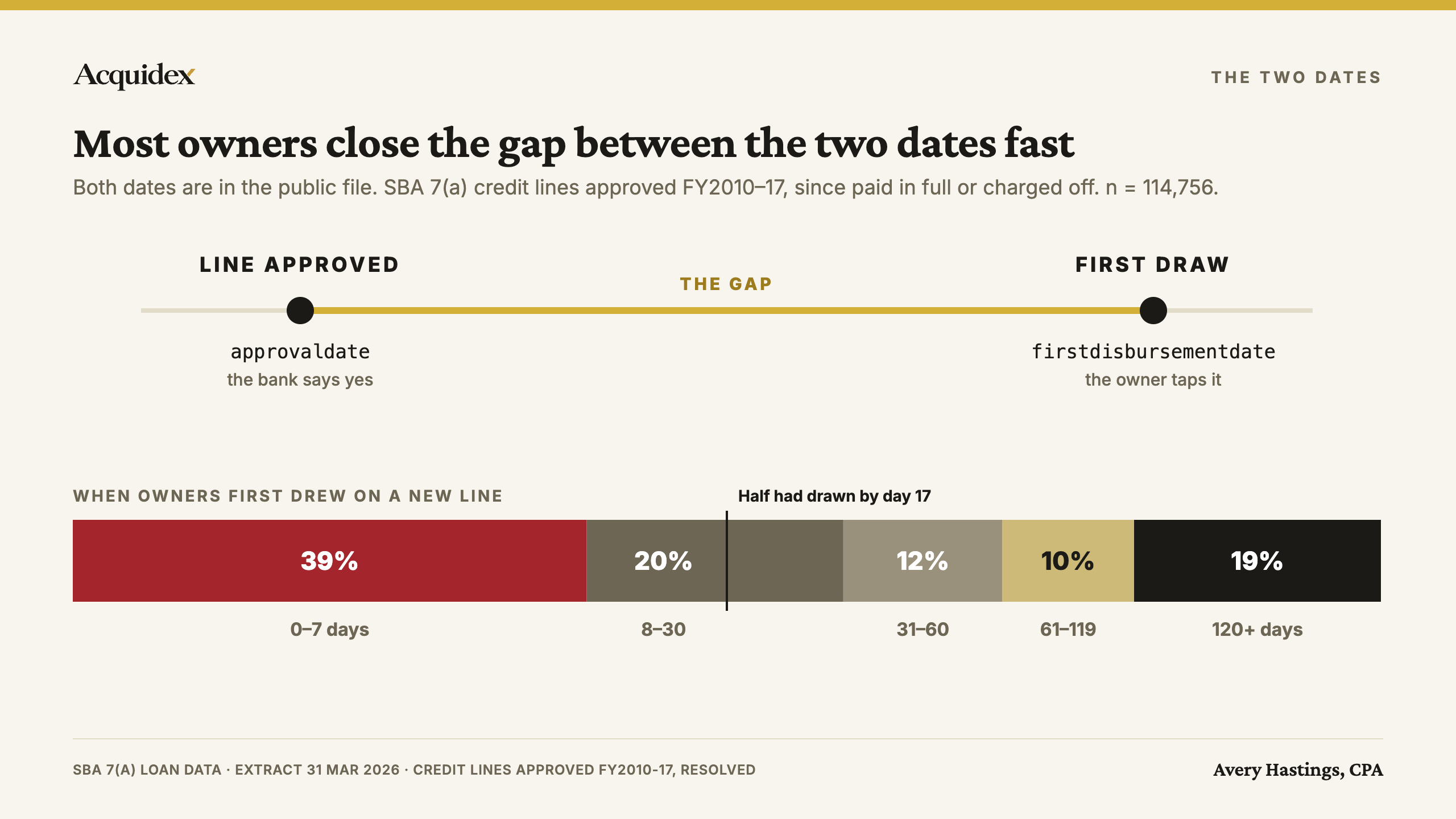
A fast draw does not mean the business is failing. Seasonal businesses often draw on schedule, and some owners open a line specifically to fund a known purchase. The point is to ask what the money was for, and to see whether the answer matches the timing. More on reading that answer is in what it means when a business draws its SBA credit line right away.
What do the loan status codes mean?
The loanstatus column uses short codes. The ones that matter most for a buyer:
| Code | Meaning | What it tells you |
|---|---|---|
P I F | Paid in full | The loan was repaid. Note the spaces; a search for "PIF" will miss it. |
CHGOFF | Charged off | The lender wrote the loan off as a loss. The clearest sign a loan failed. |
CANCLD | Cancelled | The loan was approved but cancelled before it was used. |
Other codes flag loans that are still open, in trouble, or in the SBA's recovery process. The data dictionary on the same page defines each one, and it is worth reading before you draw a conclusion from any code outside these three.
What can the file not tell you?
A clean result is not a clean bill of health. The file has real limits, and a buyer who knows them uses it better.
It only covers SBA-backed borrowing. Conventional bank loans, equipment finance, merchant cash advances and seller notes do not appear. A business with no SBA record can still carry plenty of debt, which is why hidden liabilities deserve their own review.
It does not show balances over time. You can see the amount approved and how the loan ended, not how much was owed last month.
Name matches can be wrong. Common business names return unrelated borrowers, and a charge-off under a similar name may belong to someone else entirely. Confirm with the address, then confirm with the seller.
Records can be restated between quarterly releases. If a finding matters to a deal, note the date of the extract you used.
And it says nothing on its own about why. A charged-off loan from 2012 may have belonged to a previous owner, or failed for reasons the business has since fixed.
Should you look up more than one name?
Usually, yes. Small businesses often borrow under an entity other than the one you think you are buying.
A business may have borrowed under a holding company that owns the operating company, or under a previous legal name before a rebrand. If the business moved, older loans will sit under an old address and zip code. And an owner who bought the business may have taken the acquisition loan through a new entity created for the purchase.
The secretary of state filing for the target usually lists prior names and related entities, and the purchase documents will name the entity actually being sold. Search each one. Then keep the search tied to the business and its entities; the point is to understand the company's borrowing, not to profile the people behind it.
How do you raise what you find with the seller?
As a question, early, with the record in hand. Before the LOI is the right moment, while asking is cheap and nobody is defensive yet. It belongs on the same list as the other questions to ask before buying a business.
Keep it neutral. "I noticed an SBA line of credit approved in March 2016 in the public data. Can you walk me through what it was for and how it was used?" gives an honest seller an easy opening and gives you a clean read on how they handle a direct question.
Then watch what happens. Documentation that arrives before the explanation is a good sign. An explanation that keeps changing, and documentation that never quite arrives, is a different kind of finding, and it matters more than the loan itself. The same logic runs through every red flag that can kill a deal.

Avery Hastings, CPA
Founder, Acquidex • CPA • Tokyo, Japan
Avery Hastings is a CPA based in Tokyo, Japan and the founder of Acquidex. She focuses on helping buyers evaluate small-business deals with clear cash-flow logic, realistic downside analysis, and practical diligence frameworks.
Keep up with Avery →Sources
Keep Reading
- Who Actually Steals From Small Businesses, and Why It Matters When You Buy One8 min read read
- Customer Contracts in an Acquisition: The Four Clauses That Decide What They're Worth14 min read read
- When Did the Owner Last Take Three Weeks Off? The Cheapest Diligence Question There Is7 min read read
- Who Does the Customer Call at 7pm? The Relationship Map Most Buyers Skip8 min read read
- How to Verify a Seller's Growth Story: Four Checks, and the One That Killed Mine15 min read read
- Financial Due Diligence: The Complete Guide for SMB and Lower-Middle-Market Acquisitions13 min read read