


Key Insight
In Axial's Dead Deal Reports, a diligence finding was the reason in 35 of 75 broken LOIs in 2025 (46.7%), up from 14 of 47 in 2023 (29.8%). These are shares of lower middle market deals that broke, not a failure rate.
People who had reached a preliminary decision preferred information that supported it, more so when it arrived one piece at a time than all at once (Jonas, Schulz-Hardt, Frey and Thelen, 2001).
In stock mergers with a fixed exchange ratio, acquirers whose deals ended up costing more were less likely to divest the business later: an interquartile increase in cost went with an 8 to 9 percent lower divestiture rate (Guenzel, Journal of Finance, 2025).
The short answer: after the LOI, a deal's structure adds commitment on a schedule. The call has been made, money and months are being spent, findings arrive one at a time, and the closing date gets closer. Research on escalation of commitment suggests each of these can make it harder for new information to change the decision. None of it says which deals should close, and none of it was tested on small-business acquisitions.
What changes after the LOI?
Before the letter of intent, a buyer is deciding whether to buy.
After it, the work changes. There's usually a lawyer to engage and a closing date to hold, and often a quality of earnings firm to hire and a lender to satisfy. More and more, the buyer is working toward closing something they have already chosen.
Diligence is meant to keep one question open the whole way through: knowing what I know now, would I still do this?
That tension is what this piece is about. It isn't about bad buyers or careless deals. A transaction is built in a way that steadily increases commitment, at the same time as diligence is supposed to stay capable of changing the decision.
Research from the last fifty years helps explain why that can get harder after the LOI. None of it proves that any particular deal should close or die. It's worth knowing anyway, because the pressures it describes arrive on a schedule, and the schedule is the deal.
How often do deals die after the LOI?
Plenty of deals do stop after the LOI, and more of them are stopping over what diligence finds. Axial publishes a yearly Dead Deal Report on the signed LOIs on its platform that fell apart, and why.
| Broken LOIs, by reason | 2023 | 2024 | 2025 |
|---|---|---|---|
| Broken LOIs analyzed | 47 | 65 | 75 |
| Quality of earnings discrepancies | 5 (10.6%) | 10 (15.4%) | 16 (21.3%) |
| Other diligence findings | 9 (19.1%) | 14 (21.5%) | 19 (25.3%) |
| A diligence finding, combined | 14 (29.8%) | 24 (36.9%) | 35 (46.7%) |
"A diligence finding" combines Axial's two diligence categories: quality of earnings discrepancies and every other diligence finding, such as undisclosed legal or compliance risks, customer concentration and contract issues. Financing moved the other way. It was the reason in 10 of 47 broken LOIs in 2023 (21.3%) and 8 of 75 in 2025 (10.7%).
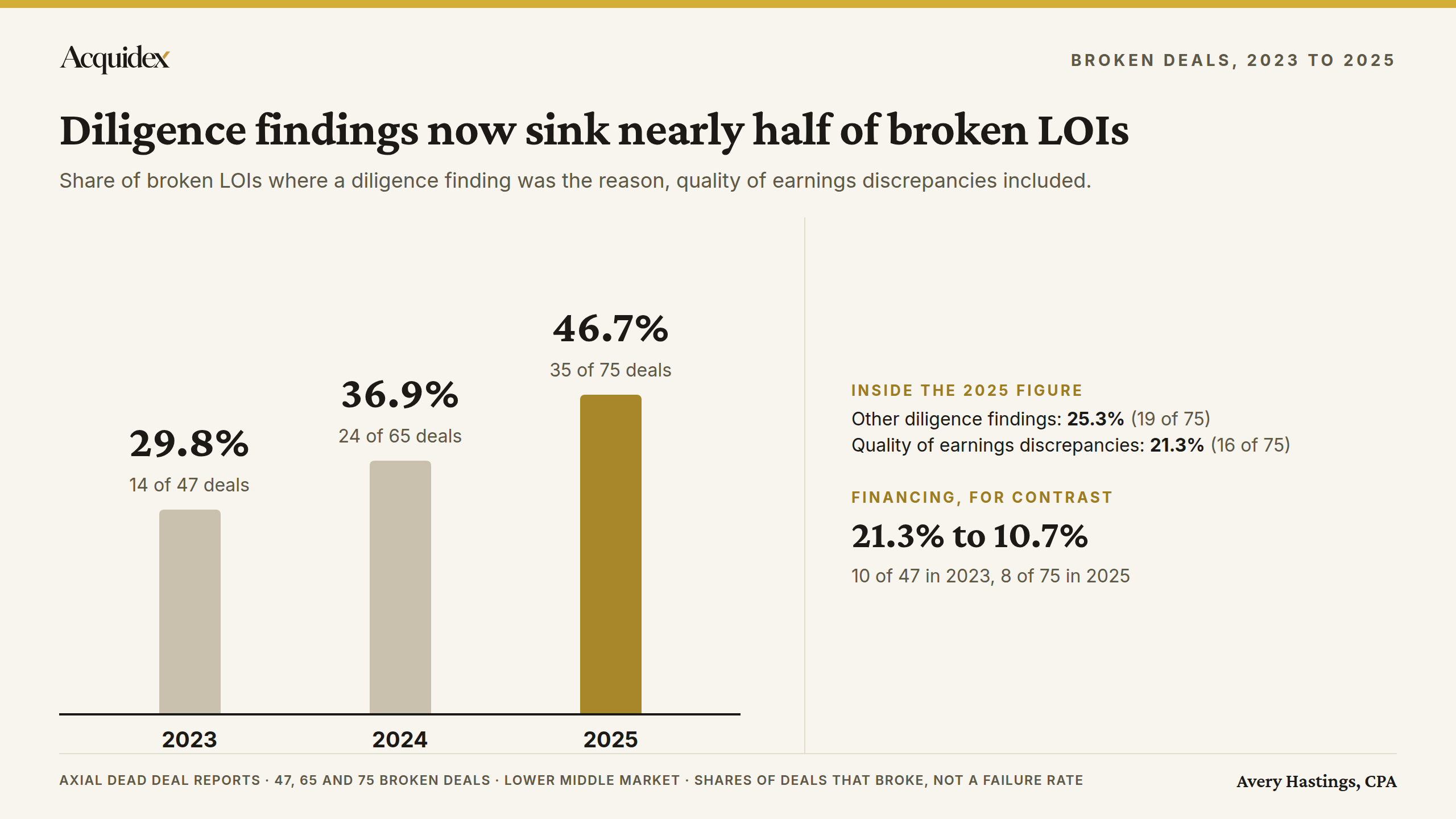
The limits are real. These are lower middle market deals, larger than most Main Street sales, on one platform, and the samples are small. They are shares of the deals that broke, not the share of all deals that fail.
They answer one question: why broken deals broke. This piece is about the other one. What happens to findings in the deals that keep going?
Why does making the call change how findings are weighed?
In 1976, the organizational psychologist Barry Staw gave 240 business students an executive's decision: where a company's research money should go. Some made the first investment decision themselves. Others inherited a decision someone else had made. Then everyone learned how that first investment had turned out, and decided where the next round of money should go.
The people who put the most new money into the division that had failed were the ones who had chosen it in the first place.
Staw's explanation centered on self-justification. In that account, pulling back means conceding that the first decision was wrong, and putting more in keeps open the chance that it was right.
A signed LOI is a decision with a name on it. The buyer picked this business and put their name to it. Nothing about that is a mistake. It does mean that every finding afterwards is weighed by someone who has already made the call.
Does money already spent keep a buyer committed?
The costs start soon after.
In a 1985 field experiment at Ohio University's theater, Hal Arkes and Catherine Blumer randomly sold some season tickets at full price and some at a discount. The full-price buyers went to more plays over the first half of the season. The plays were the same. What differed was what had been paid.
A deal has its own versions: a deposit, legal bills, a quality of earnings fee, months of evenings. None of it changes what the business is worth. All of it can make stopping feel like waste. The money already spent can keep a buyer committed after the facts have changed.
Why do findings that arrive one at a time get explained away?
This is the part of the research that fits diligence most closely.
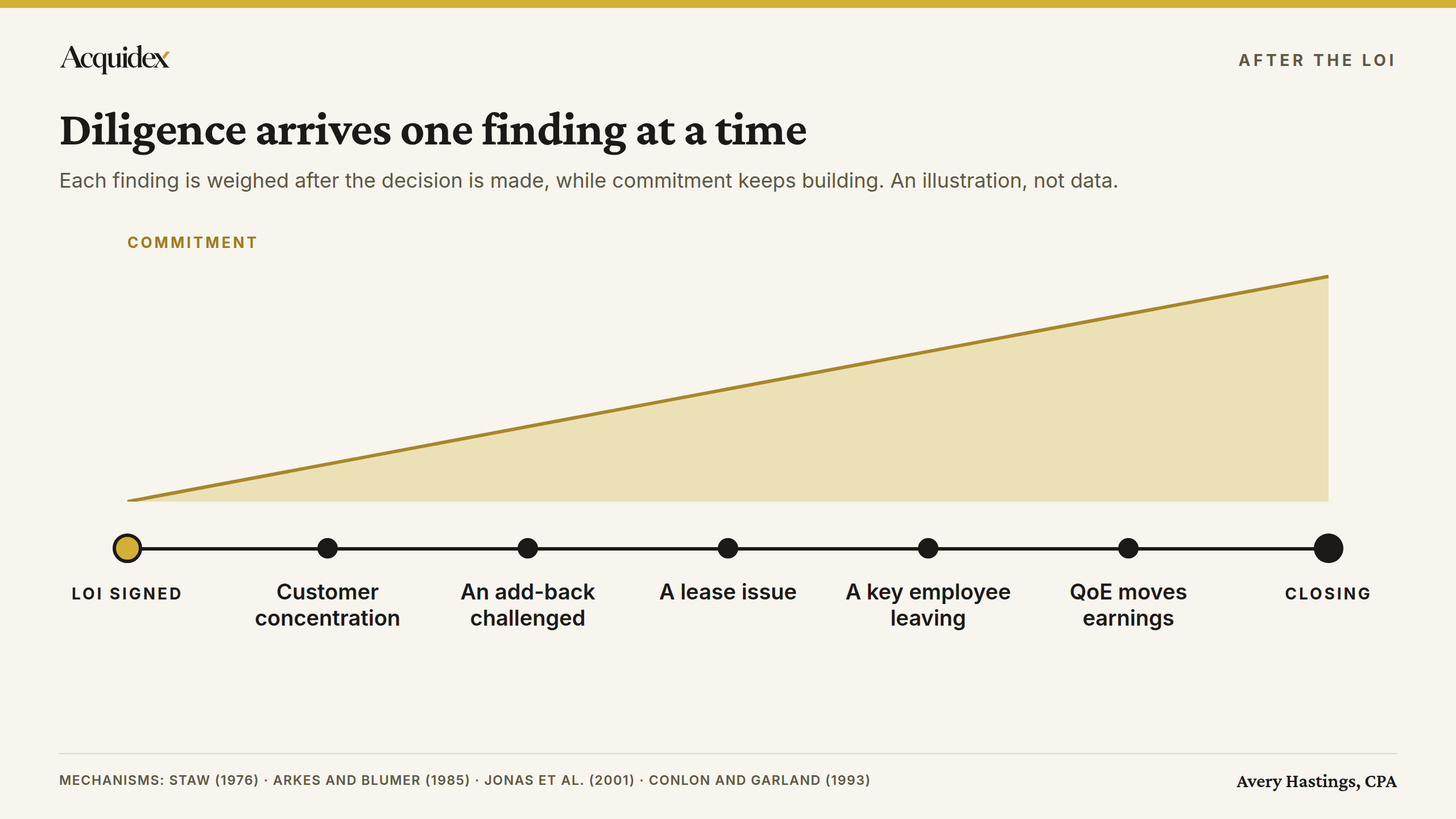
A buyer rarely discovers every problem on the same Tuesday morning. Findings arrive over weeks. Customer concentration turns up in the sales data. An add-back gets challenged. A lease issue comes out of the landlord conversation. A key employee turns out not to be staying. The quality of earnings work moves the earnings number. Then another finding lands.
Each one can have a perfectly reasonable explanation. And each one arrives after the decision has been made.
In 2001, Eva Jonas, Stefan Schulz-Hardt, Dieter Frey and Norman Thelen studied people who had reached a preliminary decision and then looked for more information. They preferred information that supported the decision they had already made. That preference was stronger when the information came one piece at a time than when it came all at once. Their explanation was that taking information in sequence keeps attention on the earlier decision, which deepens commitment to it.
As far as I know, nobody has tested this on acquisition diligence. But the structure is close. Diligence findings arrive in sequence, by the nature of the work. The risk is that each finding gets judged against the decision already made, when the findings taken together should periodically reopen it.
Diligence is supposed to update the thesis. It can quietly become a process for defending it.
Does the closing date matter?
Then the closing date gets closer.
In 1993, Donald Conlon and Howard Garland pulled apart two things that earlier studies had mixed together: how much had been spent on a project, and how close it was to finished. People were more willing to keep funding a project the closer it was to completion, and that pull appeared to outweigh the money already spent.
Much of the heaviest work in a deal, such as the quality of earnings review and the lender's conditions, comes after the LOI, and some of it lands close to closing. The findings that matter most can arrive when finishing feels closest.
Does any of this show up in real acquisitions?
Everything so far comes from experiments and from settings far from M&A. The fair question is whether any of it shows up in real acquisitions.
A 2025 study in the Journal of Finance by Marius Guenzel is one of the cleaner answers.
Guenzel studied stock mergers with a fixed exchange ratio, where the buyer pays in its own shares at a ratio set when the deal is signed. If the market moves between signing and closing, the final cost of the acquisition moves with it, for reasons largely unrelated to the business being bought. That creates a rare natural experiment: deals whose final cost ended up higher or lower because of market-wide moves outside anyone's control.
Acquirers whose deals ended up costing more were less likely to divest the business later. In the paper's terms, an interquartile increase in acquisition cost went with an 8 to 9 percent lower divestiture rate. The effect was concentrated in the years when the CEO who made the acquisition was still in office.
That last detail links back to Staw. The price paid mattered most while the person responsible for paying it was still in charge.
The limits matter. These are acquisitions by public companies, and the decision studied is whether to divest after closing, not whether to walk away during diligence. It isn't evidence about small-business buyers at the LOI stage. What it adds is evidence from real transactions that the commitment created by an acquisition can shape later decisions about it.
Why do lenders and advisers see it differently?
A buyer eleven weeks in can be inside all of this at once. The call is theirs. The money is spent. The findings have come one at a time, and the closing date is close.
The lender and the adviser are close to the deal too, and they want it to succeed. They aren't neutral, and nobody in a deal is an all-seeing referee. But they didn't pick this business, sign the LOI or write the check for the quality of earnings report.
That distance is what makes them useful. Not neutrality. Distance.
There's related research on the value of an outside perspective. In a 2012 study of private-equity investment decisions, Dan Lovallo, Carmina Clarke and Colin Camerer found that an outside view, built from a reference class of comparable cases, performed better than relying on a few analogies familiar to the decision maker.
In a deal, the two views can sound like this.
The inside view: we resolved the customer issue, management explained the add-backs, the seller note closes the gap, and we're three weeks from closing.
The outside view: what tends to happen to businesses with this combination of customer concentration, disputed earnings, thin debt coverage and owner dependence?
Both are reasonable questions. The second one can be harder to ask from inside the commitment.
What does it look like from the inside?
"Should we do this?" becomes "How do we get this done?"
Every individual finding has a reasonable explanation.
The structure starts moving to preserve the price: a larger seller note, an earnout, more of the buyer's own cash.
The closing calendar starts carrying weight in the conversation.
None of these means the deal is wrong. They are reasons to ask whether new information is still getting a clean hearing.
What did the banking research find?
Banking provides one of the more useful real-world tests of the idea, because banks have to recognize problem loans on their books.
In 1997, Staw, Sigal Barsade and Kenneth Koput followed 132 California banks over nine years. Turnover among senior executives predicted both provisions for loan losses and write-offs of bad loans. The reverse wasn't found: provisions and write-offs didn't predict later turnover. The study was testing the idea that executives who weren't responsible for the original lending decisions would find it easier to recognize the losses.
In 2002, Gerry McNamara, Henry Moon and Philip Bromiley studied a bank that monitored lending decisions more closely and moved some decisions away from the original decision maker. Both reduced commitment to struggling borrowers. The same study found side effects: in the face of the intervention, some decision makers resisted downgrading their borrowers' risk and escalated their commitment to them. The authors call this intervention avoidance.
The principle will be familiar to anyone in credit. Separating an original decision from its later review creates another set of eyes.
How can a deal process keep the decision open?
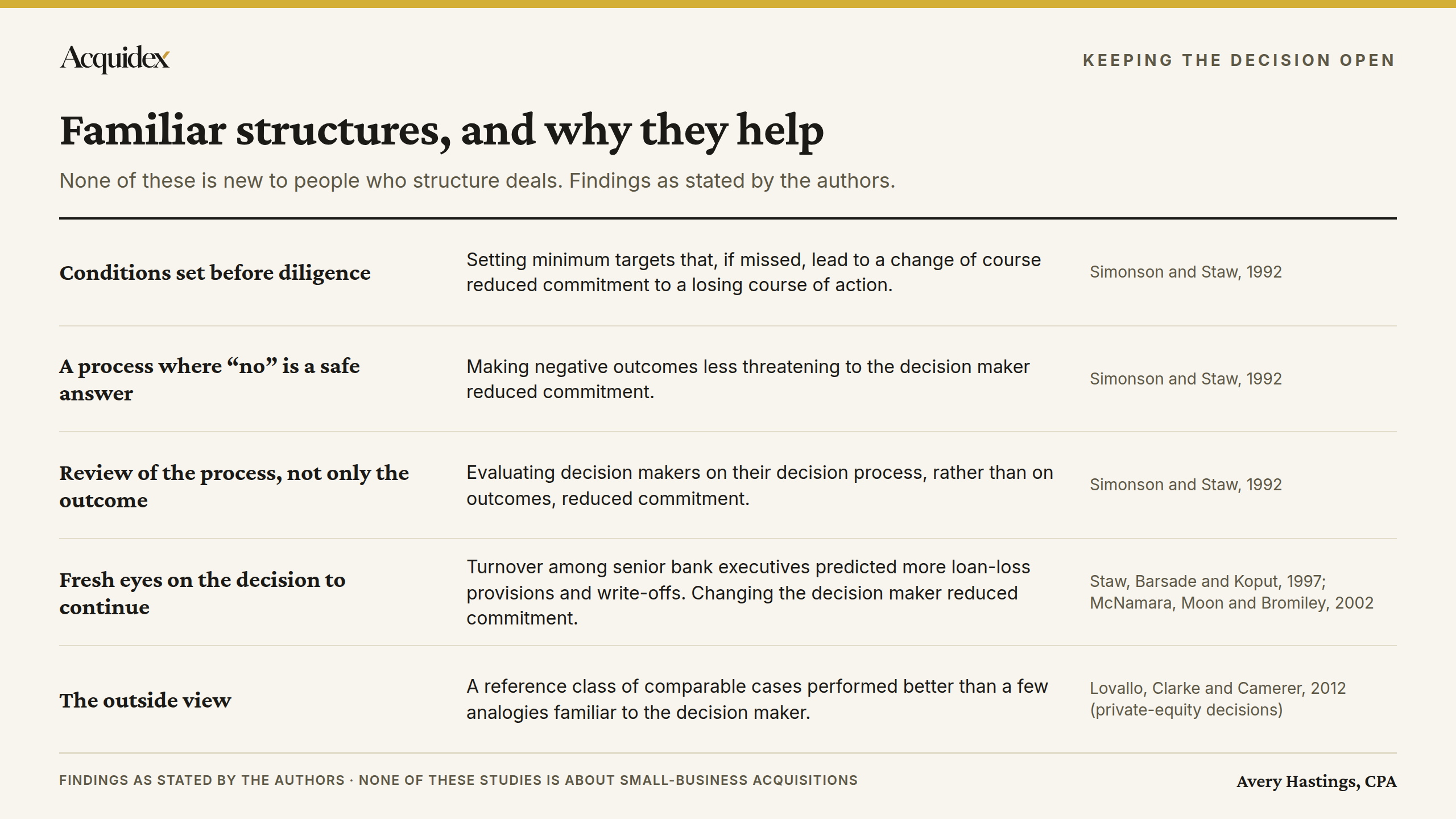
In 1992, Itamar Simonson and Barry Staw compared ways of reducing commitment to a course of action that was going badly. Three worked best:
- setting minimum targets in advance that trigger a change of course if they're missed;
- making a bad outcome less threatening to the person who made the original call;
- evaluating decision makers on their decision process rather than on outcomes.
None of this will be new to people who structure deals. Conditions agreed before diligence, second reviews, credit committees and fresh eyes on a file are familiar parts of the process. The research may help explain why they become particularly valuable as commitment rises.
- Write the walk-away conditions down before diligence starts. Simonson and Staw found that minimum targets set in advance, which trigger a change of course if missed, were among the techniques that worked best.
- Review the findings together at set points. Jonas and colleagues found the preference for supporting information was stronger when it arrived one piece at a time. Reviewing findings as a set applies that result; it hasn't been tested on diligence.
- Have someone who didn't make the original call review it. In a 2002 bank study, moving some decisions away from the original decision maker reduced commitment to struggling borrowers, with side effects of its own.
- Build the outside view. Ask what tends to happen to businesses with this combination of issues before deciding how this one will go.
- Judge the process, not the close. Simonson and Staw found that evaluating decision makers on their process, rather than on outcomes, reduced commitment to a losing course.
- Keep money already spent out of the decision. Fees already paid are gone whether the deal closes or not. The question is whether the business is still worth the price from here.
Where does the evidence stop?
None of these studies is about small-business acquisitions. They cover role-played executives, theater tickets, laboratory information searches, private-equity decisions, banks and public-company mergers. The mechanisms transfer by argument, not by measurement.
The acquisition study is closer, but it isn't this. Guenzel studied post-close decisions by public companies, not diligence decisions by small-business buyers at the LOI stage.
The sequential point is an application, not a result about diligence. The research also doesn't settle when it bites hardest. A 2011 set of studies by Peter Fischer and colleagues found that confirmation was strongest right after a preliminary decision and weakened later in a search. Early findings may get less of a clean hearing than late ones, not the other way round.
Persistence can be rational. A deal that survives difficult diligence hasn't necessarily escalated. Sometimes the explanations are right and the deal is good.
"Sunk cost" may be several things. A 2025 study found that the standard sunk-cost scenarios hang together only weakly. The effect may be several related mechanisms rather than one universal bias.
Process doesn't eliminate judgment problems. The bank study found side effects, and committees bring their own dynamics.
The deal data counts reasons, not decisions. Axial's reports show why broken deals broke. They can't show which of the deals that closed should have stopped, and nothing here claims to.
This is research applied to a transaction problem, not a report from inside deals. Lenders and advisers who have sat through far more closings will know where it doesn't fit, and I'd like to hear where.
Diligence is supposed to update the thesis. It can quietly become a process for defending it. The useful question for everyone around a deal is what helps a finding in week ten get the same hearing it would have had before the LOI.
Methodology and sources
Selection. The analysis uses the foundational escalation-of-commitment studies (Staw, 1976; Arkes and Blumer, 1985; Conlon and Garland, 1993), a study of sequential information search after a preliminary decision (Jonas and colleagues, 2001) and a later study qualifying it (Fischer and colleagues, 2011), a comparison of de-escalation techniques (Simonson and Staw, 1992), two banking studies (Staw, Barsade and Koput, 1997; McNamara, Moon and Bromiley, 2002), a study of the outside view in private-equity decisions (Lovallo, Clarke and Camerer, 2012), a natural experiment in actual acquisitions (Guenzel, 2025), and a 2025 test of sunk-cost scenarios (Białek and Biesiada). Deal context comes from Axial's Dead Deal Reports for 2023, 2024 and 2025.
Verification. Each study was checked against its authors' abstract and published summaries, not its full text, and every finding is stated as its authors summarize it. Axial's figures are kept as whole deal counts from each year's report.
Sources.
- Staw, B. M. "Knee-Deep in the Big Muddy: A Study of Escalating Commitment to a Chosen Course of Action." Organizational Behavior and Human Performance 16(1), 1976, 27–44.
- Arkes, H. R. and Blumer, C. "The Psychology of Sunk Cost." Organizational Behavior and Human Decision Processes 35(1), 1985, 124–140.
- Simonson, I. and Staw, B. M. "Deescalation Strategies: A Comparison of Techniques for Reducing Commitment to Losing Courses of Action." Journal of Applied Psychology 77(4), 1992, 419–426.
- Conlon, D. E. and Garland, H. "The Role of Project Completion Information in Resource Allocation Decisions." Academy of Management Journal 36(2), 1993, 402–413.
- Staw, B. M., Barsade, S. G. and Koput, K. W. "Escalation at the Credit Window: A Longitudinal Study of Bank Executives' Recognition and Write-Off of Problem Loans." Journal of Applied Psychology 82(1), 1997, 130–142.
- Jonas, E., Schulz-Hardt, S., Frey, D. and Thelen, N. "Confirmation Bias in Sequential Information Search After Preliminary Decisions: An Expansion of Dissonance Theoretical Research on Selective Exposure to Information." Journal of Personality and Social Psychology 80(4), 2001, 557–571.
- McNamara, G., Moon, H. and Bromiley, P. "Banking on Commitment: Intended and Unintended Consequences of an Organization's Attempt to Attenuate Escalation of Commitment." Academy of Management Journal 45(2), 2002, 443–452.
- Fischer, P., Lea, S., Kastenmüller, A., Greitemeyer, T., Fischer, J. and Frey, D. "The Process of Selective Exposure: Why Confirmatory Information Search Weakens Over Time." Organizational Behavior and Human Decision Processes 114, 2011, 37–48.
- Lovallo, D., Clarke, C. and Camerer, C. "Robust Analogizing and the Outside View: Two Empirical Tests of Case-Based Decision Making." Strategic Management Journal 33(5), 2012, 496–512.
- Guenzel, M. "In Too Deep: The Effect of Sunk Costs on Corporate Investment." The Journal of Finance 80(3), 2025. doi:10.1111/jofi.13430.
- Białek, M. and Biesiada, E. "On the Low Reliability of Sunk Cost Vignettes." Brain Sciences 15(8), 2025, 808.
- Axial. "Dead Deal Report: Unpacking 2023's Broken LOIs." https://www.axial.net/forum/dead-deal-report-unpacking-2023s-broken-lois/
- Axial. "Dead Deal Report: Breaking Down 2024's Broken LOIs." https://www.axial.net/forum/dead-deal-report-breaking-down-2024s-broken-lois/
- Axial. "Dead Deal Report: Unpacking 2025's Broken LOIs." https://www.axial.net/forum/dead-deal-report-unpacking-2025s-broken-lois/

Avery Hastings, CPA
Founder, Acquidex • CPA • Tokyo, Japan
Avery Hastings is a CPA based in Tokyo, Japan and the founder of Acquidex. She focuses on helping buyers evaluate small-business deals with clear cash-flow logic, realistic downside analysis, and practical diligence frameworks.
Keep up with Avery →Sources
No external sources are cited in this article.
Keep Reading
- Do Overconfident Buyers Pay More for Small Businesses?18 min read read
A landmark study on Forbes 500 CEOs shows overconfident executives have 65% higher odds of making an acquisition, and the market reacts 90 basis points more negatively to their deals. The mechanism transfers to private-market buyers. The measurement does not. Here is what a buyer-side test would actually look like.
- The Silver Tsunami Is Real. Most of Its Supply Won't Transfer.10 min read read
A flood of retiring owners is not a flood of buyable deals. Across the U.S. and Japan, the data shows most of the supply behind the 'generational opportunity' will close rather than change hands.
- The Formation Boom Is Real. The Pipeline Inside It Is Shrinking.13 min read
Business applications just hit a June record — but the share that becomes an employer business you can actually buy has fallen to the lowest level on record, and it's rotating hard by sector.
- Why Most Small Businesses Close Instead of Selling: 104 Industries, Ranked26 min read read
A roadside motel will sell. A law practice records thirteen times the closures per sale. Census data on 104 industries shows the difference is not profit, size, or how well the business was run.