


Key Insight
In a small business acquisition the value of contracted revenue is determined by four clauses rather than by the stated contract term, and buyers routinely price the term while inheriting the clauses. Termination for convenience allows a customer to exit without cause, making the effective term the notice period — commonly thirty, sixty or ninety days — rather than the years printed on the front page; a five-year agreement with a thirty-day convenience clause is functionally a thirty-day agreement. Change of control provisions are triggered specifically when ownership changes, meaning they fire at closing rather than during ordinary operations, which is why sellers honestly report that such clauses have never caused a problem: the triggering event has not yet occurred. Assignment provisions determine whether agreements transfer at all, and the outcome depends on deal structure, since a stock purchase generally leaves the contracting entity unchanged while an asset purchase activates every consent requirement simultaneously. Auto-renewal clauses create an annual exit window, typically requiring sixty to ninety days notice before the anniversary, so a multi-year relationship is in substance a series of one-year commitments with a scheduled exit door. The practical method is to take the top ten customers by revenue and record, for each, the notice period in days, whether a convenience right exists and whether it is mutual, the change of control effect, whether assignment consent is required under the chosen structure, and the next renewal and notice dates — then sum the revenue capable of leaving within ninety days and compare it directly against annual debt service. A business presented as ninety percent contracted can, under this analysis, hold close to zero revenue genuinely locked for twelve months. Legal diligence reliably identifies these clauses; converting them into a revenue figure that changes the price is typically nobody's assigned job, and that gap is where the loss occurs.
A word on scope
This is deal analysis rather than a data study, and it should be read as such.
Where this publication reports an empirical finding, it comes with a source, a method and a limits section, and every figure is recomputed from primary files before publication. This piece has none of those, because it makes no empirical claim. It makes a structural argument: four specific clause types determine the durability of contracted revenue, the contract term does not, and the gap between a legal deliverable and a valuation input is where the error lives.
The worked example is illustrative. The numbers are chosen to be legible, not sampled from anything.
I am not claiming how often these clauses fire. That would require a tracked deal panel which does not exist in public data, and I am not going to imply one exists. A customer with a ninety-day exit who has stayed eleven years will probably stay. The point is not that they will leave — it is that a buyer should know what they own and price it accordingly, rather than believing they own four more years when what they own is ninety days.
Structure advice belongs with your counsel. Everything here is about how to read what you are handed.
What is actually being bought when revenue is "contracted"?
The seller hands you a contract. Five years, signed last spring.
You do the arithmetic before finishing the first page. Four years left. Call it predictable revenue. It supports the multiple, it supports the debt, and it is the reason this business is worth more than the one down the road.
Then you read clause 14.
Either party may terminate this agreement for convenience upon thirty days written notice.
That is not a five-year contract. That is a thirty-day contract that both sides have politely agreed to keep renewing.
Nobody lied. The document says five years on the front page, and it is a five-year agreement. It is also cancellable in a month, and both facts are printed in the same file.
Contracted revenue is usually the single largest reason a small business trades above its category. It is what turns a job into an asset, the first thing a lender's credit committee looks for, and the first thing a broker puts on the teaser. And the number everybody quotes — the term — is the part carrying almost no information about durability.
Four clauses do the actual work. Any one can reduce a five-year agreement to nearly nothing. Most buyers read for the first, which is the least dangerous of the four, because it fires in ordinary operations where the seller has already lived through it. The other three are worse precisely because they have never fired. They are waiting for a specific event, and that event is you buying the company.
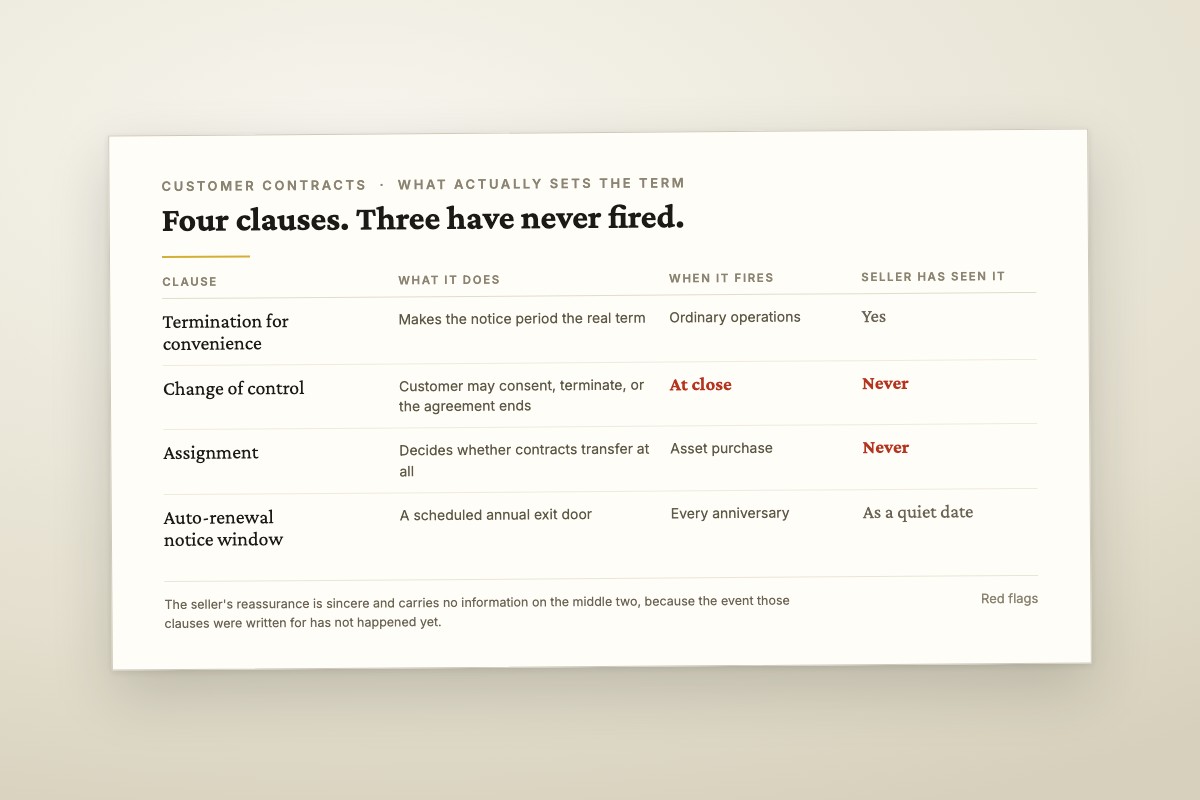
The right to receive revenue for the notice period, not for the term. Contracted revenue justifies most of the premium a business earns above its category, and the term on the cover page is the one part of the agreement that says almost nothing about whether that revenue survives a change of owner. Four clauses decide it, and three of them have never fired because the event they were written for has not happened yet.
Clause one: can they leave without a reason?
Termination for cause is normal and mostly harmless. It means the customer can leave if you fail to perform. That is fair, and if you do not fail, it does not fire.
Termination for convenience means they can leave because they feel like it. No breach, no dispute, no reason given.
Once that clause exists, the real term of the contract is the notice period. Thirty days. Sixty. Ninety. That is the number being bought, and everything before it on the front page is scenery.
What to do. Find the notice period on every contract in the top ten customers. Write the number of days beside the revenue, then sum the revenue that can leave inside ninety days. In many businesses that figure is a large fraction of what the seller described as contracted.
Two things to watch for.
The one-sided version. If the customer can leave on thirty days and the company is bound for five years, that is not a contract. That is an option the customer owns, and the buyer is purchasing the wrong side of it. Common in agreements written by a much larger counterparty.
The convenience clause with a break fee. Sometimes leaving early costs the customer money, which is meaningfully better than a bare convenience right and worth quantifying. A fee equal to three months of revenue extends the effective notice period, at least for a customer who cares what leaving costs.
Government contracts almost always carry termination for convenience as standard procurement language. A business with heavy public sector revenue is not necessarily weaker for it, but the contracted revenue on the summary page should be read as cancellable essentially at will.
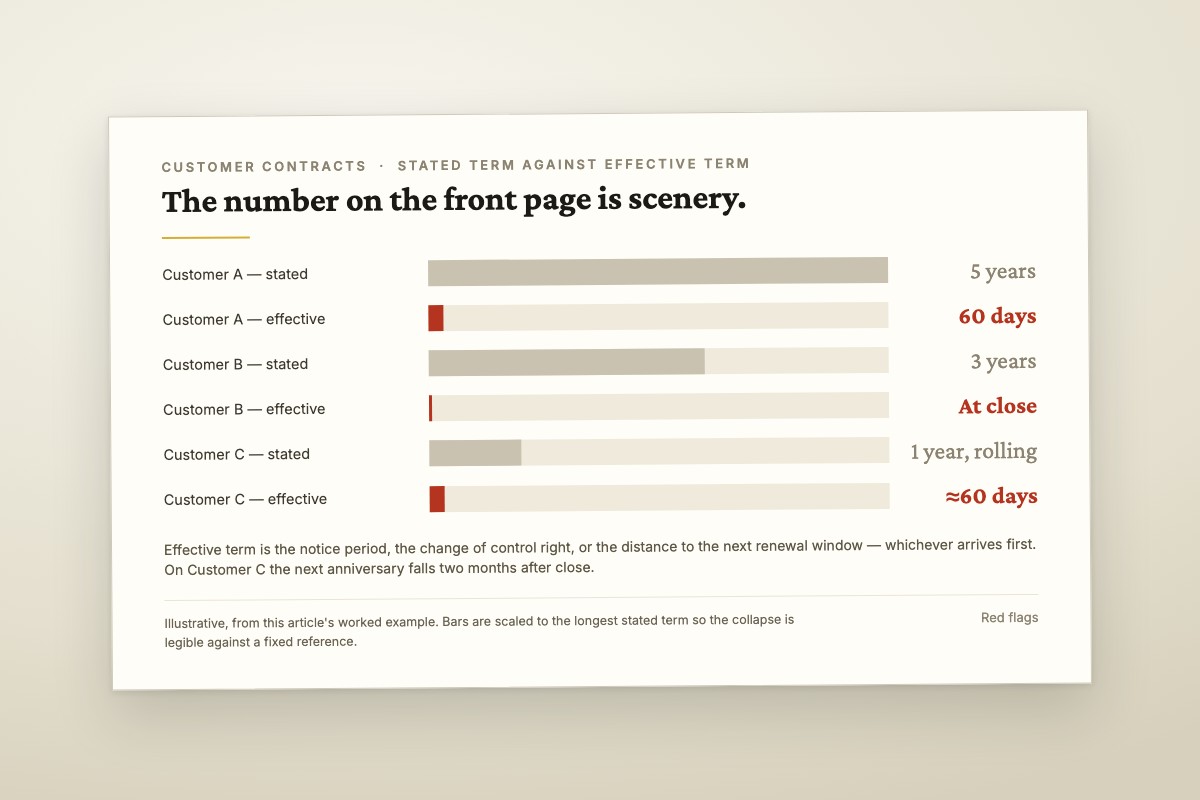
Clause two: what happens when the company is sold?
This is the clause that exists specifically because of the buyer.
A change of control provision says the agreement is affected when ownership of the company changes. Sometimes the customer must consent. Sometimes they gain a right to terminate. Sometimes the agreement simply ends.
Note what makes this different from every other risk in the deal: it does not fire during ordinary operations. It fires at close.
The seller has never triggered it and has no experience of it, which is why they will report — completely honestly — that it has never been a problem. It has never been a problem because the event it was written for has not happened yet.
What to do. Search every material contract for "change of control," "change in control," "merger or consolidation," and "assignment by operation of law." Read what each one does.
Then face the harder question, which is timing. If the customer's consent is required, when do you ask for it?
Ask before close and you have told the target's largest customer that the owner is leaving and a stranger is arriving — a conversation the customer did not request, at a moment when they have leverage and you have none. Ask after close and you have already paid.
There is no comfortable answer. There is only knowing which one you chose, and pricing it.
Structures that help. A consent condition precedent, where the deal does not close unless consents above a revenue threshold are obtained, moves the risk to the seller. It also requires the seller to have those conversations, which many will refuse. An escrow tied to post-close customer retention is the softer version and is more commonly agreed.
Clause three: do the contracts come with the company?
Whether they transfer depends on how the business is bought.
Most commercial contracts state they may not be assigned without the other party's written consent.
In a stock purchase, the contracting entity does not change. The company that signed is the company that continues, and assignment is generally not triggered.
In an asset purchase, contracts are transferred from one entity to another, and every consent requirement wakes up at the same moment.
This is why deal structure is not only a tax question. The same business, bought two different ways, arrives differently. One way it comes with an intact customer base. The other way it comes with a stack of consent letters somebody has to collect during the most fragile month of the transition.

What to do. If the structure is an asset purchase, count how many contracts require consent and what share of revenue they represent. Then ask who is making those calls, in what order, and what the script is.
The trap. Some agreements deem a change of control to be an assignment. That language collapses the distinction above and pulls the consent requirement into a stock deal as well. It is a single sentence and easy to read past.
Clause four: when can they walk away quietly?
A contract that renews itself has a date on which it can be killed, and it is not the end date.
Auto-renewal sounds like a buyer's friend, and usually it is. The catch is the window. Many auto-renew provisions require notice of non-renewal sixty or ninety days before the term expires. Miss it and you are locked in for another year, which is fine when you want to stay.
But the same clause means the customer's opportunity to leave arrives on a specific date, quietly, every single year. It is not a five-year commitment. It is a series of one-year commitments with an exit door that opens on schedule.
What to do. Build a calendar: every contract, every renewal date, every notice deadline, for the twelve months following close.

If three of the top five customers have a notice window in month four, the business has a cliff in it. Nobody mentioned the cliff, because to the seller it is an ordinary Tuesday that has passed uneventfully nine years running.
The tenth year is the one where the owner they knew is gone.
Termination for convenience makes the notice period the real term. Change of control fires at close, which is why the seller has never seen it and cannot speak to it. Assignment decides whether contracts transfer at all, and the answer changes with deal structure. Auto-renewal creates a scheduled annual exit the seller experiences as an uneventful date on the calendar. Any one of the four can reduce a five-year agreement to nearly nothing.
What does this do to a price?
Numbers make it concrete. These are illustrative, not a valuation.
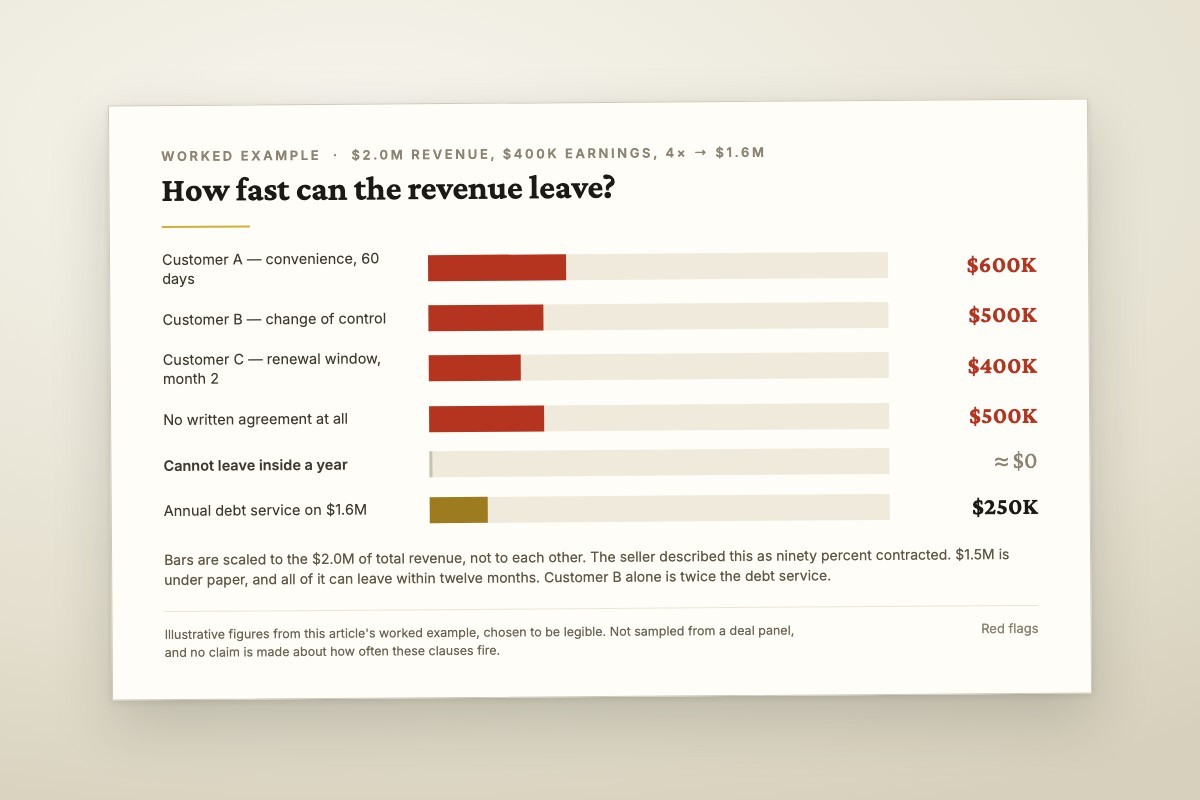
A services business. Two million of revenue, four hundred thousand of earnings. The seller wants four times, so one point six million. The pitch is that ninety percent of revenue is contracted — multi-year agreements, blue chip customers, low churn. That is the whole reason it is four times and not three.
Now read the contracts.
- Customer A, six hundred thousand of revenue. Five-year term with two years remaining. Termination for convenience on sixty days.
- Customer B, five hundred thousand. Three-year term. Change of control gives the customer a right to terminate.
- Customer C, four hundred thousand. Auto-renews annually. Notice window closes ninety days before each anniversary. The next anniversary falls two months after close.
- Everything else, five hundred thousand, no written agreements at all.
So the seller's ninety percent contracted becomes this. One and a half million is under paper, which is true. Of that, six hundred thousand can leave on sixty days for no reason. Five hundred thousand can leave because you bought the company. Four hundred thousand has an exit door opening eight weeks after you take the keys.
Contracted revenue that cannot leave within a year: close to zero.
The business may well be fine. Those customers may stay a decade. But nothing in the contracts obliges them to, and the multiple was built on a belief that something did.
Now put debt on it. A typical acquisition loan on one point six million needs roughly two hundred and fifty thousand a year of debt service. Customer B alone is five hundred thousand of revenue. If B exercises the change of control right at close, the earnings servicing that loan are gone before the first payment is due.
That is the whole exercise. Not "are these good customers." It is: how much of the revenue that covers my loan can walk before the first anniversary?
What is the fastest way to find this in diligence?
Contracts are long and diligence time is short. This order surfaces the expensive clauses first.
- Sort customers by revenue and take the top ten. Concentration means the tail rarely changes the answer.
- Go straight to the termination section. Usually near the end, often titled Term and Termination. Read it before the scope of work.
- Search the whole document for four strings: "convenience," "control," "assign," "renew."
- Only then read the rest. Pricing, service levels and liability caps matter, and they matter after you know whether the revenue is durable.
- Build one table. Customer, revenue, notice days, convenience yes or no, change of control effect, assignment consent required, next renewal date.
That table is the deliverable. It is one page, and it is worth more to the pricing conversation than any amount of prose.
What does this mean for buyers and sellers?
For buyers, run this on the top ten customers by revenue: notice period on each; termination for convenience yes or no, and whether it is mutual; change of control language, whether consent required, termination right, or silent; assignment clause tested against your structure; renewal date and notice deadline on a calendar twelve months out; total revenue that can leave inside ninety days; and that total set against annual debt service.
Also ask the seller which customers already know the business is for sale. The answer affects the timing question above, and it is better heard now.
If revenue that can walk within ninety days exceeds what is needed to cover the loan, the contracts are not supporting the deal structure. They are decorating it.
Two beliefs worth discarding along the way. Long contracts do not mean stable revenue — the term tells you the maximum, the termination and notice provisions tell you the minimum, and only one of those is a risk number. A clean history is not evidence about the contract — the clause has never fired because nothing has happened, and something is about to. Past behaviour is a good guide to future behaviour under unchanged conditions, and the buyer is the changed condition.
For sellers, the clauses are mostly fixable, and fixing them is worth more than a good year of earnings.
Renegotiate the notice period at renewal — not removing the convenience clause, which a customer will refuse, but lengthening it. Sixty days to one hundred and twenty is a small ask inside a working relationship and it doubles the durability of that revenue on a buyer's schedule.
Get change of control language softened to consent not to be unreasonably withheld, a normal formulation and a far better position than a bare termination right. Ask during an ordinary renewal, years before selling, when nobody is wondering why.
Put the handshakes on paper. Revenue with no written agreement is not safer for being undocumented; it is simply invisible, and a careful buyer treats invisible as zero.
Stagger the renewal dates. If four customers all renew in March, the business has a self-inflicted annual cliff. Moving two to September costs nothing and removes it.
And keep the counterparty as the company. Every agreement signed in a personal name is a transfer problem later — easy to fix going forward, nearly impossible retroactively.
None of this appears in earnings. All of it appears in what somebody will pay for those earnings, and in whether the deal survives diligence at the price that was shaken on.
Sources & method
No dataset. This is deal analysis drawn from how the four clause types operate and what each does to revenue a buyer is paying a multiple on.
Where this article makes a factual claim, it is a claim about what a clause means, not about how frequently it is invoked. Those are different, and the second would require a tracked deal panel that does not exist in public data.
Contract language varies enormously by industry and by counterparty size. Government and large enterprise agreements carry termination for convenience close to universally. Many small local service arrangements have no written terms at all, which is a different problem and arguably a worse one.
The worked example in the pricing section is illustrative. The figures are chosen for legibility and are not sampled from any transaction.
The five years on the front page is the number the seller quotes. The notice period in clause 14 is the number being bought.

Avery Hastings, CPA
Founder, Acquidex • CPA • Tokyo, Japan
Avery Hastings is a CPA based in Tokyo, Japan and the founder of Acquidex. She focuses on helping buyers evaluate small-business deals with clear cash-flow logic, realistic downside analysis, and practical diligence frameworks.
Keep up with Avery →Sources
No external sources are cited in this article.
Keep Reading
- How Do You Look Up a Business's SBA Loan History Before You Buy It?8 min read read
- Who Actually Steals From Small Businesses, and Why It Matters When You Buy One8 min read read
- When Did the Owner Last Take Three Weeks Off? The Cheapest Diligence Question There Is7 min read read
- Who Does the Customer Call at 7pm? The Relationship Map Most Buyers Skip8 min read read
- How to Verify a Seller's Growth Story: Four Checks, and the One That Killed Mine15 min read read
- Financial Due Diligence: The Complete Guide for SMB and Lower-Middle-Market Acquisitions13 min read read