


Key Insight
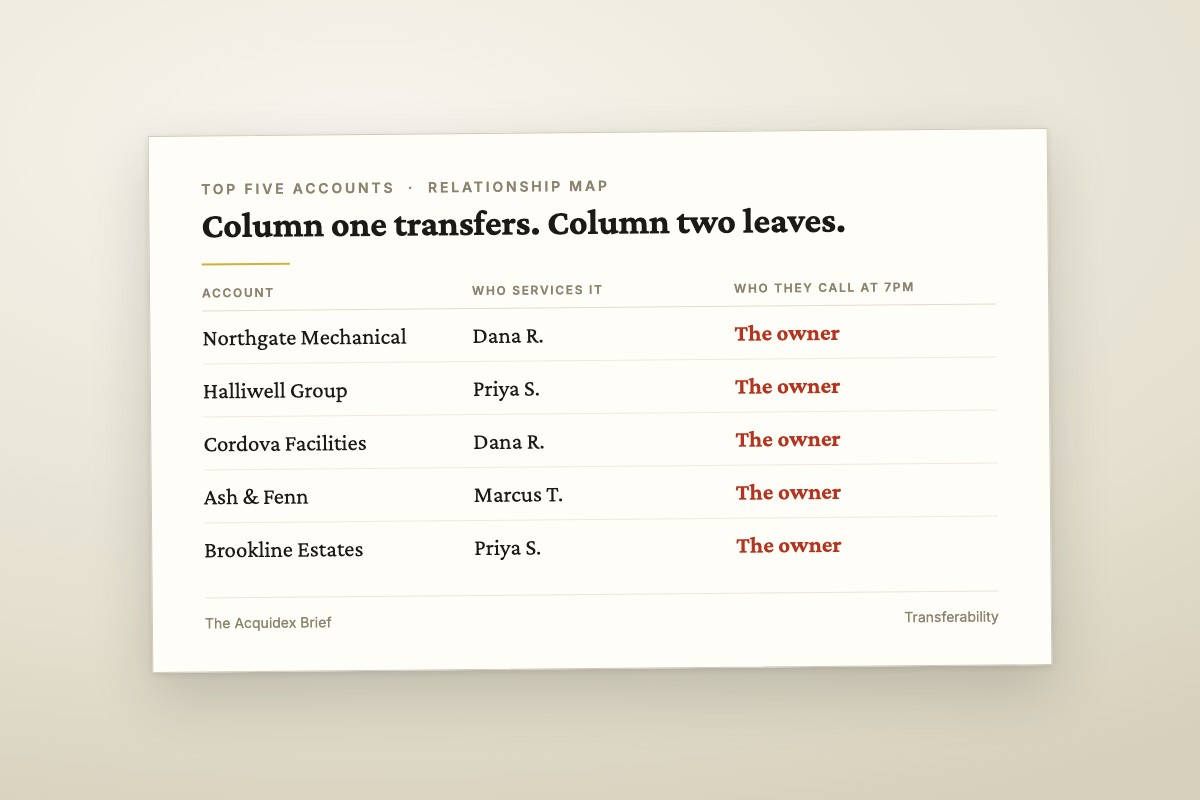
Customer relationship ownership is distinct from customer concentration, and standard diligence measures only the second. The test is a two-column exercise on the top five accounts: column one is who services the account, column two is who that customer would call at 7pm with a real problem. Column one appears in the CIM and on the org chart. Column two determines whether revenue transfers at closing. A business with five customers at 20% each looks diversified on a concentration analysis and is a single point of failure if the same name fills column two five times. The exercise takes about ten minutes, requires no adviser, and is answerable before an LOI, which matters because after an LOI it becomes a negotiation about price rather than a conversation about the business. In tax records covering roughly eleven million firms, profit fell 82% after an owner's premature death and 83% after owner retirement, with the damage concentrated in whether the firm survived rather than in the margins of firms that did.
Concentration analysis measures how revenue is distributed. It says nothing about who owns the relationship producing it. This piece covers:
- The two-column exercise: ten minutes, top five accounts, one question that is not on any schedule.
- Why diversified can still be single-point: five customers at 20% each, one name behind all of them.
- What a second name proves: the strongest evidence a business was built to survive its founder.
What is customer relationship ownership?
Customer relationship ownership is the question of which individual the customer is actually attached to, as opposed to which entity holds the contract. It is not measured by concentration analysis, revenue by account, or contract tenure, all of which describe the distribution of revenue rather than its attachment.
The distinction matters at exactly one moment: closing. Contracts assign. Relationships do not, unless the person holding them stays, and the whole premise of an acquisition is that they will not.
How do you map it in ten minutes?
Take the five largest customers by revenue. Draw two columns.
Column one: who services the account. The account manager, the project lead, whoever appears on the org chart against that logo. This information is in the CIM, and it is the column most buyers build.
Column two: who would that customer call at 7pm with a real problem. Not who they are supposed to call. Who they would actually call, when something has gone wrong and the answer matters tonight.
Column two is the one that transfers or does not.
Why can a diversified customer base still be a single point of failure?
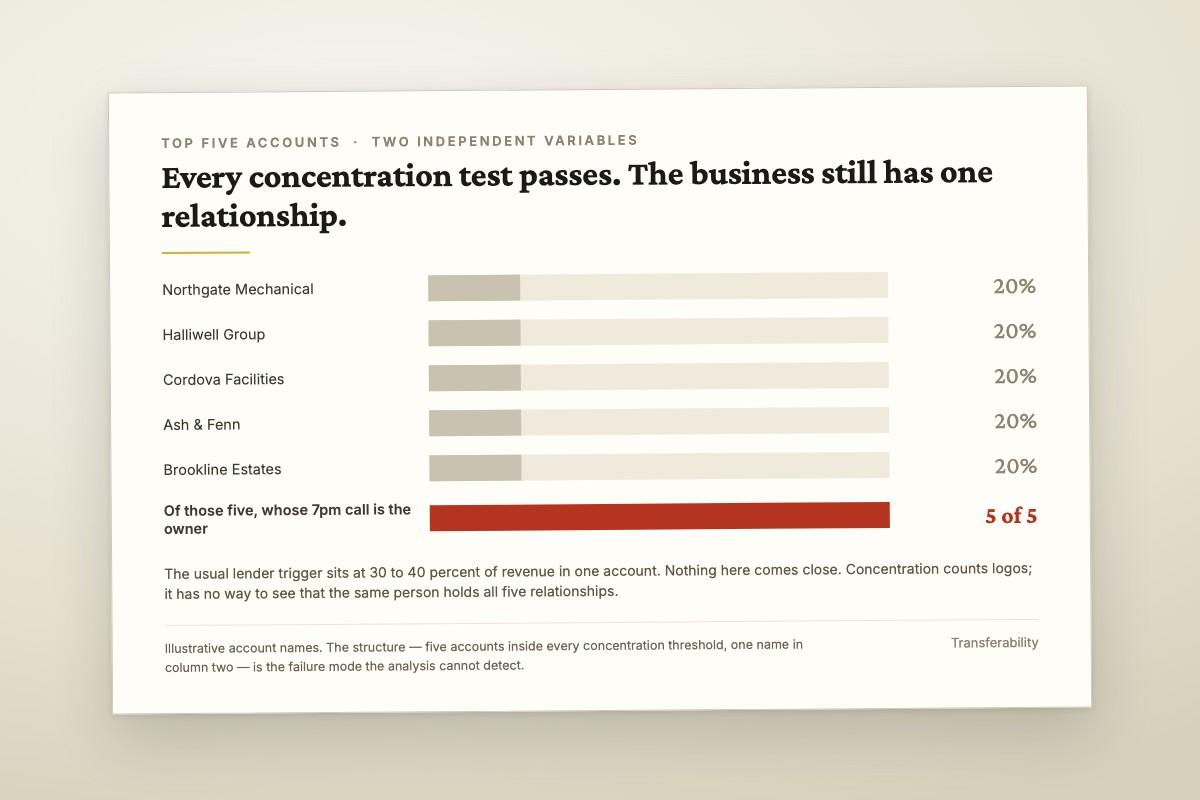
Because concentration and attachment are independent variables, and only one of them is measured.
Five customers at twenty percent each clears every concentration threshold a lender applies. No account exceeds the usual 30 or 40 percent trigger. The revenue looks properly distributed and the credit file records it as such.
Now fill in column two. If the same name appears in all five rows, the distribution is irrelevant. The business has one relationship, sold five times, and it is attached to a person who is exiting.
This is the failure mode concentration analysis is structurally unable to see. It counts logos, not attachments. A business with fifteen customers and one relationship holder is more fragile than a business with four customers each attached to a different person, and no standard concentration report will say so.
What does it mean when column two has a different name?
It is the strongest evidence available that a business was deliberately built to outlive its founder.
Deliberate relationship transfer is slow, expensive and invisible in trailing financials. An owner who has done it has spent years introducing a second person into accounts they could have serviced themselves, absorbing the short-term inefficiency for a benefit that only appears at exit. Very few do it.
So when column two returns a name that is not the owner, follow it. Ask how that happened, when it started, and whether the customer has ever escalated to that person without the owner involved. Owners who have done this work will talk about it at length, because it cost them something and nobody has ever asked.
No. Concentration and attachment are independent. Five accounts at twenty percent each satisfies every concentration threshold while remaining a single point of failure if one person holds all five relationships. Concentration analysis counts logos; it cannot see attachment.
When should you run it?
Before the LOI, and the timing is not a technicality.
Before an LOI, this is a conversation about how the business works. Sellers answer honestly because the question sounds operational and they do not yet know what a particular answer costs them. Most are proud of the relationships and will describe them in detail.
After an LOI, the same question is a negotiation about price. The seller now understands that "I handle all five personally" reduces their number, and the answers get more careful. Nothing dishonest happens. The information simply degrades.
Ten minutes, a sheet of paper, no adviser required, and it has to happen early.

What do you do when column two is the seller five times?
Not walk, necessarily. Price it, structure around it, or test it before closing, and be explicit about which one you are doing.
Test it. Ask for a joint call or site visit with the two largest accounts where a second person from the business leads and the owner attends but does not speak. What the customer does in that meeting is information you cannot get any other way, and a seller confident in the relationship transfer will usually agree.
Structure around it. A transition period that keeps the seller present is common and largely useless on its own, because presence is not transfer. What changes the risk is a defined handover with named accounts, named receiving individuals, and a schedule, tied to consideration that is contingent on those accounts still being there afterwards.
Price it. If neither of the above is available, the concentration is real and unmitigated, and it belongs in the price rather than in a paragraph of the memo describing it as manageable.
The failure mode is doing none of the three while writing the risk down as identified. Identified is not priced, and a risk register that lists owner relationships without a corresponding adjustment or structure is documentation rather than diligence.
What does the evidence say this is worth?
The underlying research measures what happens when the relationship holder is removed involuntarily.
Smith, Yagan, Zidar and Zwick linked roughly eleven million firms to their owners through tax records and identified owners who died prematurely, matching each firm to a near-identical business where no owner died. Profit fell 82%. A parallel experiment on owner retirement, where the owner stepped back and handed to a hired manager, produced 83%.
The detail that matters for this exercise is where the damage sat. Among firms that survived four years, profit barely moved. The effect ran almost entirely through survival: 41% of owner-death firms had exited within four years against 17% of their matched twins, and only about a fifth of those exits looked like sales rather than closures.
One scope limit, stated plainly: every owner in that sample earned over $1 million in fiscal income, so those are larger businesses than a typical acquisition. The read across is directional rather than measured. The direction is not reassuring, since those firms could afford management structure that a smaller business cannot.
The full analysis is in how much of a small business's profit is actually the owner.
How does this fit with the other transferability checks?
This exercise is one spoke. The broader diagnosis of whether a business runs on one person is key person risk, which covers the operational and technical dependencies this exercise does not touch: the lead estimator, the master tradesperson, the one person who knows the legacy system.
Two adjacent pieces are worth reading beside it. Verifying customer retention without trusting seller reports addresses whether customers stay, which is a different question from who they are attached to. And owner dependence after close covers what happens in the first ninety days when column two turns out to have been optimistic.
Sources and method
Matthew Smith, Danny Yagan, Owen Zidar and Eric Zwick, Capitalists in the Twenty-First Century, Quarterly Journal of Economics 134(4), November 2019. Figures read from the author-hosted full text.
The two-column exercise is not from the paper. It is a practical proxy for the attachment the research measures by removing it.
Author: Avery Hastings, CPA. This is analysis of published research and general diligence method, not a report of engagements conducted by the author.

Avery Hastings, CPA
Founder, Acquidex • CPA • Tokyo, Japan
Avery Hastings is a CPA based in Tokyo, Japan and the founder of Acquidex. She focuses on helping buyers evaluate small-business deals with clear cash-flow logic, realistic downside analysis, and practical diligence frameworks.
Keep up with Avery →Sources
Keep Reading
- How Do You Look Up a Business's SBA Loan History Before You Buy It?8 min read read
- Who Actually Steals From Small Businesses, and Why It Matters When You Buy One8 min read read
- Customer Contracts in an Acquisition: The Four Clauses That Decide What They're Worth14 min read read
- When Did the Owner Last Take Three Weeks Off? The Cheapest Diligence Question There Is7 min read read
- How to Verify a Seller's Growth Story: Four Checks, and the One That Killed Mine15 min read read
- Financial Due Diligence: The Complete Guide for SMB and Lower-Middle-Market Acquisitions13 min read read