


Key Insight
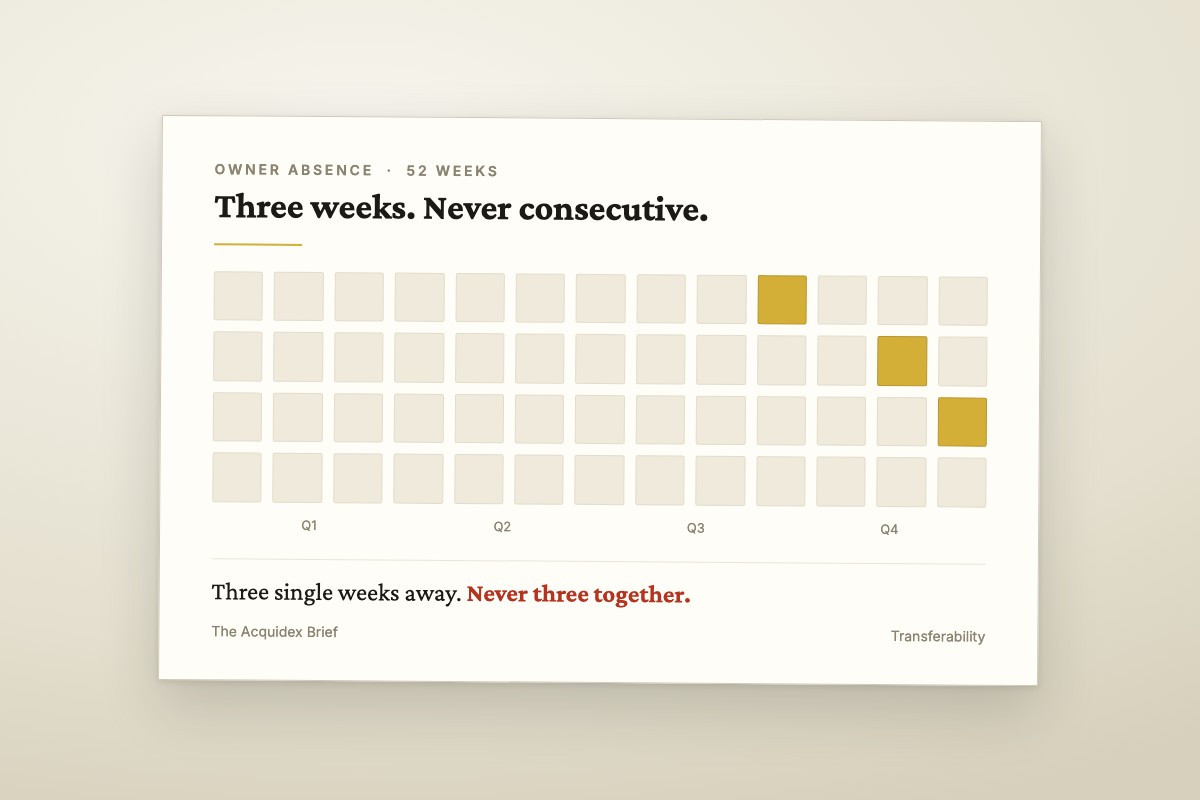
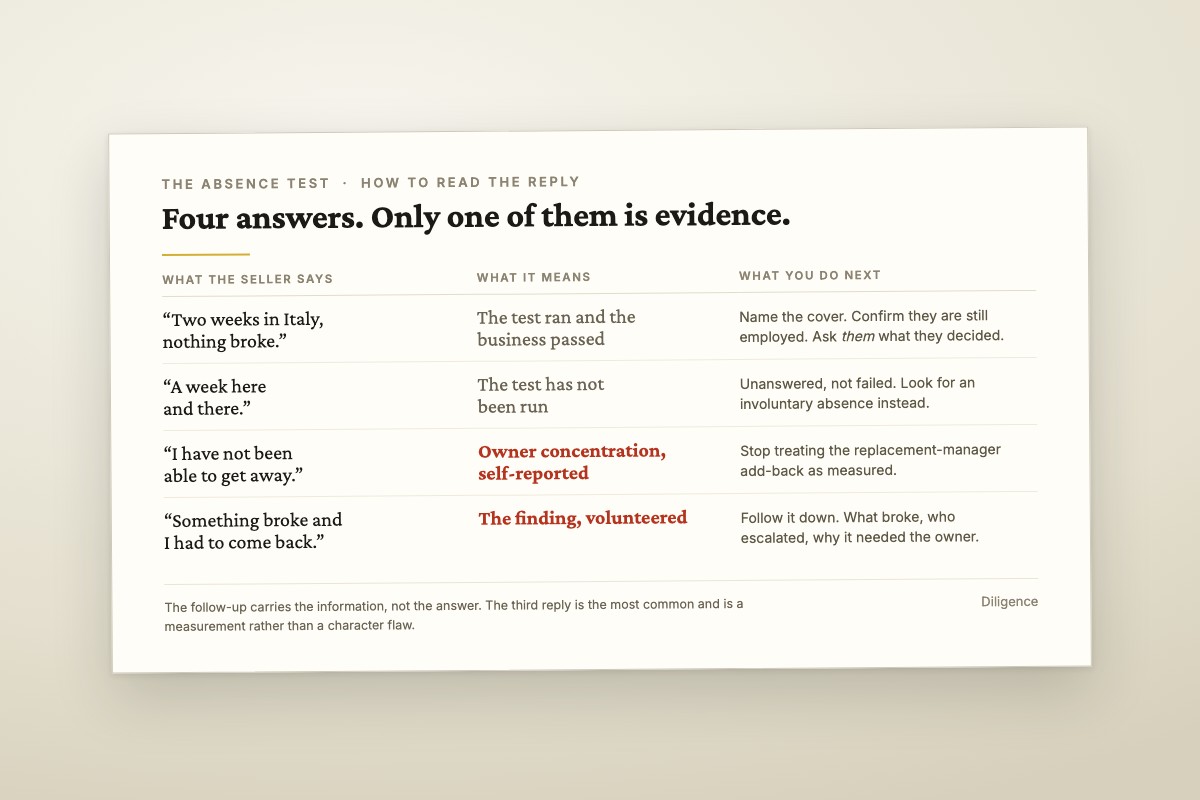
The three-week absence test is a single diligence question: when did the owner last take three consecutive weeks completely offline, and what broke while they were gone. Three weeks is the threshold because it crosses a month-end, a payroll run, and at least one thing going wrong, where a single week sits inside the operating cycle and proves nothing. The question costs nothing, takes ten seconds, and cannot be prepared for, because the answer is a historical fact rather than an opinion about the business. Four answers recur, and each is readable: a named cover who is still employed is the strongest transferability evidence available; "a week here and there" means the test has not been run; "I have not been able to get away" is an honest measurement of owner concentration volunteered by the person best placed to know; and "I had to come back" is the most useful answer of all, because the story of what forced the return is the transferability finding told by someone with no incentive to tell it.
One question, ten seconds, answerable over coffee before you spend a dollar on diligence. This piece covers:
- Why three weeks and not one: the threshold is not arbitrary.
- The follow-up that matters more than the answer: what broke, and who fixed it.
- Four answers and how to read each: including the one most buyers treat as small talk.
What is the three-week absence test?
It is one question asked of the seller: when did you last take three consecutive weeks off, completely unreachable? Followed immediately by the half that carries the information: what broke, and who fixed it.
The value is that it cannot be prepared for. Add-back schedules, management presentations and org charts are all constructed for the sale. An owner's holiday history is a fact that already happened, and the story of what went wrong in their absence has usually never been rehearsed because nobody has ever asked for it.
Why three weeks rather than one?
Because a week sits inside the operating cycle and proves almost nothing.
Most businesses can hold their breath for five working days. Decisions defer, calls get returned late, and nothing structural is tested. The owner returns to a manageable backlog and concludes, sincerely, that the business runs without them.
Three weeks crosses a month-end. It crosses at least one payroll run. It is long enough that a customer problem arrives, escalates, and has to be resolved by someone else, and long enough that a supplier or a bank needs a decision that cannot wait.
That is the point of the threshold. You are not testing whether the business survives the owner's absence. You are testing whether the organisation had to function, and who it turned out to depend on when it did.
How do you read the four answers?
"Last summer, two weeks in Italy, nothing broke."
Follow up on who covered. If the seller can name that person, and that person is still employed, you have found the most valuable thing in the data room, and it is not in the data room.
Then verify it independently: ask the covering person what they decided while the owner was away, and whether they escalated. A genuine deputy will have specifics. A nominal one will describe the period in general terms.
"I take a week here and there."
The test has not been run. This is not evasion; most owners genuinely have not been away for three consecutive weeks in years, and a week is what they have. Treat it as an unanswered question rather than a bad answer, and look for a natural experiment elsewhere: an illness, a family emergency, a period of enforced absence.
"I have not really been able to get away."
The most common answer, and the most honest one. It is not a character flaw and it should not be treated as a red flag in the moralising sense. It is a measurement of owner concentration, volunteered by the person best placed to know, at no cost to you.
What it should change is the weight you put on the replacement-manager adjustment. An owner who cannot leave for three weeks is telling you the business has not been tested without them, which means the add-back is untested too.
"We had a problem while I was away and I had to come back."
The most useful answer available, and the one most buyers treat as small talk.
Follow it all the way down. What was the problem. Who escalated it. Why did it require the owner specifically rather than anyone else. What would have happened if they had been genuinely unreachable rather than on a plane.
That story is your transferability finding, delivered by the person with the least incentive to deliver it.
No. It is a reason to stop treating the replacement-salary adjustment as measured rather than assumed. An owner who has never been absent for three weeks has not disproved transferability, but they have confirmed that nobody has tested it, which is a different position from the one the schedule implies.
What if the owner has never been away at all?
Then look for the absence that happened to them rather than the one they chose.
Most owner-operated businesses have had an involuntary test at some point: an illness, a hospital stay, a bereavement, a family emergency that took the owner out for a fortnight with no notice and no handover. Those events are better evidence than a planned holiday, because nothing was prepared and nobody was briefed.
Ask directly and without drama: has there been a period when you were unexpectedly out of the business for more than a week? The answer is usually yes, and the story is usually detailed, because those weeks are memorable in a way that a good holiday is not.
The second place to look is the calendar rather than the memory. Ask when the owner last took a full week without checking email, then ask what the business did that week: revenue, orders, decisions escalated. If the owner cannot say, the business is not being run to a dashboard that would survive them either.
What does the research say the answer is worth?
The test is a proxy for something that has been measured directly, by removing owners involuntarily.
Smith, Yagan, Zidar and Zwick linked roughly eleven million firms to their owners in tax records, identified owners who died before 65, and matched each firm to a near-identical business where no owner died. Profit fell 82%. Measured separately, owners who simply retired and handed to a hired manager produced 83%.
The retirement figure is the one that bears on this question, because it describes a planned, voluntary handover to exactly the professional a replacement-salary add-back assumes can be hired. It went worse than death.
The damage also sat somewhere unexpected. Firms that survived four years earned only marginally less. The effect ran through survival itself: 41% of owner-death firms had exited within four years against 17% of matched twins.
Scope limit worth stating: every owner in that sample earned over $1 million in fiscal income, so these are larger firms than a typical acquisition and the read across is directional, not measured. It runs the uncomfortable way, though, since those firms could afford management structure that a smaller business cannot.
There is a seller-side reading of all this. An owner planning an exit in three years can change the answer to this question, and it is one of very few valuation inputs genuinely within their control. Taking three weeks off, deliberately, and documenting what broke is both the cheapest preparation available and the only version of the evidence a buyer will believe. Full analysis in how much of a small business's profit is actually the owner.
Where this sits among the other checks
This is a single diagnostic, deliberately narrow. The full assessment of whether a business runs on one person is key person risk, which covers dependencies beyond the owner: the estimator, the licensed tradesperson, the one technician who knows the install base.
Two companions. Who does the customer call at 7pm maps relationship ownership specifically, which the absence test only implies. And owner dependence after close is what happens when the absence test was never run and the answer arrives in month two instead.
Sources and method
Matthew Smith, Danny Yagan, Owen Zidar and Eric Zwick, Capitalists in the Twenty-First Century, Quarterly Journal of Economics 134(4), November 2019. Figures read from the author-hosted full text.
The absence test itself is not from the paper. It is the cheapest available proxy for the dependency the research measures by removing it.
Author: Avery Hastings, CPA. This is analysis of published research and general diligence method, not a report of engagements conducted by the author.

Avery Hastings, CPA
Founder, Acquidex • CPA • Tokyo, Japan
Avery Hastings is a CPA based in Tokyo, Japan and the founder of Acquidex. She focuses on helping buyers evaluate small-business deals with clear cash-flow logic, realistic downside analysis, and practical diligence frameworks.
Keep up with Avery →Sources
Keep Reading
- How Do You Look Up a Business's SBA Loan History Before You Buy It?8 min read read
- Who Actually Steals From Small Businesses, and Why It Matters When You Buy One8 min read read
- Customer Contracts in an Acquisition: The Four Clauses That Decide What They're Worth14 min read read
- Who Does the Customer Call at 7pm? The Relationship Map Most Buyers Skip8 min read read
- How to Verify a Seller's Growth Story: Four Checks, and the One That Killed Mine15 min read read
- Financial Due Diligence: The Complete Guide for SMB and Lower-Middle-Market Acquisitions13 min read read