


Key Insight
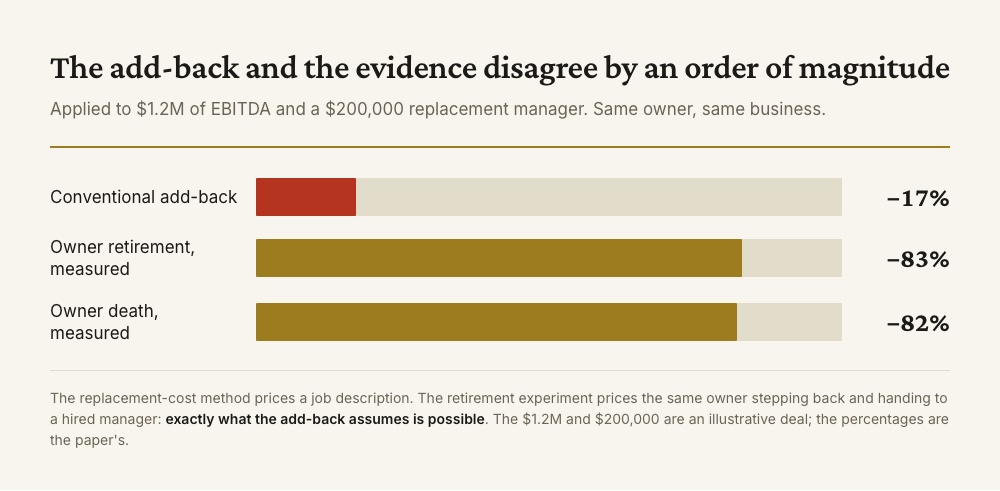
A replacement-salary add-back adds an under-market owner salary back into earnings and deducts what a professional manager would cost. On $1.2M of EBITDA with a $200,000 replacement manager it marks the owner down by roughly 17%. Two natural experiments on tax records covering about eleven million firms measured what actually happens when the owner leaves: profit fell 82% after premature death and 83% after retirement, where retirement means the owner stepped back and handed operations to a hired manager, which is precisely the substitution the adjustment assumes will work. The two methods differ by close to an order of magnitude on the same person. The reason is structural rather than careless: a replacement salary prices a role, and roles are the only component with an observable market price, while what departs also includes personally held customer relationships, supplier terms extended on tenure, undocumented pricing judgment, staff retention attached to the individual and credit relationships. None of those carries a salary line, so a schedule built from the payroll register cannot see them. The adjustment is better understood as a floor than as an estimate.
The standard owner adjustment is a hypothesis presented as a measurement. This piece covers:
- The arithmetic gap: 17% against 82 to 83%, on the same owner.
- Why the method persists: three reasons, none of them incompetence.
- What to do instead: test the hypothesis in diligence rather than asserting it in a schedule.
What is a replacement-salary add-back?
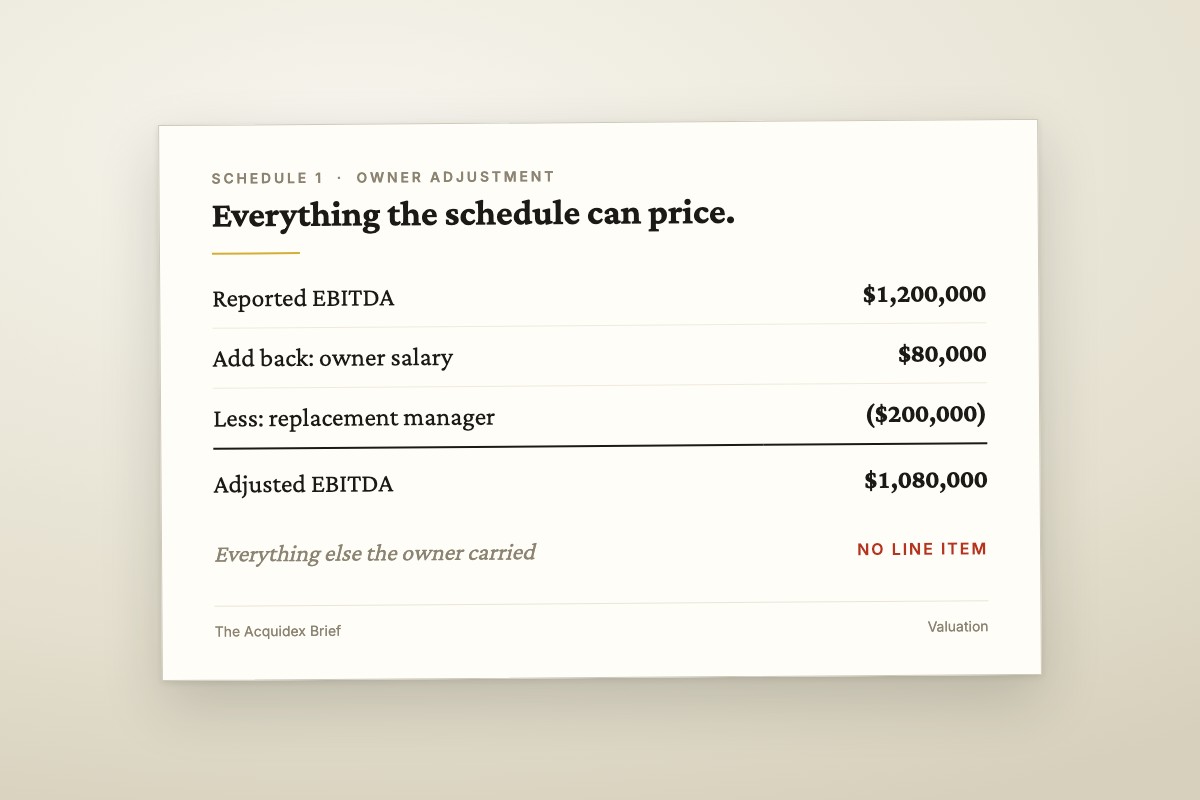
It is the adjustment that normalises owner compensation. The owner's below-market salary is added back to earnings, and the market cost of a professional manager to perform their visible duties is deducted. The net figure becomes adjusted EBITDA, and the multiple is applied to it.
Worked on typical numbers: a business reports $1.2M of EBITDA, the owner draws $80,000, and a general manager performing the visible duties would cost $200,000. Add back the $80,000, deduct the $200,000, and adjusted EBITDA is $1.08M. Many practitioners round to $1.0M for conservatism. At a 4× multiple that is a business worth roughly $4.0M to $4.3M, and the owner adjustment has moved the valuation by about half a million dollars.
The adjustment marks the owner down by roughly 17% of profit.
What do measured owner departures show?
Substantially more, and it is not close.
Smith, Yagan, Zidar and Zwick linked about eleven million firms to their owners through tax records and ran two natural experiments. The first used premature owner death as an exogenous shock, matching each affected firm to near-identical firms on three-digit industry, size, owner age and owner income where no owner died. Profit fell 82%, with a preferred point estimate of −81.6%.
The second is the one that bears directly on the add-back. They identified owner retirement from the tax record, where a firm transitions from four straight years of paying its owner W-2 wages to two years of paying none, on the presumption that the owner stepped back and a non-owner manager took over.
That is the replacement-manager assumption, run as an experiment by owners on themselves.
Profit fell 83%.
Why does the method understate so badly?
Because it prices a role, and a role is the only part with an observable market price.
A general manager's compensation is quotable from salary surveys, verifiable against a job posting, and defensible to a credit committee. The residual, meaning whatever the owner contributes beyond the role, has no market reference at all. When one component of an adjustment is precisely measurable and the other is not, practice gravitates to the measurable one and treats the remainder as zero. A reporting convention hardens into an analytical claim.
What the tax record indicates actually departs is broader:
- Customer relationships held personally, where the buying decision follows the individual rather than the entity
- Supplier terms extended on tenure, which reprice when the relationship ends and surface months later as a working-capital variance
- Undocumented pricing judgment, the discretion about what to charge which customer, which in owner-run businesses typically lives in one head
- Staff retention attached to the individual, particularly among senior operators who joined because of the owner
- Credit relationships, where a banking history or personal guarantee is doing more work than the balance sheet
- Reputation that wins work before a bid is submitted, invisible in a win-rate analysis because the lost bids were never solicited
None of these carries a salary line. That is the structural reason a schedule built from the payroll register cannot capture them, and why the omission is systematic rather than occasional.

Why has the method survived if it is this wrong?
Three reasons, and none of them is incompetence.
It is symmetric across the table. Both advisers generally agree on the method and negotiate the input. An argument about whether $180,000 or $220,000 is the right manager cost is tractable and gets settled. An argument about whether the framework understates by sixty points is not tractable inside a transaction timeline, and neither side is incentivised to open it.
The failure is invisible in the data practitioners see. A buyer who overpays for owner-dependence does not discover it at closing. The consequence arrives one to four years later as underperformance or as a business that quietly stops, and it gets attributed to execution, the market, or the buyer. The feedback loop that would discipline the method runs longer than most people's memory of the deal that caused it.
Nobody is assembling the counterfactual. Which is exactly the gap a study on eleven million matched firms fills: it constructs the comparison that individual experience cannot.
No. It should be labelled as what it is: a floor on the owner adjustment, derived from the one component with a market price, rather than an estimate of the whole. The number is not wrong; the claim that it is complete is.
What should a buyer do instead?
Separate the two questions the adjustment conflates. What would it cost to hire someone to perform the visible duties, and what proportion of earnings depends on relationships and judgment a hire does not acquire. The first has a market price. The second requires evidence from the business.
Test the hypothesis before closing rather than after. If the schedule assumes a $200,000 manager restores the owner's contribution, that person can often be identified and installed during the pre-close period while the seller is still available. An adjustment that cannot survive being named and tested is an assumption carried at full value.
Establish who holds each significant relationship, independently of who services it. The 7pm test is the ten-minute version.
Look for a period when the business ran without the owner. The three-week absence test is the cheapest natural experiment available inside a single company.
Where does the damage actually land?
Not in margins, which changes what a lender should be worried about.
The effect decomposes into whether the firm survives and what survivors earn. An owner's death made a firm 19.8 percentage points less likely to exist four years later, at a t-statistic of 11.6. Among firms that did survive, profit fell about $13,252, at a t-statistic of 1.9, which is marginally significant and economically small.
Forty-one percent of owner-death firms exited within four years against 17% of matched twins, and only about a fifth of those exits looked like reorganizations or sales rather than closures.
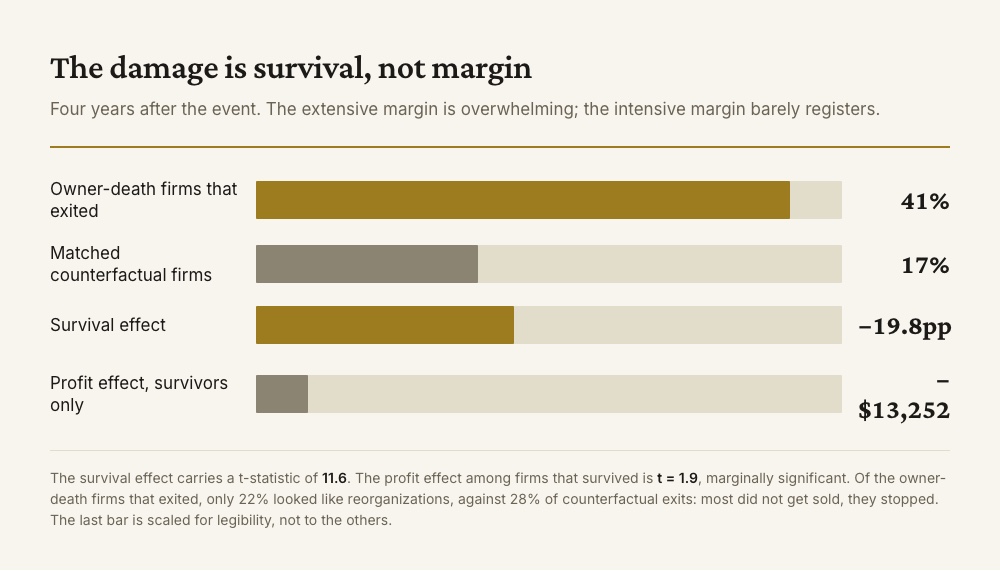
For a lender, that is not coverage compression, which a covenant reset can absorb. It is borrower survival, and no debt-service calculation built on trailing earnings contains that term.
Scope, stated plainly
Every owner in that study earned over $1 million in fiscal income. These are larger firms than a typical acquisition, and no equivalent study has been run on the smaller population. The inference is directional, not measured.
It runs the uncomfortable way. Those firms were large enough to support genuine management structure, and profit still fell 82%. There is no apparent mechanism by which a smaller and more owner-concentrated business proves more transferable. That is an argument about sign, not size, and it should not be quoted as a Main Street figure.
Adjacent reading: does SDE include owner salary covers the definitional question this piece assumes, and key person risk is the broader diagnosis. The full research analysis is how much of a small business's profit is actually the owner.
Sources and method
Matthew Smith, Danny Yagan, Owen Zidar and Eric Zwick, Capitalists in the Twenty-First Century, Quarterly Journal of Economics 134(4), November 2019. Figures read from the author-hosted full text, not from a summary.
The $1.2M EBITDA, $200,000 manager and 4× multiple are an illustrative deal constructed for the worked example. The percentages are the paper's.
Author: Avery Hastings, CPA. This is analysis of published research and general valuation method, not a report of engagements conducted by the author.

Avery Hastings, CPA
Founder, Acquidex • CPA • Tokyo, Japan
Avery Hastings is a CPA based in Tokyo, Japan and the founder of Acquidex. She focuses on helping buyers evaluate small-business deals with clear cash-flow logic, realistic downside analysis, and practical diligence frameworks.
Keep up with Avery →Sources
Keep Reading
- SDE vs EBITDA: Which One Is a Small Business Actually Valued On?9 min read read
- What Are Add-Backs in a Business Sale? A CPA's Guide to Which Ones Survive9 min read read
- What Is a Good SDE Multiple? Why the Number Is a Verdict, Not a Bargain9 min read read
- How Much Is a Business Worth With $500,000 in Revenue?11 min read read
- How to Calculate SDE: Step-by-Step Formula with Add-Back Examples10 min read read
- What Is Normalized SDE? The Difference Between Broker and Lender Earnings9 min read read