


Key Insight
For a seller, concealing something small is one of the most expensive decisions available, and the cost has almost nothing to do with the item concealed. The reason is how diligence works. A buyer cannot verify every transaction, contract and customer relationship, so they check a fraction and extend their confidence from what they checked to what they did not. That extension is the entire product. A problem that is disclosed sits inside the sample as a known item: the buyer prices it once, adjusts the price, escrow or structure by a specific amount, and the conversation ends. A problem discovered after a question should have surfaced it does something different. It tells the buyer the population is not what they assumed, so everything unverified returns to being unknown. Four things then happen, none of which require anyone to be angry: the diligence budget rises because the sample must grow, the timeline extends because a bigger sample takes longer, every remaining representation is worth less because a representation is only worth the credibility of the person making it, and the price protection the buyer demands widens because they are now pricing a distribution of unknowns rather than a list of known items. A seller who discloses a real problem early usually gets it priced once. A seller caught concealing a small one gets everything repriced.
The trade most sellers get wrong
Every business being sold has something in it the owner would rather not lead with. Deferred maintenance. A customer who has gone quiet. Three years of a family member on the payroll who does not really work there. A lease with a problem in it.
The instinct is to keep it back. Not to lie about it, just to not raise it, and to answer honestly if asked.
That instinct is expensive, and understanding why requires looking at what the buyer is actually doing.
What a buyer is really buying
Strip away the earnings and the customers and the equipment, and what a buyer is purchasing is a set of statements made by somebody they met a few months ago.
They will verify some of those statements. They cannot verify all of them, and nobody ever has. They will check a fraction of the transactions, a fraction of the contracts, a fraction of the customer relationships, and then extend their confidence from what they checked to what they did not.
That extension is the whole exercise. It is why diligence works at all, and it is fragile in a specific way.
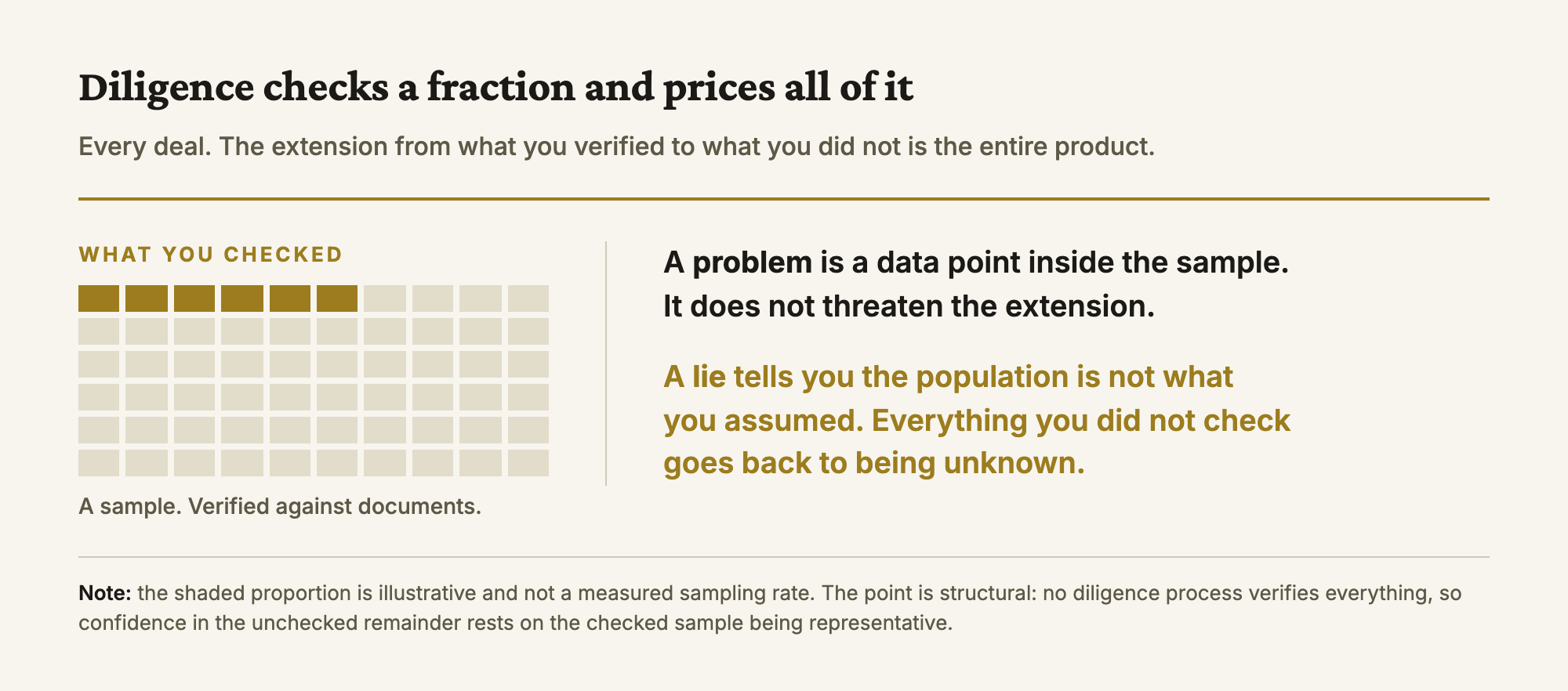
A disclosed problem is a data point inside the sample. The buyer already knows the population contains it, prices it, and moves on. Nothing about the extension is affected.
A concealment is different in kind. It tells the buyer that the records they were handed are the sort of records that can be wrong on purpose, and the moment they know that, everything they did not personally verify goes back to being unknown.
The four things that happen next, in order
None of this requires the buyer to be offended. It happens even with a buyer who likes you and still wants the business.
The diligence budget goes up. The sample has to get bigger, because the old sample size was justified by an assumption that no longer holds. Bigger samples cost more.
The timeline extends. More work takes more weeks, and every additional week is a week in which your other buyer loses interest, your staff notice something is happening, and your trailing twelve months rolls forward into a period you have been distracted through.
Every remaining representation is worth less. A representation in a purchase agreement is only worth the credibility of the person making it. Buyers do not usually say this out loud. They express it as a bigger escrow.
The price protection widens. This is the expensive one. Before, the buyer was pricing a list of known items. Now they are pricing a range of unknowns, and a rational buyer prices a range conservatively.
The asymmetry, with numbers attached
Suppose the item is worth $40,000 of adjustment. Deferred maintenance, a customer who has reduced their order, an add-back that will not survive.
Disclosed at the outset: the buyer takes $40,000 off, or escrows it, or splits it. One conversation. It is not a pleasant conversation and it is a conversation, which is the important part. The problem sits still while you have it.
Found in week ten, after a direct question: the $40,000 is still there, and it is now the smallest number in the discussion. The buyer widens the expense sample. The escrow goes from five percent to ten. The survival period on the representations extends. Two of your add-backs that were previously accepted get re-examined because they rested on your word rather than a document. The deal closes eight weeks later at a price that is not $40,000 lower.
Sometimes it does not close at all, and the reason given is rarely the item itself.
Disclosure has a shelf life
The same fact costs different amounts depending on when it arrives.
Volunteered before anyone asks reads as information. It also does something useful for you: it makes the rest of what you say more credible, because you have demonstrated you will say the unflattering thing without being pushed.
Given in answer to a direct question reads as a response. Neutral. No credit, no damage.
Produced after documents have already been exchanged reads as a correction, and corrections raise the question of what else has not been corrected yet.
Found by the buyer is the expensive one, regardless of whether you were ever asked.
The content is identical in all four cases. Only the sequence changed.
What to surface, and when
The test is not whether disclosure is legally required. It is whether discovering it later would make a buyer re-examine everything else you told them.
- Customer movement. Any customer above a meaningful share of revenue who has given notice, reduced volume, or gone quiet. This is the single most common cause of post-closing disputes.
- Anything personal running through the business. Family on the payroll, a vehicle, a phone, a holiday booked through the company. These become add-backs, and add-backs a buyer discovers are worth much less than add-backs you present with documentation. Buyers already arrive expecting inflated ones.
- Deferred maintenance and equipment at end of life. Bounded, priceable, and almost always found eventually.
- Key people who have signalled they may leave. Including anyone who has asked about their position after a sale.
- Disputes, licensing and lease issues. Anything with a counterparty is discoverable, so treat it as already known.
- The quality of the records themselves. If the books are thin, say so at the start. Thin books explained up front are a known condition. Thin books discovered are a reason to widen the sample.
What the buyer does with a problem you hand them
It is worth knowing what actually happens on the other side of the table when you disclose something, because sellers usually imagine it is worse than it is.
A competent buyer sorts every finding into one of two buckets. Is this a problem, or is this a credibility issue?
A problem gets priced. They put a number on it, decide whether it comes off the price, goes into escrow, or gets split, and then they stop thinking about it. Problems are what the price is for, and a buyer who cannot tolerate finding any will never buy anything.
A credibility issue gets a different response entirely, and the distinction is worked through at length in a $500,000 problem against a $417 lie. They stop pricing and start re-underwriting: widening the sample in whatever category it came from, going back through the model to mark every input as either documented or asserted, and re-asking questions they already have answers to in order to test whether the answers hold.
Everything you disclose voluntarily lands in the first bucket. That is the whole benefit, and it is worth more than the negotiating advantage you think you are protecting by staying quiet.
The one number sellers should understand
There is a further reason to take this seriously, which is that the downside is not capped at the size of the item.
In In re Dura Medic Holdings, Inc. Consolidation Litigation, decided in the Delaware Court of Chancery in February 2025, a buyer had priced a business at trailing twelve month EBITDA multiplied by 6.7797. Two significant customers had already given notice and this had not been disclosed. The court did not award the buyer the lost earnings. It worked out the lost earnings from those two customers over the same twelve month period the price had been built on and applied the same 6.7797 multiple, on the reasoning that where the price was set using a multiple and the agreement does not say when a multiple applies, the common law permits damages measured the same way.
A recurring problem that is concealed does not cost what the problem costs. It can cost the problem times the multiple, because it was quietly priced into something both sides assumed would keep happening.
That is one Chancery decision rather than a general rule, and most disputes never get near a courtroom. But it tells you which direction the risk runs.
If you are on the other side of this, the buyer's version of the same exercise is how to analyse a small business deal.
The one sentence version
You are going to pay for every one of these things.
The only decision in front of you is whether you pay for the item, or for the item plus everything the buyer can no longer take your word for.

Avery Hastings, CPA
Founder, Acquidex • CPA • Tokyo, Japan
Avery Hastings is a CPA based in Tokyo, Japan and the founder of Acquidex. She focuses on helping buyers evaluate small-business deals with clear cash-flow logic, realistic downside analysis, and practical diligence frameworks.
Keep up with Avery →Sources
Keep Reading
- How to Analyze a Gym or Fitness Business Acquisition9 min read read
- How to Analyze a Liquor Store Acquisition9 min read read
- How to Analyze a Restaurant Acquisition9 min read read
- Capital Gains Tax When You Sell a Business (and How to Legally Reduce It)10 min read read
- How to Do Due Diligence on a Small Business Acquisition11 min read read
- How to Verify Customer Retention Without Trusting the Seller's Reports11 min read read