


Key Insight
Choose a quality of earnings provider on four things: the scope it will deliver, who it works for, whether its experience fits the deal and the lender, and whether its report ties each adjustment to evidence. QoE findings are behind a growing share of broken deals, at least on one platform. In Axial's Dead Deal Reports, QoE EBITDA discrepancies were the reason in 16 of 75 broken LOIs in 2025 (21.3%), up from 10 of 65 in 2024 (15.4%) and 5 of 47 in 2023 (10.6%). Other diligence findings were the single most common reason in 2025, at 19 of 75 (25.3%). These are shares of lower middle market deals that broke, from small samples on one platform. They are not a failure rate.
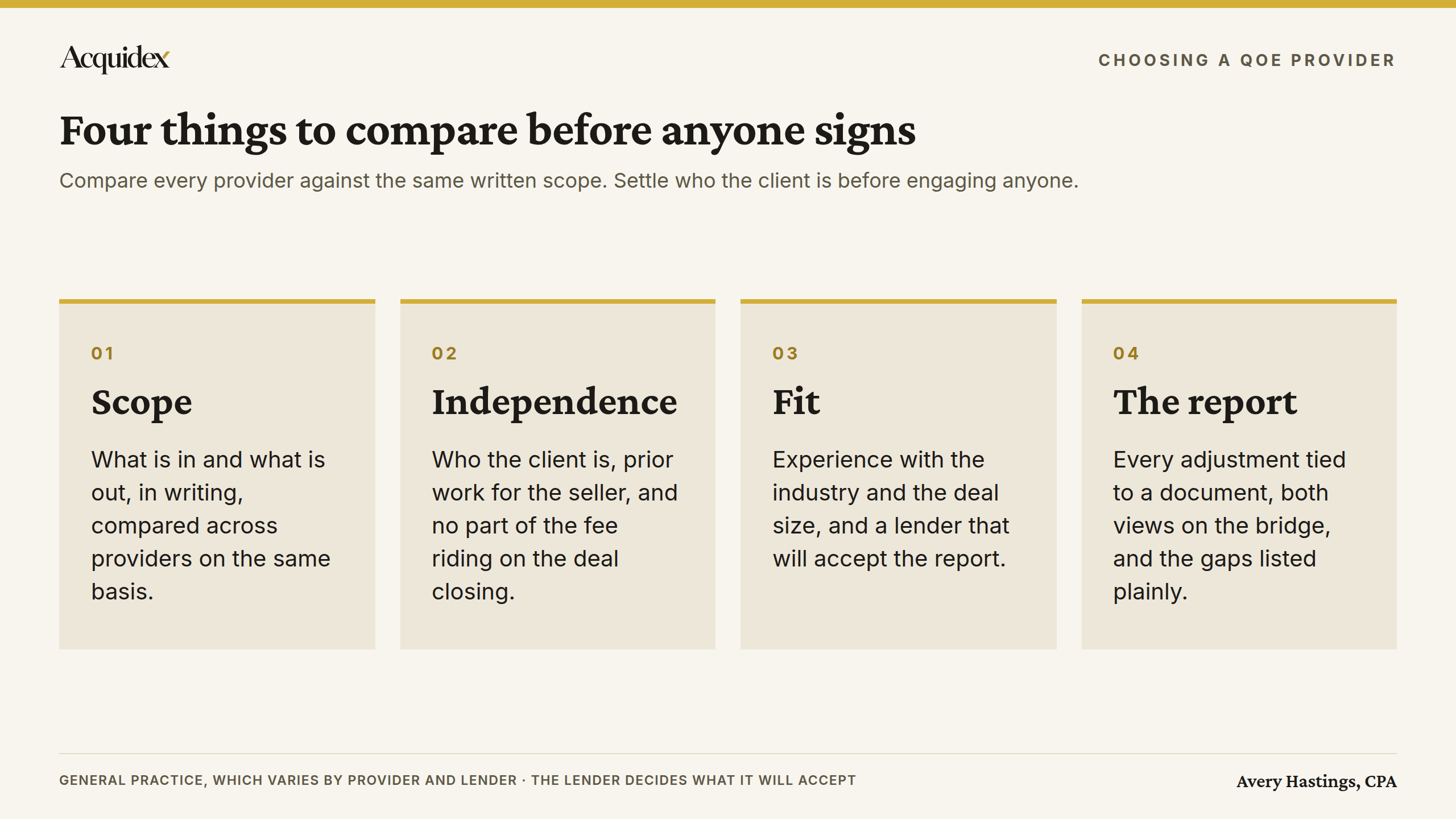
The short answer: settle who is commissioning the report first, because on a financed deal the lender may want to. Then put the scope in writing, confirm the provider has no stake in the deal closing, match its experience to the industry and the deal size, and read a redacted sample report. Compare quotes only against the same scope, and pick the firm whose report a skeptical reader could trace, adjustment by adjustment, to documents.
What a QoE tests is covered in what a quality of earnings report actually tests, and whether a deal needs one in when a QoE is worth commissioning. This piece covers choosing who does the work.
Why does the choice of quality of earnings provider matter?
The choice matters because the QoE tests the earnings the price rests on, and on at least one platform its findings are behind a growing share of broken deals. Axial's yearly Dead Deal Reports, which cover signed LOIs on its platform that failed to close, show the trend.
| Year | Broken LOIs | QoE EBITDA discrepancies | Other diligence findings |
|---|---|---|---|
| 2023 | 47 | 5 (10.6%) | 9 (19.1%) |
| 2024 | 65 | 10 (15.4%) | 14 (21.5%) |
| 2025 | 75 | 16 (21.3%) | 19 (25.3%) |
Axial describes the QoE category as reported performance diverging materially from buyer expectations. The other category covers findings outside the QoE, such as undisclosed legal or compliance risks, customer concentration and contract issues.
Four limits apply. These are shares of deals that broke, not a failure rate. They are lower middle market deals, larger than most Main Street sales. The samples are small. And they come from one platform.
What are you actually buying in a QoE engagement?
In a QoE engagement you are buying a defined set of analyses, fixed in the engagement letter. The adjusted earnings bridge is the core. Working capital, proof of cash, revenue and customer analysis and debt-like items are commonly part of a buy-side scope, but providers draw the line in different places, and that line decides what a quote is worth.
| Workstream | What it answers | Common treatment (varies by provider) |
|---|---|---|
| Adjusted EBITDA or SDE bridge | Which earnings survive testing against the records, adjustment by adjustment | The core of the engagement |
| Net working capital | What level the business needs to operate, and so where the peg should sit | Commonly included; confirm you get a proposed peg, not only history |
| Proof of cash | Whether reported revenue ties to bank deposits | Often included; can cover the full period or selected months |
| Revenue and customer analysis | Concentration, trends and revenue that will not recur | Commonly included at summary level; customer-by-customer work may cost more |
| Debt and debt-like items | What else should reduce the price or be settled at closing | Commonly included; depth varies |
| Tax, forecast review, IT and operations | Questions outside the historical earnings | Often separate scopes or add-ons |
Two quotes can use the same words and cover different work. A proof of cash on every month of the review period tests something different from one on a few sample months. A working capital analysis that stops at monthly history leaves the peg, the number that moves money between buyer and seller at closing, to be argued later.
A narrower scope can be the right call for a simple business. What matters is that everyone reading the report knows what was left out. Legal matters sit with counsel, and tax exposure with a tax adviser unless the scope says otherwise.
Who does the QoE provider work for?
A QoE provider works for the client named in its engagement letter. When the buyer commissions the report, the buyer is the client. On some financed deals the lender commissions it instead, and on a sell-side QoE the client is the seller. Independence, in this sense, means the provider's only stake in the outcome is getting the answer right.
On a financed deal, settle the client question first. Some lenders commission the QoE themselves, some accept a report the buyer commissions, and some want to rely on the buyer's report, which generally needs the provider's written agreement and is easier to arrange at engagement than after delivery. Ask the lender before engaging anyone.
Then ask about relationships directly:
- Prior work for the other side. Has the firm prepared the seller's tax returns, kept its books, or done a sell-side QoE on this business?
- Referral ties. Did the referral come from someone paid on closing, such as a broker on a success fee, and is there a referral arrangement?
- Contingent fees. Does any part of the provider's fee depend on the deal closing?
- Follow-on work. Is post-closing accounting or tax work on the table? It exists only if the deal closes.
None of these rules a firm out on its own. Each is worth knowing before anyone relies on the report, and counsel can review what the engagement letter says about conflicts and liability.
For sellers' advisers, the questions run the other way. A sell-side QoE is written for the seller, and whether a buyer or lender can rely on it depends on what the provider agrees in writing. In my judgment, a sell-side report that evidences each adjustment as a buy-side report would is easier for the buyer's provider to test and build on.
What experience should a QoE provider have?
A QoE provider should have experience that matches the industry, the size and shape of the deal, and the lender. Industry experience tells a provider where the accounting judgments sit in that kind of business. Deal size decides whether its process fits. The lender decides whether the report will be accepted, so its view comes first.
Earnings in different businesses hinge on different records: revenue recognition on unfinished jobs for a contractor, inventory counts and costing for a distributor, payer mix and collections for a medical or dental practice, deferred revenue for a subscription business. A provider that has worked through those questions is more likely to know what to request at the start.
Deal size cuts both ways, and this is judgment rather than data. A firm built for larger transactions may scope and staff the work more heavily than a smaller deal needs. A firm built for small deals may be stretched by several entities, related party transactions or more than one revenue stream.
Lenders may have views on which providers they accept and what the report must cover. Those views are not uniform and can differ by loan program, so ask early, ideally before the LOI is signed, and get the answer in writing if the financing depends on it.
What should a finished QoE report let you do?
A finished QoE report should let you negotiate with it. That takes a report in which each adjustment is tied to a document, the seller's figure sits beside the provider's, and anything that could not be verified is stated plainly. A QoE carries no audit opinion, so its weight comes from the evidence it shows.
- A bridge that shows both views. Reported earnings to adjusted EBITDA or SDE, with the seller's adjustments separated from the provider's and a view on each: accepted, adjusted, rejected or unverified.
- A source for every adjustment. The invoice, bank statement, payroll record or contract behind the number.
- A plain list of gaps. What the provider asked for and did not get, and what it could not verify.
- Working schedules. The analysis in a spreadsheet, not only a PDF, so a lender or adviser can trace a figure.
Ask each shortlisted provider for a redacted sample, or a blank template of its main exhibits if it cannot share one. What each exhibit looks like, and what to challenge in it, is walked through in this quality of earnings report example.
What should you ask a QoE provider before engaging?
Before engaging a QoE provider, ask about scope, independence, experience, the deliverable, and how the fee and timing are set. The answers are most useful side by side, from every provider on the shortlist, against the same written scope.
| Question | Why it matters |
|---|---|
| What is in scope, and what is excluded? | Exclusions are where similar quotes can differ |
| Will the working capital analysis include a proposed peg? | The peg moves money at closing |
| What period does the proof of cash cover? | A full period and a sample test different things |
| Have you done any work for this seller or business? | Prior work for the other side is a relationship to weigh |
| Does any part of your fee depend on closing? | A contingent fee is a stake in the answer |
| Who will do the work, and who reviews it? | The team, not the firm's name, produces the analysis |
| Which deals of this size and industry have you worked on? | Fit shows in the questions a firm knows to ask |
| Will you extend reliance to our lender, and on what terms? | Settling it at engagement can avoid a delay later |
| Is the fee fixed or hourly, and what would change it? | Scope changes and slow data move both fee and timing |
| When will we see preliminary findings? | Early findings leave time to act inside the diligence period |
How do you compare quality of earnings providers on fee and timing?
Compare quality of earnings providers against the same scope. A fee reflects the work quoted and the state of the records, so a lower quote for a narrower scope is not a saving. Send each provider the same written scope and document list, then compare what each will deliver, how the fee is structured, and what would change it.
Providers commonly quote either a fixed fee for a defined scope or an hourly fee, sometimes against an estimate or a cap. A fixed fee gives more certainty up front, but it rests on assumptions about the data, and work outside the scope is typically billed as a change. An hourly fee follows the work done, which cuts both ways when the records are messy. Either way, ask what would trigger a change and how it would be raised before it is billed.
Data readiness drives the timetable. The work cannot move faster than the seller produces the general ledger, bank statements and support for each add-back, and unanswered requests hold it up. That makes preparation the part of the timetable a seller's adviser can influence most directly.
The engagement also has to fit inside the diligence period and exclusivity set in the letter of intent. In my judgment, choosing and scoping the provider before the LOI is signed, so work can begin as soon as the records are available, protects the time left to act on what the report finds.
Sources
- Axial, Dead Deal Report: Unpacking 2025's Broken LOIs. 75 broken LOIs.
- Axial, Dead Deal Report: Breaking Down 2024's Broken LOIs. 65 broken LOIs.
- Axial, Dead Deal Report: Unpacking 2023's Broken LOIs. 47 broken LOIs.
Axial's figures count why signed LOIs on its platform failed to close, as whole numbers of each year's broken deals. They cover lower middle market deals in small samples and are not a failure rate. Everything else here is general practice, which varies by provider and lender, and the author's judgment, not a report of engagements the author has conducted. It is for informational purposes only, not legal, tax or investment advice.

Avery Hastings, CPA
Founder, Acquidex • CPA • Tokyo, Japan
Avery Hastings is a CPA based in Tokyo, Japan and the founder of Acquidex. She focuses on helping buyers evaluate small-business deals with clear cash-flow logic, realistic downside analysis, and practical diligence frameworks.
Keep up with Avery →Sources
Keep Reading
- Should a Seller Get a Sell-Side Quality of Earnings?9 min read read
- What Happens When a Quality of Earnings Report Comes In Low?10 min read read
- Should a Seller Disclose a Problem Before Listing? The Cost Asymmetry Nobody Explains7 min read read
- How to Analyze a Gym or Fitness Business Acquisition9 min read read
- How to Analyze a Liquor Store Acquisition9 min read read
- How to Analyze a Restaurant Acquisition9 min read read