


Key Insight
A quality of earnings (QoE) report "comes in low" when its adjusted EBITDA or SDE lands below the figure the LOI price was built on, often the seller's number from the confidential information memorandum (CIM). When the price is a multiple of that figure, the gap is multiplied: in a hypothetical deal at 5 times earnings, each $100,000 the QoE removes takes $500,000 off the price, and a lender that sizes debt to cash flow may lend less. Axial's Dead Deal Reports, which track why signed LOIs on its platform fell apart, found QoE EBITDA discrepancies behind 16 of 75 broken LOIs in 2025 (21.3%), up from 5 of 47 in 2023 (10.6%), and failed renegotiation of price or structure behind 11 of 75 in 2025 (14.7%). These are shares of deals that broke, not a failure rate, from small samples of lower middle market deals on one platform. The options are to reprice, restructure, reconcile the adjustments, or walk.
The short answer: it reopens the number the price depended on. At the same multiple, the lower figure supports a lower price, and a lender that sizes debt to cash flow may lend less even if the price holds. The parties then reprice, restructure, reconcile the adjustments or walk, depending on why the number moved.
What does it mean when a QoE comes in low?
The price in an LOI is often built on an earnings figure the seller's side presented, such as the adjusted EBITDA in the confidential information memorandum (CIM), or seller's discretionary earnings (SDE) for smaller owner-run businesses.
The buyer's QoE, typically commissioned after the LOI and inside the exclusivity period, rebuilds that figure from the records to test whether the earnings are real, sustainable and transferable to a new owner. What a QoE actually tests covers the method.
"Comes in low" means the QoE's adjusted EBITDA or SDE lands below the figure the price assumed. The QoE EBITDA is lower than the CIM's, and the price has not caught up.
The gap is the sum of specific line items, and the QoE's bridge shows each one. They fall into a few recognizable groups:
- Add-backs not accepted. A cost treated as personal or one-time that the records don't support, or that turns up year after year.
- Owner pay reset to market. Where the deal is priced on EBITDA, the QoE charges a market-rate cost for the owner's job if the seller's figure left it out or understated it.
- Revenue that won't recur. A one-off project, or a customer that has left.
- Accounting adjustments. Cash-basis books restated to accrual, revenue or costs booked in the wrong period, missing accruals.
- Pro forma adjustments not accepted. A price rise or cost saving counted for a full year before it has happened.
- A newer trailing period. Diligence may run on a later twelve months than the CIM did, and the business may simply have earned less.
The size of the gap is half the information. The reasons are the other half, and they decide which options are realistic.
Why does an earnings gap turn into a bigger price gap?
When the price is a multiple of earnings, the gap is multiplied with it. A hypothetical with round numbers:
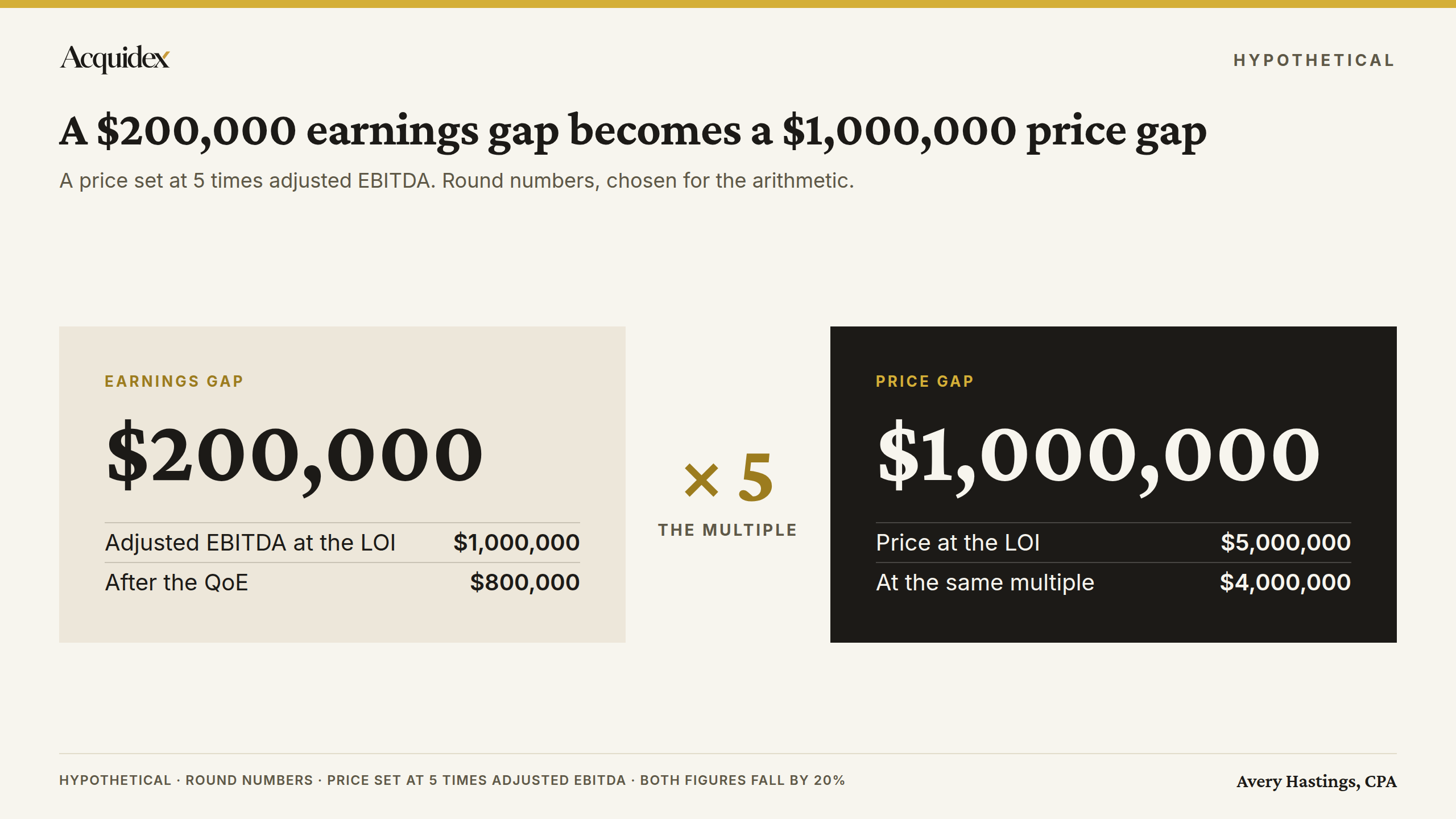
Say an LOI priced a business at 5 times adjusted EBITDA of $1,000,000, or $5,000,000. The QoE lands at $800,000. At the same multiple, $800,000 supports $4,000,000.
| Hypothetical | At the LOI | After the QoE |
|---|---|---|
| Adjusted EBITDA | $1,000,000 | $800,000 |
| Multiple | 5 times | 5 times |
| Price at that multiple | $5,000,000 | $4,000,000 |
Both lines fall by 20%. The dollars don't: a $200,000 gap in earnings is a $1,000,000 gap in price. That is why a finding that looks modest on the bridge can dominate the negotiation.
Two qualifications. Applying the old multiple to the new figure is the default arithmetic, not a rule. It is cleanest when the LOI stated the earnings figure the price assumed; when the LOI named only a price, a seller can fairly argue the price was not a strict multiple.
And the multiple can move too. A QoE that shows a declining trend or a concentrated customer base can reopen the multiple as well as the earnings figure. In my view those two arguments are better kept apart, because they rest on different evidence.
How can a low QoE change the financing?
Lenders that lend against cash flow size the loan to the earnings they accept, typically through a coverage test: cash flow available for debt service divided by the year's loan payments, known as the debt service coverage ratio. Some also cap total debt at a multiple of EBITDA. Either way, earnings are the input, and a lower input supports less debt.
Continue the hypothetical. Say the lender's test, whatever form it takes, allowed a loan of up to $3,000,000 on $1,000,000 of earnings, and the buyer planned to borrow the full amount. If the lender works from the QoE's $800,000, the same test allows about $2,400,000.
If the seller accepts $4,000,000, the loan and the price have both fallen by a fifth, and the buyer needs $1,600,000 from other sources instead of $2,000,000. If the price holds at $5,000,000, the loan still falls to $2,400,000, and other sources must find $2,600,000. That is a $600,000 hole, to be filled by more buyer equity, a seller note, or a lower price.
If the lender first deducts items that don't shrink with earnings, such as a fixed allowance for maintenance capital spending, the loan falls by more than a fifth. This is why a low QoE can stall a deal even when the buyer is willing to pay the original price.
My read, and it is judgment, is that a lender holding a QoE is unlikely to underwrite earnings the QoE rejected without its own support for them. The lender decides which earnings it underwrites, what it deducts first, and what coverage it requires.
How often is a QoE gap behind a broken deal?
The data available answers a narrower question. Axial publishes a Dead Deal Report each year on signed LOIs on its platform that failed to close, broken down by reason. QoE EBITDA discrepancies, where reported performance diverged materially from buyer expectations, have taken a growing share:
| Year | Broken LOIs | QoE EBITDA discrepancies | Share |
|---|---|---|---|
| 2023 | 47 | 5 | 10.6% |
| 2024 | 65 | 10 | 15.4% |
| 2025 | 75 | 16 | 21.3% |
In 2025, renegotiation was the reason in 11 of 75 broken LOIs (14.7%). Axial describes it as an inability to align on revised pricing or structure, often following diligence findings or updated financial analyses.
Four limits apply. These are shares of deals that broke, not a failure rate, so they say nothing about how many low QoEs still close. The deals are in the lower middle market, larger than most Main Street sales. The samples are small. And it is one platform.
What are the options on the table?
Each option puts the gap somewhere different.
| Option | What it changes | Who bears the risk of the gap |
|---|---|---|
| Reprice | The headline price | The seller, at closing |
| Seller note | When part of the price is paid | The buyer owes it; the seller bears the risk it goes unpaid |
| Earnout | Whether part of the price is paid | Shared, settled by results after closing |
| Holdback | Whether money held back is released | Shared, settled by a defined condition |
| Reconcile the adjustments | The earnings figure itself | Nobody yet; it settles how big the gap is |
| Close as agreed | Nothing | The buyer, and any lender that funds it |
| Walk | Everything | Both sides, in time and costs already spent |
Reprice. The agreed multiple applied to the reconciled figure, or a price somewhere between the old and the new. The seller absorbs the gap at closing, and the buyer keeps any upside if the QoE proves cautious.
Restructure. Keep more of the headline price, but move part of it out of cash at closing. The three tools solve different problems, compared in seller notes, earnouts and holdbacks:
- A seller note defers payment. It fills a financing gap more than a valuation gap: a buyer who values the business at $4,000,000 and agrees to $5,000,000, part of it on a note, has still agreed to $5,000,000.
- An earnout pays part of the price only if agreed results arrive after closing. It suits a disagreement about the future, such as a new contract not yet in the trailing numbers, and it needs tight definitions or the argument simply moves to after closing.
- A holdback keeps back part of the price against a specific, checkable item, such as an add-back awaiting documents, and releases it when the condition is met.
If there is a senior lender, it will want a say in the structure: where a seller note ranks, when it can be paid, and whether an earnout is allowed at all. Some financing rules certain structures out entirely. The lender decides, and counsel drafts.
Which adjustments can be reconciled?
Reconciling means setting the QoE's bridge beside the seller's and asking of each difference why it exists. A QoE bridge typically sets out the seller's adjustments and the provider's own, with a view on whether each is supported; a QoE report, section by section shows the layout.
One useful way to sort the differences is into three kinds, because they behave differently:
| Kind of gap | Example | Can it move? |
|---|---|---|
| Documentation | A one-time repair with no invoice in the file | Yes, if the documents exist |
| Judgment | The market rate for a replacement manager | Sometimes, with support for another view |
| Performance | A lost customer, or a weaker trailing year | Not by argument; it can be priced or structured |
Documentation items are where a seller's effort goes furthest, in my view. An add-back rejected as unverifiable can come back if the support exists, and a QoE provider can revise its figure when new evidence arrives. Reconciliation can move the figure in either direction.
Judgment items are where the advisers on both sides and the QoE provider can usefully talk, each with the support for their view. The answer may land between the two.
Performance items are not disagreements about the records. Arguing them, in my view, spends credibility the seller will want for the items that can move.
A sell-side QoE, if the seller has one, gets the same treatment: the two bridges side by side, and the differing lines isolated.
Does it help to show the reasoning line by line?
For a seller, in my view, the distinction that matters most is between a disagreement and a surprise. A disputed add-back is a disagreement about one line. A finding the seller knew about and didn't raise reads differently, because it can reopen lines that were already settled. The mechanism is set out in why a disclosed problem gets priced once.
- Get the bridge line by line. Ask for each adjustment, its amount, its reason and the document behind it, beside the seller's figure.
- Sort every gap. Documentation, judgment or performance. Each kind moves differently.
- If there's a lender, bring it in early. It has to underwrite a figure too, and it will want a say in any seller note or earnout.
- Reread the LOI with counsel. Beyond the time and fees already spent, what walking away costs is set largely by what the LOI binds, such as exclusivity, expenses and any break fee.
- Reconcile before you restructure. Reconciling settles how big the gap is. A seller note, earnout or holdback only decides who carries it.
- Keep the multiple argument separate. A lower earnings figure and a lower multiple rest on different evidence.
When does walking away make sense?
In my judgment, walking deserves serious thought in three situations: the gap sits mostly in the performance column and is large relative to the price; the financing no longer closes at any price the seller will accept; or a finding is a credibility problem rather than a disagreement.
A seller can walk too, and take the business back to market, perhaps with its own QoE to settle the number first.
Beyond the time and fees already spent, what walking costs is set largely by the LOI. Price terms in an LOI are generally non-binding, while provisions such as exclusivity, confidentiality and expenses are typically written to bind. What a particular LOI says, including any expense reimbursement or break fee, is a question for counsel. The LOI guide covers the clauses that usually bind.
A low QoE doesn't decide the deal. It decides which conversation comes next, and the reasons behind each line shape how that conversation goes.
This is general information about deal mechanics, not legal, tax or investment advice. Counsel, a CPA and the lender each decide their part.
Sources
- Axial, Dead Deal Report: Unpacking 2025's Broken LOIs, 75 broken LOIs.
- Axial, Dead Deal Report: Breaking Down 2024's Broken LOIs, 65 broken LOIs.
- Axial, Dead Deal Report: Unpacking 2023's Broken LOIs, 47 broken LOIs.
The worked example is hypothetical, with round numbers chosen for the arithmetic. Author: Avery Hastings, CPA. This is analysis of general deal mechanics and published data, not a report of engagements conducted by the author.

Avery Hastings, CPA
Founder, Acquidex • CPA • Tokyo, Japan
Avery Hastings is a CPA based in Tokyo, Japan and the founder of Acquidex. She focuses on helping buyers evaluate small-business deals with clear cash-flow logic, realistic downside analysis, and practical diligence frameworks.
Keep up with Avery →Sources
Keep Reading
- How Do You Choose a Quality of Earnings Provider?9 min read read
- Should a Seller Get a Sell-Side Quality of Earnings?9 min read read
- Should a Seller Disclose a Problem Before Listing? The Cost Asymmetry Nobody Explains7 min read read
- How to Analyze a Gym or Fitness Business Acquisition9 min read read
- How to Analyze a Liquor Store Acquisition9 min read read
- How to Analyze a Restaurant Acquisition9 min read read