


Key Insight
A sell-side quality of earnings is a QoE the seller commissions, usually from an independent accounting firm, before or during marketing. It tests the same kinds of things a buyer's QoE tests, earlier, and it reports to the seller first. The case for it rests on what breaks deals once a buyer starts checking. In Axial's Dead Deal Reports, QoE EBITDA discrepancies were 21.3% of broken LOIs in 2025 (16 of 75), up from 10.6% in 2023 (5 of 47). Diligence findings combined, QoE and non-QoE, were 46.7% of broken LOIs in 2025 (35 of 75). These are shares of deals that broke, not failure rates, from lower middle market deals on one platform, in small samples. They do not show that a sell-side QoE would have saved any of those deals.
The short answer: sometimes, and the call is a judgment rather than a rule. A sell-side QoE tends to earn its place when the add-backs are complex, the books are messy, there are several entities or locations, or a larger business is being sold through a competitive process. It tends to matter less for a small deal on clean, simple books. It will not replace the buyer's diligence or guarantee a price. What it buys is timing: the seller finds the problems first, while there is still room to fix, document or disclose them.
What is a sell-side quality of earnings?
A quality of earnings for sellers, usually called a sell-side QoE, is a quality of earnings analysis the seller commissions for its own sale. An independent accounting firm usually prepares it, before the business goes to market or early in marketing.
It is not an audit, and it gives no opinion on whether the books follow an accounting standard. Like a buyer's QoE, it asks whether the earnings a price will be built on are real, sustainable and transferable. What a quality of earnings report tests covers that question in full.
The output is a written report with supporting schedules, prepared for the seller. Within the terms of the engagement, the seller decides who else sees it.
How is a sell-side QoE different from the buyer's QoE?
The tests are much the same. What differs is who sets the scope, who sees the findings first, and what the findings turn into.
| Aspect | Sell-side QoE | Buy-side QoE |
|---|---|---|
| Commissioned by | The seller | The buyer |
| Usual timing | Before or during marketing | After the LOI, during exclusivity |
| Scope agreed by | The seller and the provider | The buyer and the provider |
| The question behind it | Will this number hold up when a buyer checks it? | Is this number worth paying a multiple on? |
| Findings go first to | The seller | The buyer |
| Findings turn into | Items to fix, document or disclose | Arguments over price and structure |
The last two rows are the reason to do one. A buy-side finding arrives during exclusivity, with the buyer holding it. A sell-side finding arrives while the seller still controls the timing and the explanation.
When a buyer needs its own QoE is a separate question, covered in quality of earnings reports for SMB acquisitions.
What does a sell-side QoE test?
It typically covers the same adjustments and normalization a buyer's QoE tests, because it is trying to anticipate that work:
- owner compensation, normalized to a market-rate replacement;
- the add-backs, one by one, against their support;
- one-time items, separated from recurring ones;
- revenue quality and customer concentration;
- net working capital, which later feeds the peg;
- reported revenue tied to bank deposits, often called a proof of cash;
- debt and debt-like items.
A quality of earnings report example walks through each of those exhibits and what to challenge in it.
The difference is in the scope, not the tests. The seller and the provider agree what is in and what is out, and a careful buyer will read the exclusions as closely as the findings.
What can a sell-side QoE do for a seller?
Four things, none of them a promise about price.
It moves discovery forward. A problem found before marketing can still be fixed, documented or explained on the seller's schedule. Found by the buyer's QoE during exclusivity, it becomes the buyer's point to make. Should a seller disclose a problem sets out why a problem raised early tends to get priced once, while one the buyer finds can reprice everything the buyer had taken on trust.
Say a sell-side review finds that a repair listed as a one-time add-back appears in three straight years. Before marketing, the seller can drop it from the add-backs, or document why it will not recur. Found in the buyer's QoE instead, it becomes a reason to look harder at the other add-backs.
It supports the add-backs. A sell-side QoE tests each add-back against the documents and typically gives a view on it. The ones that hold up go to market with their support attached. The rest come out before any buyer has built a price on them.
It gives the buyer's team a head start. Organized schedules and reconciliations let a buyer's accountant spend its time testing rather than assembling. The buyer's work does not disappear, but it can get narrower.
It can reduce surprises after the LOI. Axial's Dead Deal Reports cover letters of intent that broke on its platform. They separate QoE EBITDA discrepancies, where reported performance diverged materially from buyer expectations, from other diligence findings, such as undisclosed legal or compliance risks, customer concentration concerns and contract issues.
| Year | QoE EBITDA discrepancies | Non-QoE diligence findings | Diligence findings combined |
|---|---|---|---|
| 2023 | 10.6% (5 of 47) | 19.1% (9 of 47) | 29.8% (14 of 47) |
| 2024 | 15.4% (10 of 65) | 21.5% (14 of 65) | 36.9% (24 of 65) |
| 2025 | 21.3% (16 of 75) | 25.3% (19 of 75) | 46.7% (35 of 75) |
Four caveats apply. These are shares of deals that broke, not a failure rate. They come from lower middle market deals, which are larger than most Main Street sales. The samples are small. And they come from one platform.
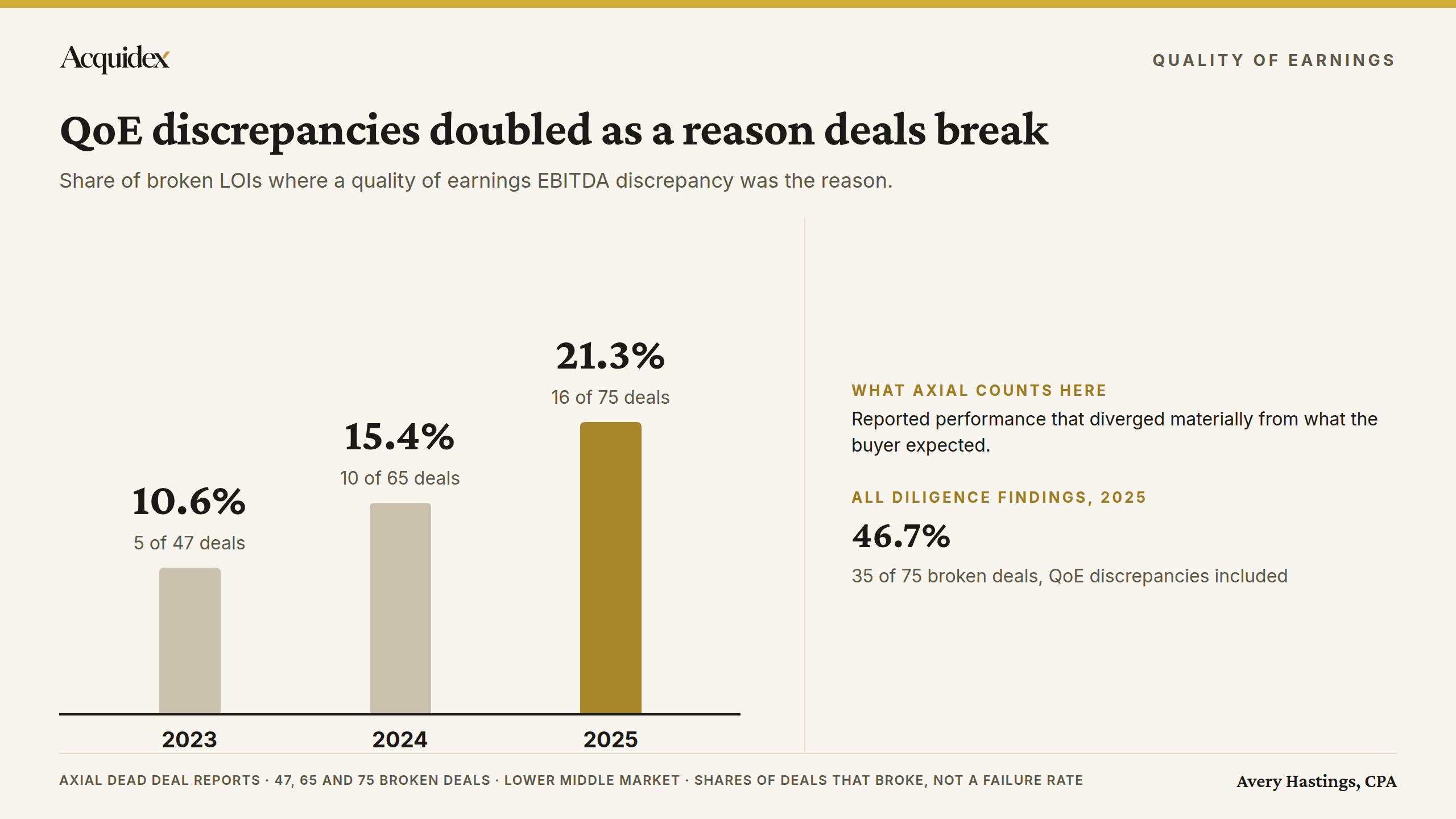
Nor do these figures say whether any of those deals had a sell-side QoE, so they cannot show that one would have helped. They show how often, among deals that broke, the reason was something diligence found. A seller who tests the earnings first is trying to find those things while it still controls the process.
What can't a sell-side QoE do?
It cannot replace the buyer's diligence. Buyers and lenders commonly do their own work even when a sell-side report exists. The seller paid for the report, agreed its scope and is the firm's client. Buyers are also commonly asked to sign an access or release letter before reading it, and those letters often limit or exclude any right to rely on it. Who can rely on the report is a term to settle with the provider and with counsel. Whether a lender will accept it for its own purposes is the lender's call.
It cannot guarantee a price. A tested earnings figure is still one the buyer puts its own multiple on, after its own diligence. The report does not bind the buyer, and it does not stop the buyer's team from finding something the seller's provider missed. Treat any promise that it will add a particular amount to the price with care: price comes out of a negotiation the report does not control.
It cannot un-find something. A sell-side QoE can surface things the seller would rather not know: an add-back that does not hold up, revenue that does not tie to the bank, a large customer whose orders are shrinking. Once that is written into a report the seller commissioned, it will be hard to claim later that the seller did not know. The choices then are to fix it, take it out of the numbers or disclose it, and often more than one. What a concealed problem costs shows how much larger the bill can be when a buyer finds out after closing. What to disclose, when and how is a question for the seller's counsel.
When does a sell-side QoE tend to make sense?
This is judgment, not a rule. The seller's adviser, the provider and any likely lender will have views on the specific deal, and those should count for more than a general table.
| Tends to make more sense | Tends to make less sense |
|---|---|
| Add-backs that are large, numerous or hard to document | A few add-backs, each with clean support |
| Messy books: late closes, a change of bookkeeper, cash and accrual mixed | Clean books, reconciled monthly and consistent year to year |
| Several entities or locations, with shared costs or intercompany balances | One entity and one location |
| A competitive process, with several buyers working from the same numbers | One buyer already at the table |
| A larger deal, where the fee is likely to be a smaller share of the price | A small deal, where the fee is a real share of the proceeds |
The left column shares one idea: the more places the earnings could be argued, the more a seller gains from arguing them first. A competitive process adds a second reason. When several buyers work from one tested set of numbers, their bids are easier to compare, and the seller is not answering the same questions for each of them separately.
Messy books need one caution. A QoE on top of unreconciled books will mostly document the mess, and the seller's CPA may be better used getting the records ready first.
What should a seller ask a provider about scope?
- Are you independent of the books? A firm that keeps the books or prepares the tax returns would be reviewing its own work, and a buyer may discount the report for it.
- Which periods will you cover, and how will you update them? A buyer will want recent numbers. Ask how the trailing twelve months get refreshed if marketing runs long.
- Will you tie revenue to bank deposits? Ask whether a proof of cash is in scope, and for which periods.
- Will you give a view on each add-back, with the support cited? Without the support, the buyer's team has to rebuild it.
- Will you analyze working capital? The peg is negotiated later, and a view of normal working capital gives the seller a starting point. See working capital adjustments at closing.
- Will you schedule debt and debt-like items? They commonly come off the price or get settled at closing, so the seller should see the list before a buyer builds one.
- Who can see the report, and on what terms? Ask what access or release letter buyers will sign, whether anyone besides the seller can rely on the report, and whether you will take questions from a buyer's accountant or lender.
- What will the report say you did not do? Ask for the expected exclusions and anything you may be unable to verify. A careful buyer reads that section closely.
How should a buyer or lender read a sell-side QoE?
As a head start, not a conclusion. The useful questions are about the engagement as much as the arithmetic: who hired the firm, what was in and out of scope, how recent the periods are, which add-backs it accepted and on what support, and what it could not verify.
A buyer's own accountant can then test those schedules instead of rebuilding them. Where the buyer's work and the seller's report disagree, the gap is itself a finding, and a good place to start the next conversation with the seller.
This article is general information, not legal, tax or investment advice. The seller's counsel and CPA decide what applies to a given sale, and a lender decides what it will accept.
Sources
- Axial, Dead Deal Report: Unpacking 2025's Broken LOIs, 75 broken LOIs.
- Axial, Dead Deal Report: Breaking Down 2024's Broken LOIs, 65 broken LOIs.
- Axial, Dead Deal Report: Unpacking 2023's Broken LOIs, 47 broken LOIs.
The combined figures add Axial's QoE and non-QoE diligence categories for each year. How sell-side engagements are scoped and shared is described here as general practice, not drawn from these reports.
Author: Avery Hastings, CPA. This is general explanation of transaction practice, not a report of engagements conducted by the author.

Avery Hastings, CPA
Founder, Acquidex • CPA • Tokyo, Japan
Avery Hastings is a CPA based in Tokyo, Japan and the founder of Acquidex. She focuses on helping buyers evaluate small-business deals with clear cash-flow logic, realistic downside analysis, and practical diligence frameworks.
Keep up with Avery →Sources
Keep Reading
- How Do You Choose a Quality of Earnings Provider?9 min read read
- What Happens When a Quality of Earnings Report Comes In Low?10 min read read
- Should a Seller Disclose a Problem Before Listing? The Cost Asymmetry Nobody Explains7 min read read
- How to Analyze a Gym or Fitness Business Acquisition9 min read read
- How to Analyze a Liquor Store Acquisition9 min read read
- How to Analyze a Restaurant Acquisition9 min read read